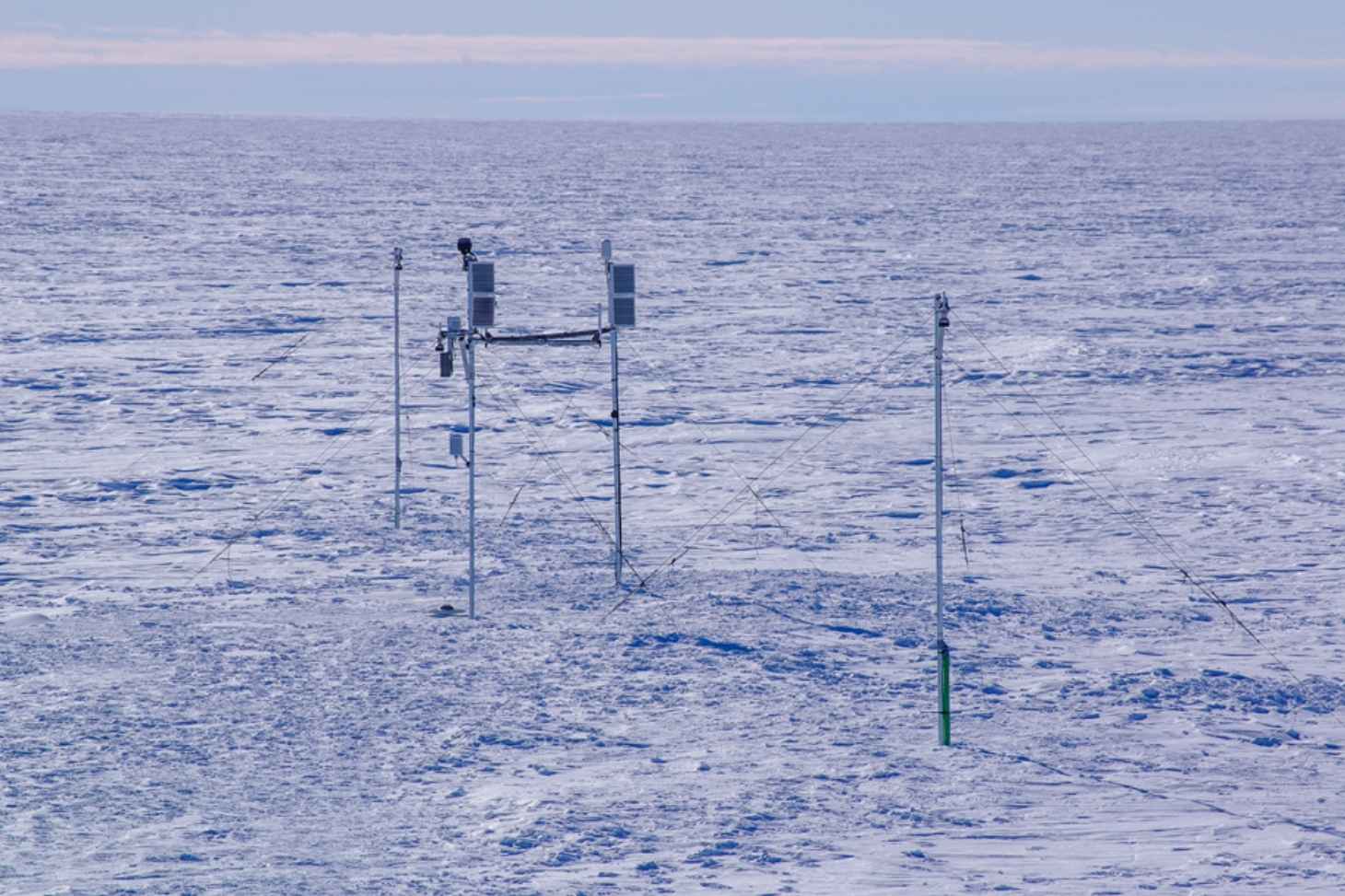
For the first time, reference altimetric stations have been installed at the heart of the Antarctic ice sheet by a team from the Institut des géosciences de l'environnement in Grenoble (IGE – CNRS/INRAE/IRD/UGA – Grenoble INP-UGA). This major technological breakthrough supports the calibration of European satellites and advances our understanding of sea-level rise.
The Institut des géosciences de l'environnement is taking a decisive step forward within the framework of the St3TART-FO project, coordinated by NOVELTIS and supported by the European Space Agency (ESA) and the European Commission through the Copernicus program.
For the first time, two reference altimetric stations have been deployed directly onto the Antarctic ice sheet. Named premisses01 and premisses02, they provide
in-situ measurements with centimeter-level accuracy, which are essential for calibrating and validating data from the Sentinel-3A and Sentinel-3B satellites.
These measurements, known as "
Fiducial Reference Measurements" (FRM), establish a very high-quality standard to ensure the reliability of satellite observations regarding ice surface altitude.
An Extraordinary Scientific and Logistical Challenge
The installation of these stations is the result of over a year of preparation, including testing phases in the Alps and heavy logistics to transport the equipment to Antarctica.
On the ground, Emmanuel Le Meur (UGA professor-researcher) and Arnaud Reboud (UGA research engineer) led a scientific expedition between December 25, 2025, and January 15, 2026. They operated under extreme conditions marked by particularly violent katabatic winds.
Each station is equipped with ultrasonic sensors to measure snow depth, as well as GNSS systems to precisely track ice movements. They were installed at the following coordinates:
- premisses01: 137.822°E / 67.719°S
- premisses02: 138.745°E / 66.954°S
Cutting-Edge Technologies Deployed in an Extreme Environment
Beyond the ground stations, the mission achieved a milestone: the first-ever drone flights in this polar region, which is typically difficult to access due to weather conditions and proximity to the magnetic pole.
These flights gathered crucial topographic data to create Digital Surface Models (DSM), utilizing photogrammetry and an onboard lidar.
In addition, the team collected independent measurements using a topographic wheel—despite episodes of blizzard conditions—in order to validate and refine the observations.
Promising Data for Climate Monitoring
Both stations are now fully operational and are transmitting data continuously. After processing, this data will soon be accessible online in real time.
Initial analyses confirm a vertical accuracy that meets FRM requirements, validating the quality of the system. This data will strengthen the reliability of satellite altimetry measurements, particularly beneath the orbits of the Sentinel-3 satellites.
International Cooperation Benefiting Climate Stakes
This mission illustrates the success of a collaboration between scientists, engineers, and European institutions. The IGE relied on the logistical support of the Institut polaire français Paul-Émile Victor (IPEV), a key player in Antarctic operations.
Ultimately, the collected data will help improve the tracking of mass loss from the Antarctic ice sheet, a crucial parameter for anticipating sea-level rise.
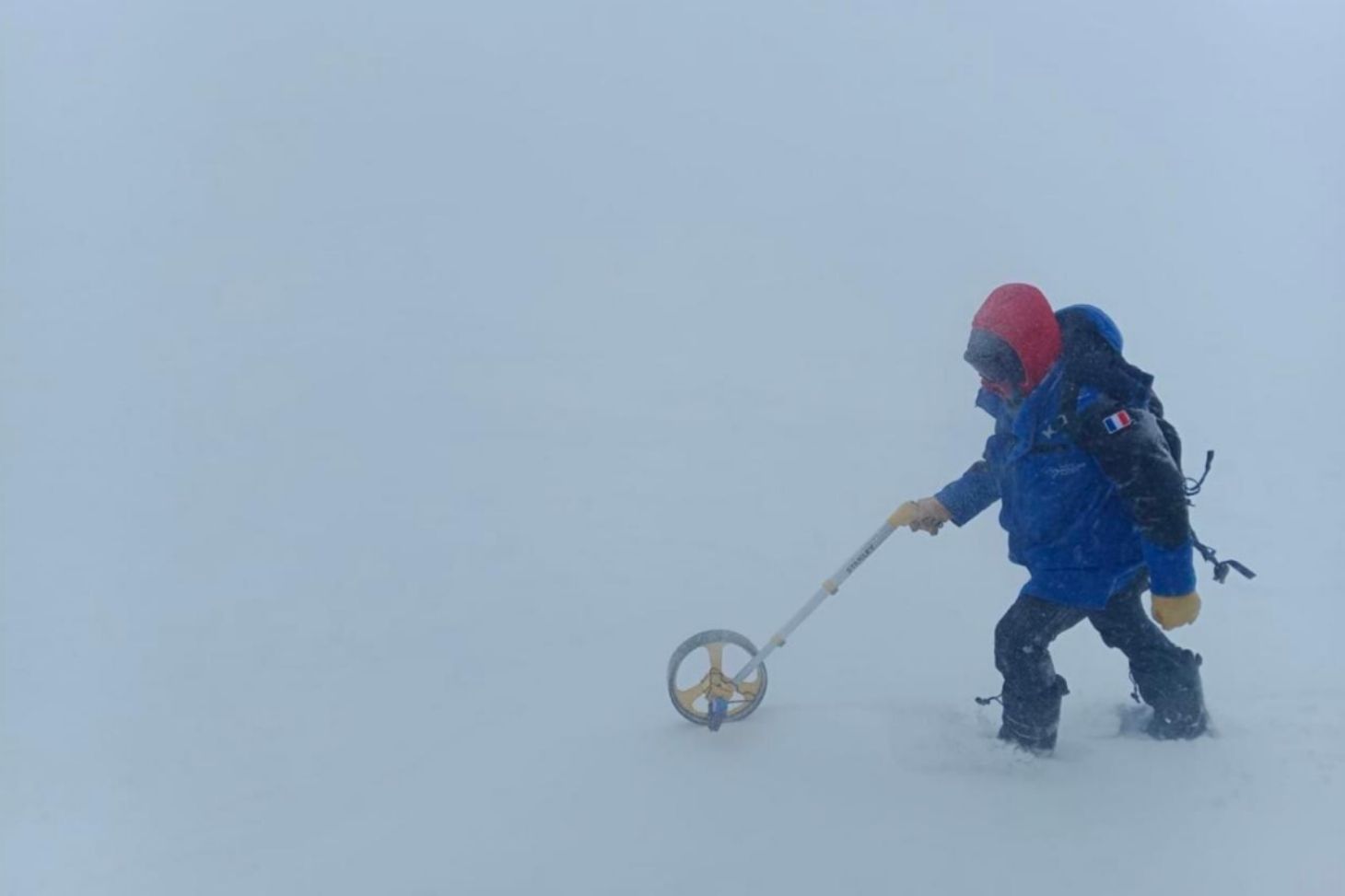
Figure 2: Carrying out a surface topographic survey using a topographic wheel during blizzard conditions.
The Project's Scientific Team
Vincent Favier, UGA observatory physicist, IGE
Laurent Arnaud, CNRS research engineer, IGE
Ghislain Picard, UGA professor, IGE
Emmanuel Le Meur, UGA associate professor, IGE
Arnaud Reboud, UGA research engineer, IGE
Lucile Fayon, UGA research engineer, IGE