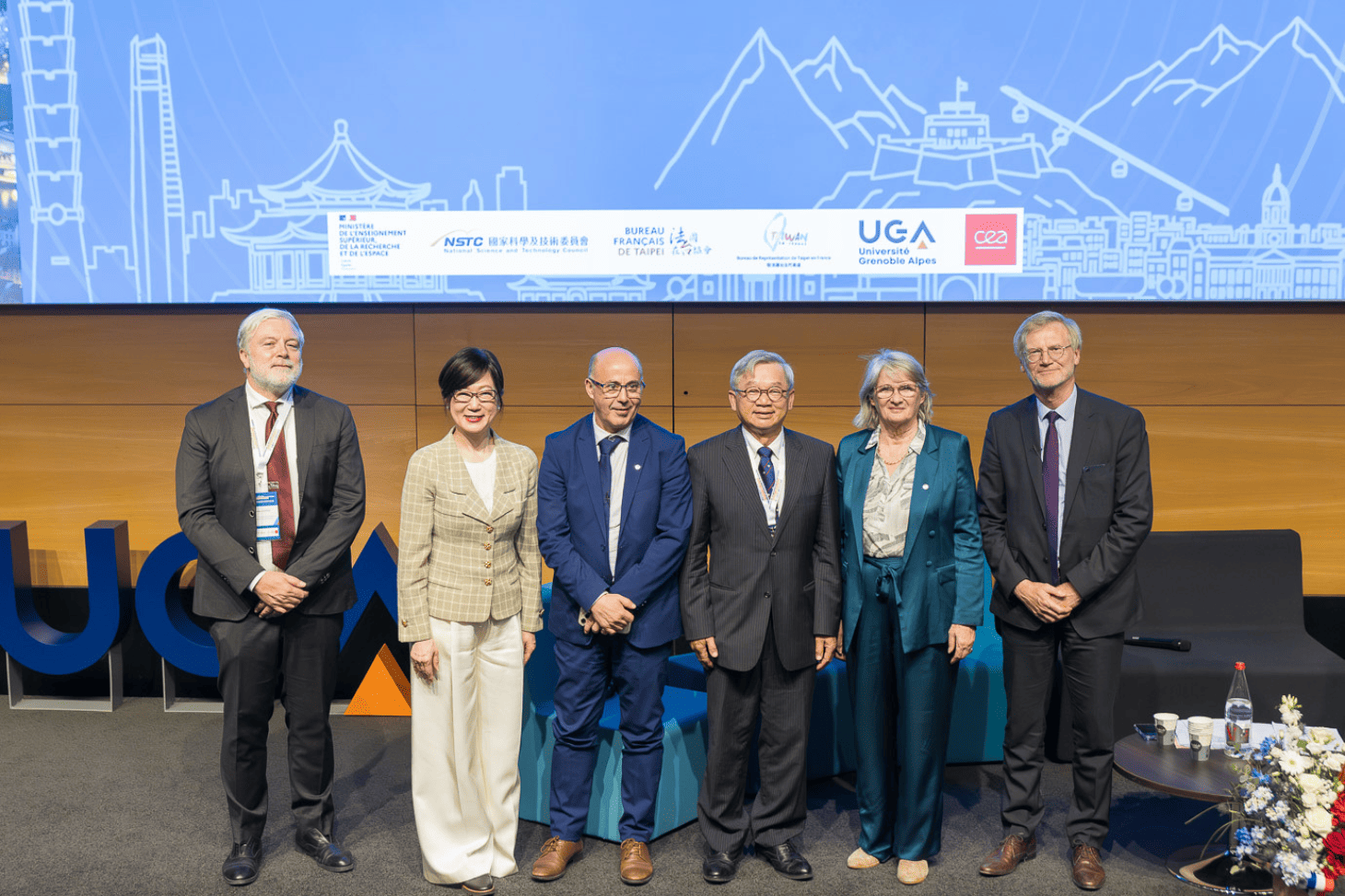
On 20 and 21 April, the Université Grenoble Alpes hosted the second edition of the Franco-Taiwanese Science Conference. Two days of intensive work — site visits, roundtables, scientific sessions — that showcased, in all its density, a research and innovation ecosystem unique in Europe, with UGA at its core.
"Grenoble is actually the city of science, research and innovation, not just in France but in the world, a very important city." — Prof. Cheng-Wen Wu, Minister of the National Science and Technology Council
These words came from the Minister of Taiwan's National Science and Technology Council, after a day spent moving through laboratories, technology platforms and industrial sites. A spontaneous remark, almost one of surprise, that captures better than any formal assessment what the 75 Taiwanese representatives came looking for here — and what they found. Because behind what the Minister saw lies a singular ecosystem: that of UGA, in which the CEA, CNRS, Inria, Inserm and the other major national research organisations are not merely neighbours, but partners fully integrated into the university's strategy and activities.
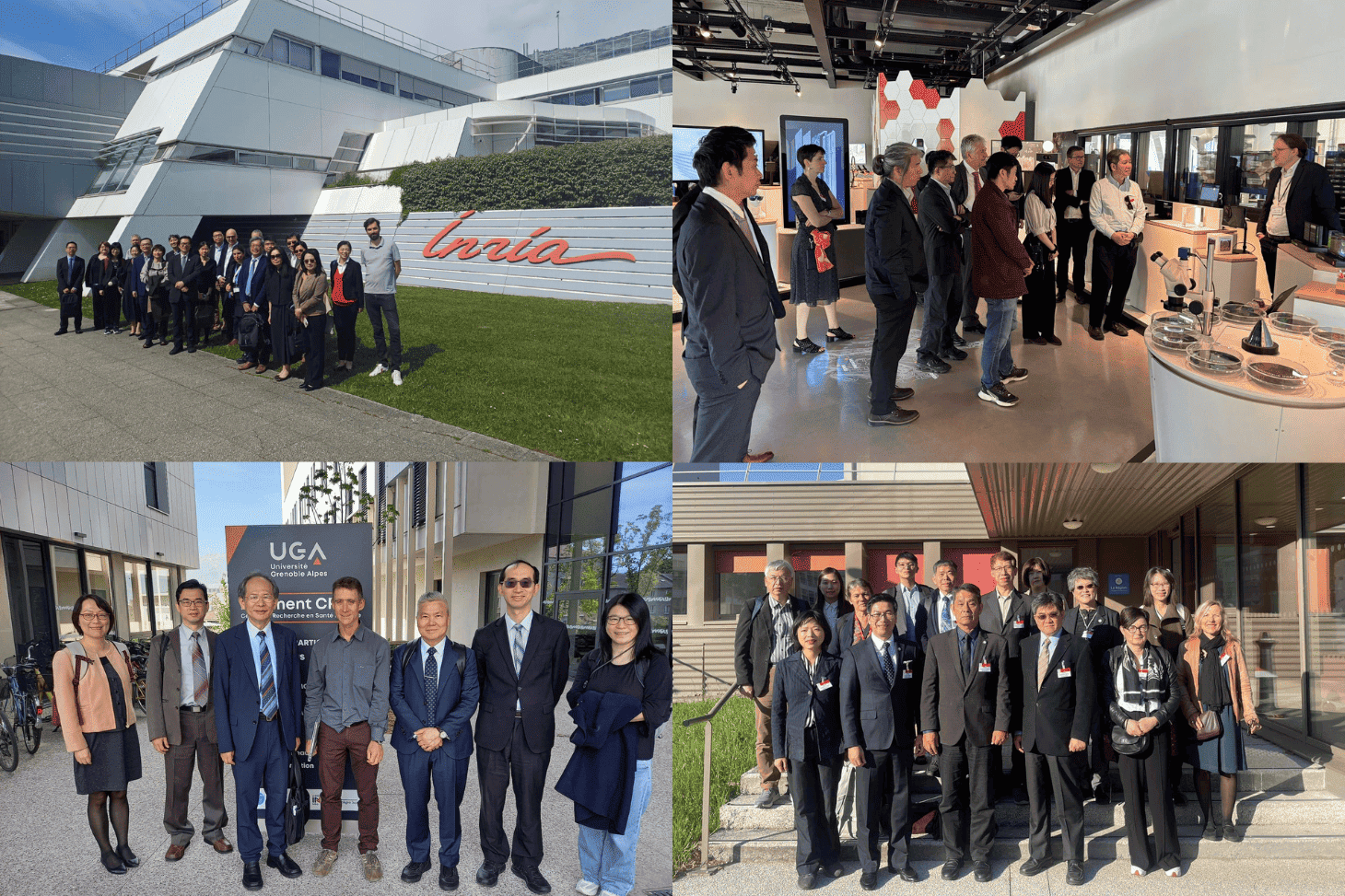
These Assises began on the ground. Before the institutional speeches and roundtables, the delegations moved through laboratories, research centres and industrial sites carried or co-carried by UGA, organised around four thematic tracks. Semiconductors first, with an immersion at CEA-Leti, the Laboratory for Microelectronics Technology (UGA, CNRS), and then at STMicroelectronics: from upstream research to industrial production, within just a few kilometres. Digital next, between the MIAI cluster, CyberAlps and UGA's Inria centre, focusing on artificial intelligence and cybersecurity. Health, with a meeting with startups in the sector, a visit to the Grenoble Institute of Neurosciences (UGA, Inserm, CNRS) and to CReSI, a centre specialising in implantable medical devices. Energy finally, from CEA-Liten and G2Elab (UGA, CNRS) to IntenCity, Schneider Electric's demonstrator building. Four tracks, one shared reality: here, fundamental research, national organisations and industry do not merely coexist — they work together, driven and coordinated by UGA, which makes this ecosystem one of the most integrated and dense in the world.
It is this reality that the conference set out to place at the service of a deeper bilateral scientific cooperation. Bringing together nearly 200 figures — researchers, institutional leaders, representatives of research organisations and universities — the event built on a first edition held in Taipei two years ago, and on a scientific and technological cooperation agreement signed in 2023. But the stated ambition was to shift up a gear.
"We move from dialogue to action. From aspiration to accountability. From shared interests to shared commitments." - Professor Yassine Lakhnech, President of UGA
Over two days, nearly 90 scientific experts worked across eight strategic domains: quantum technologies, semiconductors, artificial intelligence, cybersecurity, health, energy, ocean sciences and space. These are not arbitrary choices — they are precisely the domains where technological sovereignty is being won or lost, and where the complementarities between the two sides are strongest. Taiwan brings its world-renowned excellence in semiconductors and precision engineering. French research brings its capacity to bridge fundamental science and real-world applications.
The scale of French mobilisation speaks to the seriousness with which this event was prepared. Alongside UGA President Professor Yassine Lakhnech were Bruno Feignier, Deputy CEO of CEA, Bruno Sportisse, CEO of Inria, Professor Didier Samuel, CEO of Inserm, as well as representatives from CNES, Ifremer, the Institut Laue-Langevin, IRAM and the ESRF. The French university community was also widely represented: France Universités, several members of Udice — including Université Paris-Saclay, Université de Lille, Université de Bordeaux and Université de Lorraine — as well as other institutions
"This is the French research community — united, engaged, and speaking with one voice." - Professor Yassine Lakhnech
Two days of work that laid solid foundations and identified the most promising scientific priorities for 2026 and 2027. And already, attention is turning to the next edition, to be held in Tainan in 2028.