Sunrise: a new sleep apnoea diagnostic solution that reduces the time taken to access diagnosis and treatment by a factor of seven
Research, Innovation
On March 18, 2026
Obstructive sleep apnoea is a major public health issue: it affects more than 900 million people worldwide and raises questions about access to appropriate diagnosis and treatment. Supported by the French Ministry of Health as part of the national Forfait Innovation programme, a national study conducted in 18 sleep centres across France, coordinated by scientific teams from the University of Grenoble Alpes and Inserm, shows that the new Sunrise technology for at-home diagnostic pathways significantly reduces the time taken to access diagnosis and treatment. These findings are published today in The Lancet Regional Health – Europe.
The SUNSAS study is coordinated by two professors from the University of Grenoble Alpes (UGA) and Grenoble Alpes University Hospital (CHU Grenoble Alpes): Jean-Louis Pépin, holder of the Sleep Health-AI* Chair, and Matthieu Roustit, based at the Clinical Investigation Centre (Inserm/CHU Grenoble Alpes). It evaluates a home-based diagnostic pathway using Sunrise technology, in comparison with polysomnography, the gold standard test.
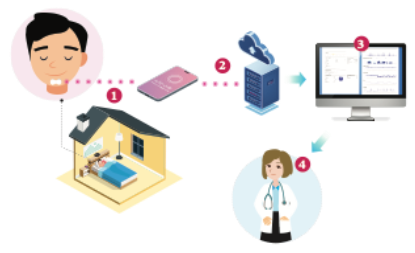
This study was conducted between 2021 and 2024 among 849 adults who were randomly assigned to one of two diagnostic pathways: a conventional pathway based on polysomnography (a test designed to monitor various physiological parameters during sleep) and a home-based pathway using the Sunrise medical device. This device uses a lightweight sensor worn under the chin to record jaw movements during sleep. This physiological signal, analysed by dedicated algorithms, generates a sleep report detailing the number of nocturnal breathing pauses and other sleep quality parameters, intended for clinical interpretation. The study aimed to determine whether this approach could enable faster access to diagnosis and treatment of obstructive sleep apnoea without compromising clinical outcomes.
The results show that the median time to diagnosis was reduced from 106 days to 15 days in the Sunrise group. The median time to treatment was also reduced, from 124 days to 50 days. Three months after diagnosis, clinical efficacy regarding daytime sleepiness was comparable between the two groups. Furthermore, earlier initiation of treatment in the Sunrise group was associated with improved outcomes in terms of daytime sleepiness, quality of life and work productivity three months after inclusion.
Given its scale, randomised design and its place within the Innovation Package, the SUNSAS study provides robust and significant evidence of the ability of a home-based diagnostic pathway to reduce waiting times for the treatment of obstructive sleep apnoea, without compromising clinical outcomes.
This work forms part of a research and innovation initiative that has been underway for several years, notably through the European SENSAPNEA project supported by EIT Health, a European initiative designed to boost innovation in healthcare, which has received several awards and contributed to the initial validation stages of this integrated home-based sleep apnoea diagnostic solution.
*The Sleep Health-AI Chair: The Sleep Health-AI International Research Chair, part of the MIAI Cluster led by the University of Grenoble Alpes (UGA), aims to transform sleep medicine by harnessing artificial intelligence (AI) and real-world data analysis to make sleep health assessment and care more accessible, accurate and effective.
Sunrise is a home-based sleep diagnostic solution that combines a lightweight sensor worn under the chin, a mobile app and cloud-based analysis software. The device records jaw movements during sleep, and the data is then analysed using artificial intelligence technology to generate a clinical report for the doctor to review, annotate and edit.
Share the linkCopyCopiedClose the modal windowShare the URL of this pageI recommend:Consultable at this address:La page sera alors accessible depuis votre menu "Mes favoris".Stop videoPlay videoMutePlay audioChat: A question? Chatbot Robo FabricaMatomo traffic statisticsX (formerly Twitter)