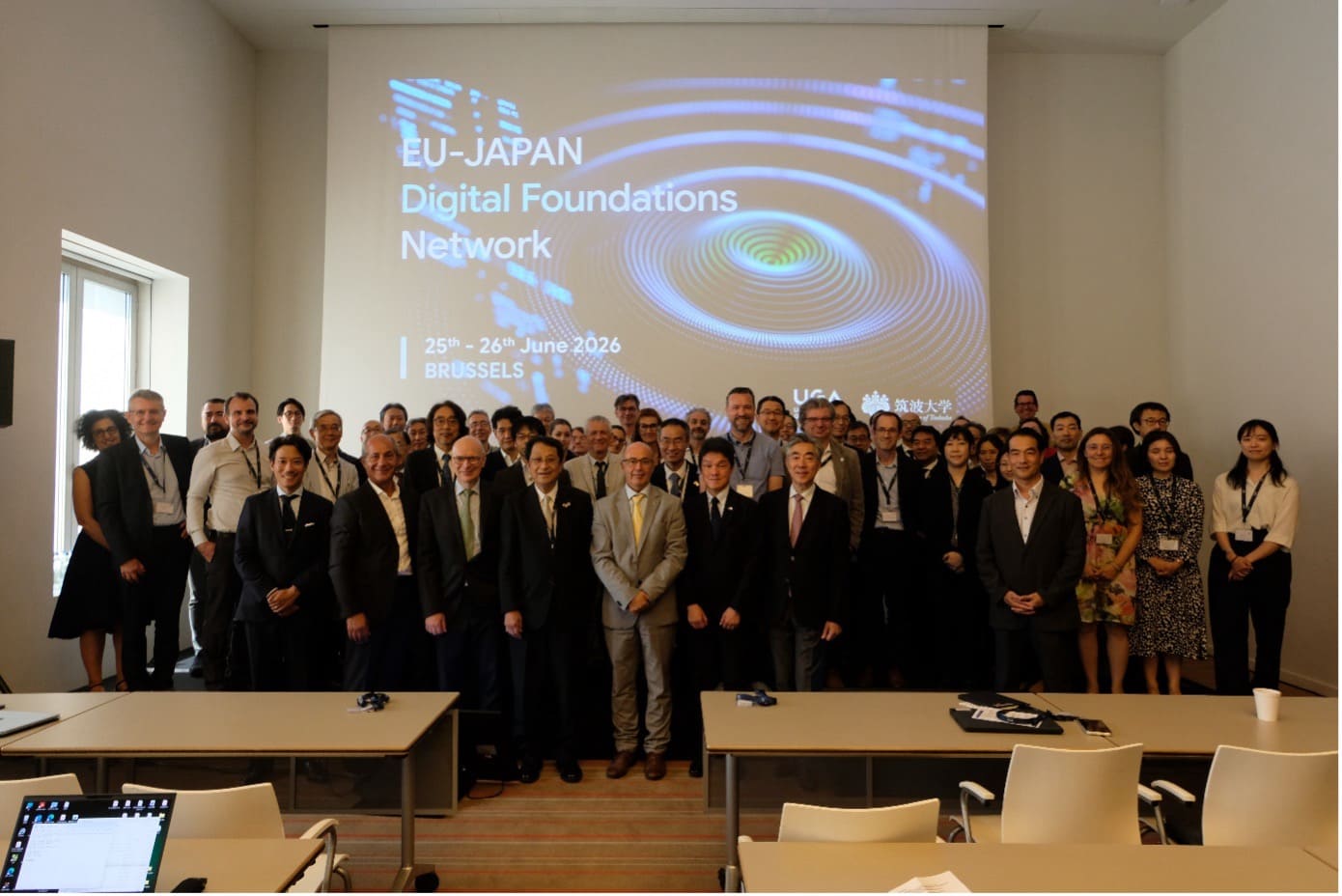
Europe and Japan are stepping up their scientific cooperation on strategic digital.
Research, International, Innovation, Industry
On July 1, 2026
Meeting in Brussels on 25 and 26 June 2026, more than 70 university leaders, researchers, industry representatives and institutional stakeholders from 15 countries took a new step forward in building Europe-Japan scientific cooperation dedicated to critical digital technologies. Co-founded by Université Grenoble Alpes (UGA) and the University of Tsukuba, the EU-Japan Network for Digital Foundations is establishing itself as a strategic platform for artificial intelligence, semiconductors, quantum technologies and sustainable digital technologies. A first white paper setting out shared research priorities will be published in the coming weeks.
Scientific cooperation at the heart of digital sovereignty challenges
Against a backdrop of accelerating global technological competition and the need to secure supply chains, the European Union and Japan are strengthening their scientific cooperation on the technologies that will shape tomorrow's economy.
Organised by Université Grenoble Alpes and the University of Tsukuba, the second symposium of the EU-Japan Network for Digital Foundations is part of the digital partnership between the European Union and Japan. Over two days, it brought together universities, research organisations, industry players and public decision-makers around a shared vision for research and innovation in foundational digital technologies. Participants included European institutions such as CEA, CNRS, Inria, universities from the UDICE network and IMEC, as well as Japanese partners such as AIST, Tohoku University and the Institute of Science Tokyo. Invited institutions, including Fraunhofer and RIKEN, and industry partners such as IBM Japan and STMicroelectronics, also took part in the discussions.
Key figures:
70 participants
15 countries represented
More than 30 universities, research organisations and industry partners
3 international working groups
1 strategic Europe-Japan white paper to be published
Three key areas for a shared roadmap
The main outcome of this second edition is a strategic white paper, to be published in the coming weeks. The result of a year of work since the founding symposium in Tokyo, it identifies the scientific priorities on which Europe and Japan intend to focus their joint efforts, structured around three areas:
Artificial intelligence, with a particular focus on the interplay between AI for Science and Science for AI, as well as their applications;
Computing technologies, covering next-generation semiconductors, microelectronics, quantum technologies and spintronics;
Sustainable digital technologies, to design digital infrastructure that is leaner, more efficient and more environmentally responsible.
Each working group has identified several research priorities and begun forming international consortia to respond to future European and Japanese calls for projects.
An integrated platform bringing together research, industry and public authorities
The originality of the network lies in its integrated approach. Beyond scientific exchange, it brings together key innovation players to speed up the transfer of knowledge to industrial applications and strengthen the appeal of talent in strategic digital sectors.
The symposium was supported by the Mission of Japan to the European Union and involved representatives of the European Commission, as well as major international industry players including IBM Japan, STMicroelectronics and Hitachi Europe. Partner institutions include French, Belgian, Dutch and Japanese universities, as well as major research organisations such as CNRS, CEA, Inria, RIKEN, AIST, NIMS and IMEC.
Beyond the round-table discussions, the two days provided an opportunity for extensive scientific and institutional exchanges to identify new areas of collaboration: visits to laboratories and centres of excellence, exchanges with research communities and the sharing of expertise on topics such as health, neuroscience, ageing, materials, energy, quantum technologies, science diplomacy and climate.
Next step: turning priorities into research projects
Following the Brussels symposium, the working groups are continuing their discussions to turn the priorities identified into collaborative projects, foster researcher and student mobility, and strengthen partnerships between laboratories, universities and industry.
The third symposium will be held in Japan in 2027. It will showcase the first collaborations launched and continue to build this scientific alliance in support of digital innovation.
Published on July 1, 2026
Updated on July 1, 2026
The EU-Japan Network for Digital Foundations
Founded in 2025 on the initiative of Université Grenoble Alpes and the University of Tsukuba, the EU-Japan Network for Digital Foundations supports the digital partnership between the European Union and Japan. It brings together universities, research organisations, industry players and public institutions around a shared goal: to develop high-level scientific cooperation in foundational digital technologies, strengthen the competitiveness of both partners, and support the emergence of new generations of researchers and engineers.
Share the linkCopyCopiedClose the modal windowShare the URL of this pageI recommend:Consultable at this address:La page sera alors accessible depuis votre menu "Mes favoris".Stop videoPlay videoMutePlay audioChat: A question? Chatbot Robo FabricaMatomo traffic statisticsX (formerly Twitter)