

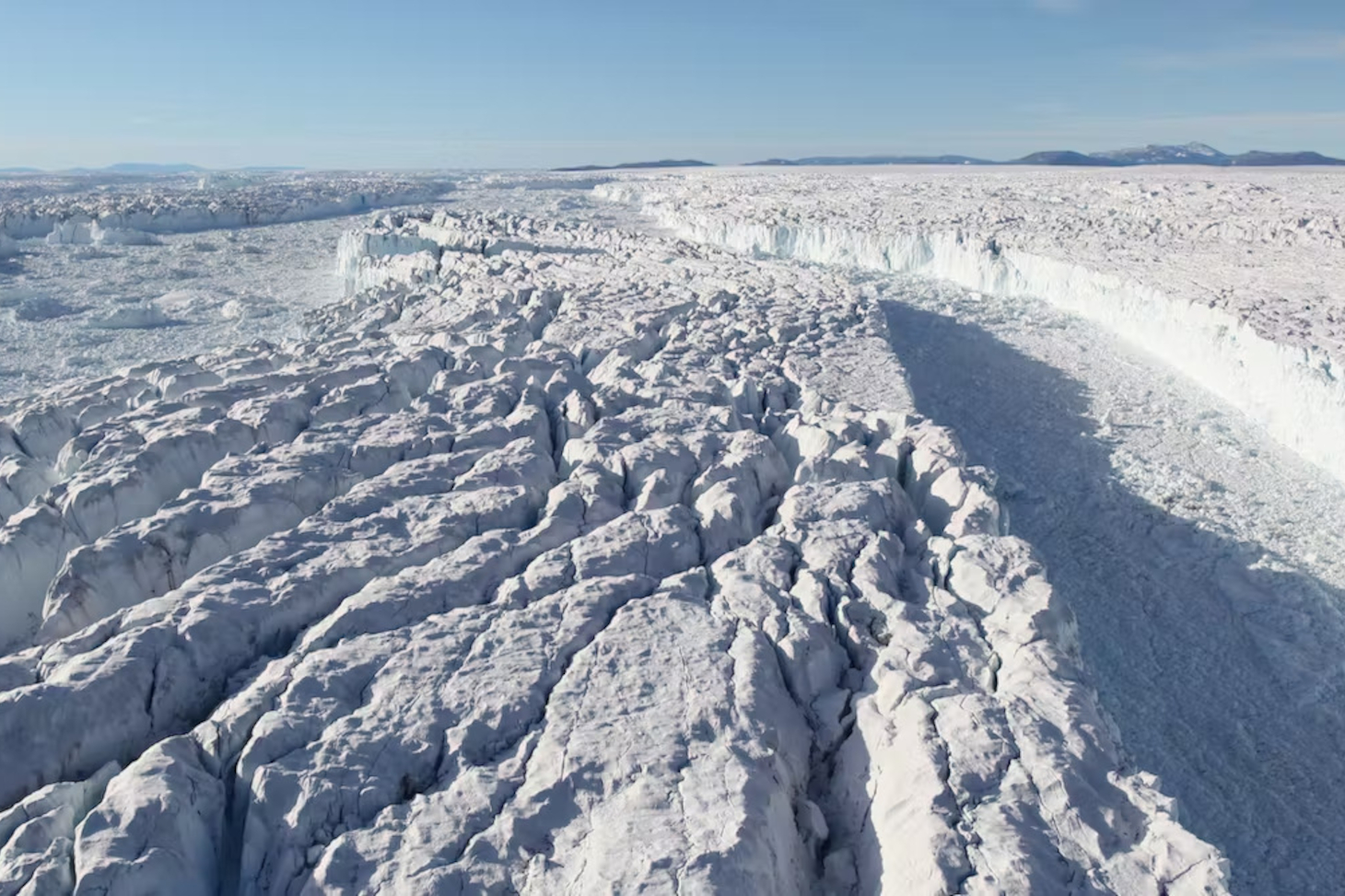
In this region, the glaciers have characteristics that are unique to Greenland: once they reach sea level, they begin to float and form ice shelves that are tens or even hundreds of kilometers long. These ice shelves, which are natural extensions of the ice sheet, act as immense frozen “dams” that regulate the amount of ice flowing into the ocean.
However, these ice shelves are gradually shrinking, and three of them have already collapsed since the early 2000s. This is a worrying sign: the weakening of these ice shelves could threaten Greenland’s glaciers and contribute to accelerating sea-level rise. This is what we just published on November 7 in *Nature Communications* on November 7, in collaboration with Danish and American colleagues.
[More than 85,000 readers rely on The Conversation’s newsletters to better understand the world’s major issues. Subscribe today]
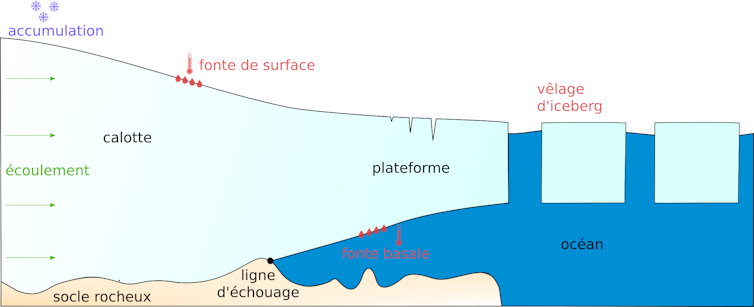
To understand how these glaciers evolve, it is necessary to understand how ice caps work. It may be hard to imagine, but glaciers flow under the force of their own weight, much like honey on a slice of bread. First, snow accumulates at the top of the ice cap and gradually turns into ice. This mass at the summit pushes the ice downward, creating a flow, which then begins to melt as it encounters a warmer atmosphere at lower elevations.
As it reaches the coast, the ice will be carried away by several branches flowing down valleys—the fjords—in two possible ways:
Either by forming large ice cliffs, called fronts, from which pieces break off to become icebergs.
Either the glacier will form large floating platforms. In the latter case, the melting of the ice from below—as it comes into contact with warm ocean water—will add to the melting caused by icebergs breaking off from the front.
To assess the health of the glacier and determine the extent to which these phenomena contribute to sea-level rise, glaciologists calculate the mass balance. This is the difference between the total amount of ice that accumulates on the ice sheet and the amount that is lost. Accumulation results from the successive addition of layers of winter snow. On the loss side, there are several phenomena, such as melting upon contact with the air or the ocean, or loss in the form of icebergs—a process known as calving (see diagram above). This mass balance then makes it possible to determine precisely the amount of ice lost or gained over a given period and to deduce the glacier’s contribution to sea-level rise.
As a result of global warming, two phenomena are intensifying and contributing to increased losses from the Greenland ice sheet, while the gains remain the same, causing it to lose mass.
The primary cause of these increased losses (60%) is a warmer atmosphere, which increases surface melting.
The second part (40%) is due to the acceleration of this glacial movement, which causes an increase in iceberg calving and melting at the ocean’s edge. This ice flow can increase, in particular, when the front of glaciers ending in the ocean retreats, or when ice shelves thin. Just like when you pop the cork on a bottle of champagne, stresses are released, causing the ice to accelerate.
The Greenland ice sheet alone accounted for more than 17% of the rise in sea level during the 2006–2018 period.
Greenland’s remaining ice shelves thus play a crucial role as a barrier, stabilizing the ice outflow from the ice sheet. It is therefore essential to understand the mechanisms that weaken them in order to predict future changes in the polar ice sheets, both in the North and in the South (in Antarctica, most glaciers have floating extensions). Measuring these changes is, however, extremely complex, as these ice shelves are in contact with both the ocean and the atmosphere.
It is therefore necessary to distinguish between melting caused by warming air and melting caused by warming oceans. Apart from melting processes, the weakening of these ice shelves can also be measured by the increasingly frequent formation of crevasses (damage), or by the retreat of the ice front and the point where glaciers meet the ground (known as the grounding line).
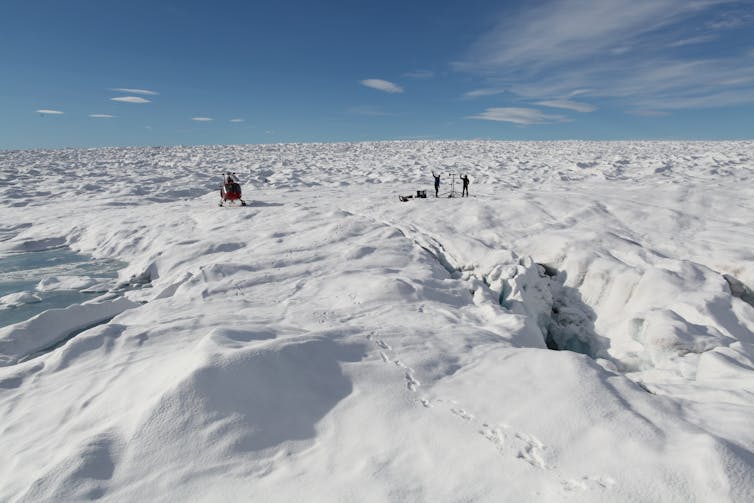
To complicate matters further, these platforms are located in very remote, nearly inaccessible areas with extremely harsh weather conditions. Measuring all of these processes in the field is therefore very challenging—and in some cases, even impossible—as shown in the video below. To address this problem, satellite imagery and numerical models are key tools.
By combining data from satellites and aircraft (as shown in the video above), we were able to demonstrate alarming signs of glacier retreat in northern Greenland. In collaboration with the University of Copenhagen and the Geological Survey of Denmark and Greenland, we were able to calculate the amount of ice lost by these ice shelves—more than one-third of their volume.
By combining these data with climate models, we were able to reconstruct the history of melting beneath floating ice shelves. It turns out that this melting has increased dramatically since the 2000s, when we were able to begin tracking this process in greater temporal detail. By combining these results with observations and reconstructions of ocean conditions, we demonstrated a correlation between the increase in this sub-ice melting and rising ocean temperatures. We were also able to show that sub-ice melting accounts for 56% of the ice shelves’ mass loss. Calving (icebergs breaking off the ice shelves and falling into the ocean) accounts for 38% of mass loss, while surface melting accounts for the remaining 6%; it is therefore a minor factor in the thinning process.
The problem is that this weakening of the platforms directly impacts the glaciers located upstream. Over the entire observation period, we measured a marked retreat of the glacier grounding lines, with the most significant retreats reaching up to 8 km. The changes observed at this natural boundary are sensitive indicators of the glacier’s response to global warming and are also used as a marker of instability.
By measuring the flow and thickness of the glaciers, we were also able to calculate the amount of ice discharged into the ocean as a result of this weakening of the ice shelves. For some glaciers, this ice discharge increased by more than 25 percent, causing even more ice to be released directly into the sea.
A steady rise in air and ocean temperatures, as shown in the latest report from the IPCC, could thus pose a long-term threat to the last remaining ice shelves in northern Greenland. For example, the Zachariæ Isstrøm Glacier lost its floating ice shelf in the early 2000s, and we subsequently observed a volume of ice flowing into the ocean that was nearly doubled. This region could then become one of the regions of the polar ice cap that contributes most to sea-level rise.