

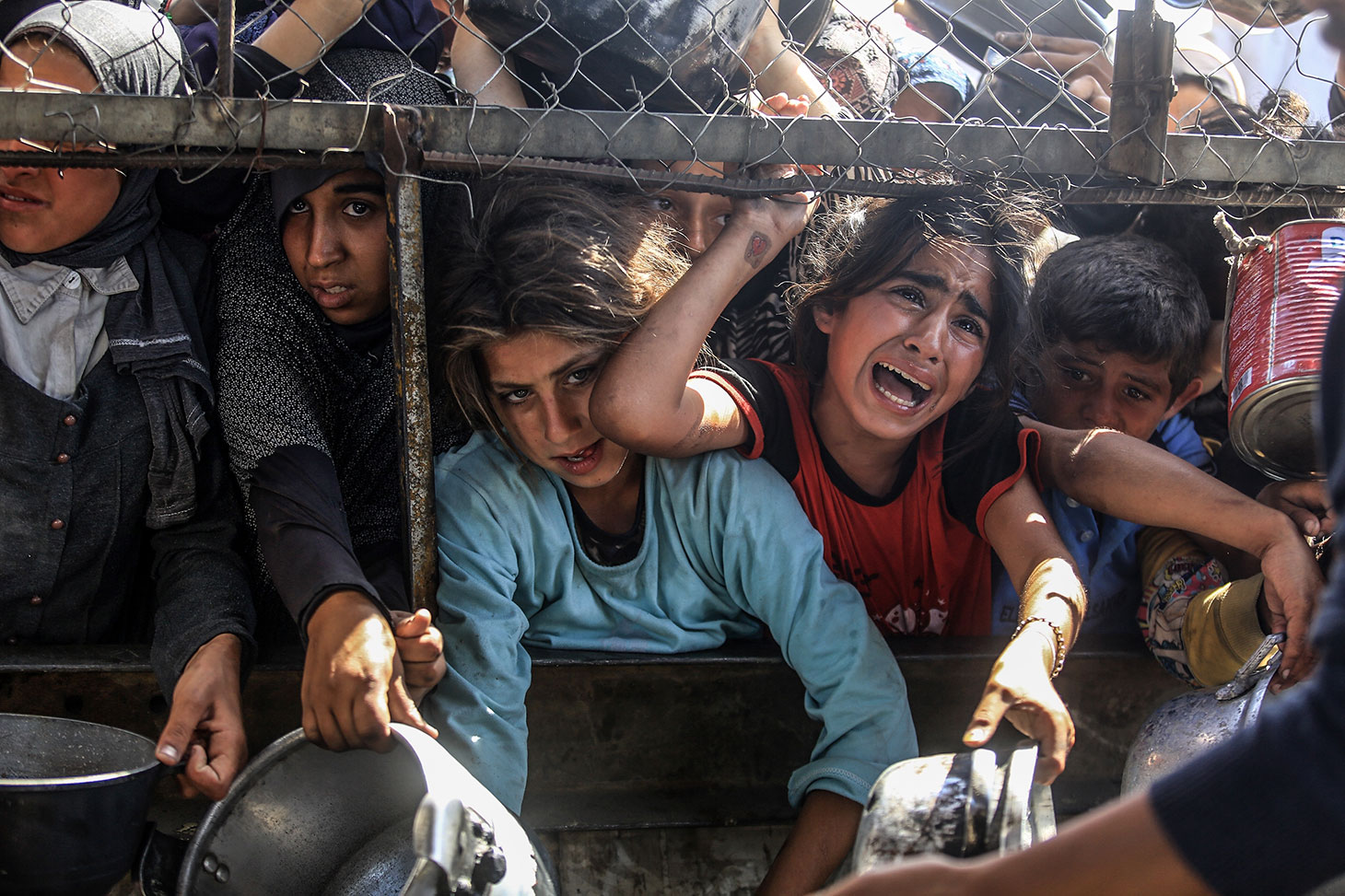
Under international pressure, a tentative resumption of humanitarian aid deliveries is beginning in Gaza. However, Israeli officials—as has been the case since 2005—are once again prolonging their “controlled drip strategy.” The mechanisms leading to the current crisis have thus been known and denounced for over a year. Vital food supplies have been maintained at a level just short of suffocation—barely enough to prevent mass deaths that would cap off the tragedy that has been unfolding since October 2023.
With such a high death toll, the risk would be too great for a consensus to finally emerge that could break through the incredible inertia that prevails in the governance of international relations. The Israeli authorities know this.
However, the announced cosmetic aid shipments do nothing to resolve the crisis that the civilian population of this territory has been enduring for more than eighteen months now.
Food airdrops: a paltry form of aid for a population ravaged by famine
These measures, following in the wake of the disastrous initiative by the Humanitarian Foundation for Gaza, continue to disregard any concern for effectiveness and respect for humanitarian principles with regard to a civilian population living in a territory occupied by a foreign power. This is because the announced measures undermine the effective implementation of food security, which is based on four pillars.
The first pillar is food availability. The announced increase in aid volumes focuses solely on this aspect. However, the scale of this increase raises doubts: 100 trucks have been announced, whereas before the full-scale conflict, more than 500 were deployed each day. The UN estimates that 62,000 metric tons of food per month are needed.
The second pillar concerns the civilian population’s effective access to food that has crossed the border. This access relates to the ability to travel to reach the food: geographic accessibility, which is particularly crucial for the sick, the wounded, and the elderly—tens of thousands of people in this case; exposure to military violence jeopardizes safe access; and, depending on the distribution channels subsequently used for the food, costs that can be prohibitive if left to the deregulated black market fostered by the lack of oversight on the ground (financial accessibility).
The third pillar relies on the ability of communities to effectively use the products that have entered the country. That is, to have access to cooking utensils, fuel, and other ingredients—including water— that enable the preparation of foods requiring cooking. Seriously injured or unconscious patients also require specialized parenteral nutrition (administered intramuscularly or intravenously, ed.) under the supervision of healthcare professionals, among whom there has also been a massive death toll since October 2023.
Finally, the fourth component of food security is the long-term stability of the three preceding pillars—not, as has been the case for the past eighteen months, erratic deliveries in terms of both time and location.
Acute malnutrition, which can lead to death, thus results from an imbalance between the intake that ensures food security and excessive losses—most often linked to acute diarrhea, which is very common in areas where the quality of drinking water cannot be guaranteed. This is the case for the population of Gaza, whose population density prior to the conflict was among the highest in the world (6,090 people persquare kilometer in 2023, editor’s note).
Under the Israeli siege, Gazans are left to face a devastating famine
The population—more than 80 percent of which is forced into a state of perpetual displacement—is now concentrated in small areas, living amid human and animal waste, without even the means to maintain basic personal hygiene, and at a time when chronic malnutrition is exposing people—especially children—to higher mortality rates due to immune deficiency.
None of these vital issues can be resolved by the modest increase in volume announced by the Israeli authorities alone. If taken in isolation, this decision amounts to nothing more than humanitarian marketing.
This collective punishment has gone on for far too long for the 2 million people stranded in an area 40 km long and 10 km wide. Despite recent announcements, vigilance remains essential to ensure that the meager supplies—which have received extensive media coverage—are not portrayed as a generous and sustainable solution… An unprecedented mobilization of major international NGOs continues to draw attention to the catastrophic situation faced by both the population and humanitarian aid workers.
A genuine ceasefire must be established, and political decisions must be made so that prospects for a lasting peace can finally emerge.
The next United Nations General Assembly, to be held in September 2025 in New York, presents an opportunity to make decisions for “the day after” the conflict. Political initiatives are multiplying, particularly around recognition of the State of Palestine by a growing number of countries.