

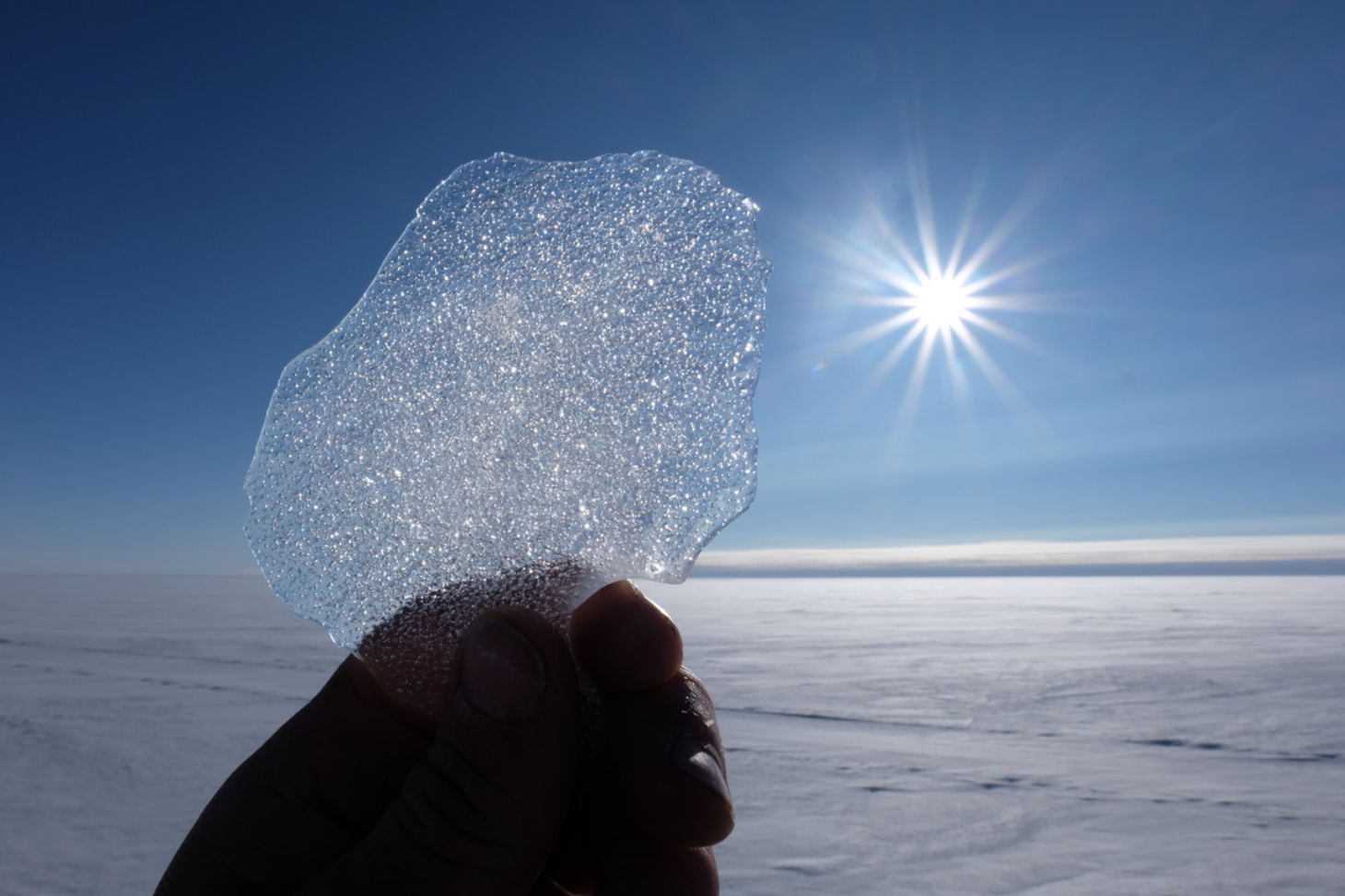
Analysis of air bubbles trapped in ice cores more than 200,000 years old reveals periods in the planet’s history when atmosphericCO2 concentrations rose suddenly. It suggests that we may be on the cusp of a similar event… This increase, which would be in addition to human emissions, remains, however, far below the levels ofCO2 we are currently releasing.
The atmosphere is in a state of constant change. Its composition has varied regularly throughout our planet’s climatic epochs, particularly the concentration levels of carbon dioxide (CO2), a crucial factor in determining our planet’s climate.
Analysis of air bubbles trapped in ice cores has made it possible to reconstruct these variations over the past 500,000 years. This is demonstrated by our study published in the journal *Nature Geoscience*, which documents recent “spikes” inCO₂ —corresponding to increases of approximately 10 parts per million (ppm) in atmosphericCO₂ concentrations in less than a century.

These “spikes,” which correspond to the most abrupt natural variations in atmosphericCO2 that have occurred in the Earth’s climate history, are nevertheless much smaller in magnitude than the recent increase responsible for global warming.
The study shows that theseCO2 spikes occurred at times when the angle of the Earth’s rotational axis relative to the plane of its orbit around the Sun—known as obliquity—was high. The Earth is currently in a period of high obliquity.
That's not all: these spikes are triggered by disruptions in the AMOC, a major ocean current in the North Atlantic that plays a crucial role in regulating the climate and is currently showing signs of slowing down.
This could lead to an additional surge inCO2 emissions, which would add to anthropogenic emissions.
These spikes in atmosphericCO2 correspond to increases of about 10 parts per million (ppm) over the course of a century in atmospheric concentrations over the past half-million years.
Although significant, these increases are, on average, 10 to 20 times smaller than the increase in human-caused emissions. Over the past hundred years, this increase is estimated at 115 ppm—ten times greater than the observed spikes inCO2 levels.
[There are already more than 120,000 subscribers to The Conversation’s newsletters. What about you? Subscribe today to gain a better understanding of the world’s major issues.]

Analysis of this ice core—a long tube of ice approximately 10 cm in diameter extracted from a depth of several kilometers in Antarctica, a region whose surface is almost entirely covered by ice—was conducted at the Institute of Environmental Geosciences in Grenoble.
It made it possible to identify seven newCO2 spikes during the period from 260,000 to 190,000 years before the present and to confirm 15 spikes already documented in previous records.
Above all, it demonstrated that 18 of the 22CO2 spikes studied occurred when the planet's axial tilt was high.
CO2 spikes—abrupt phenomena—are in fact caused by the concurrence of two phenomena.
The initial trigger for these shifts is the disruption of the Atlantic Meridional Ocean Circulation (AMOC), a major factor in regulating the Earth’s climate. The shutdown of the AMOC leads to a global reorganization of precipitation and temperatures.
However, this necessary condition is not sufficient: not every disturbance of the AMOC systematically leads to aCO₂ spike. This is where the second key parameter in the occurrence ofCO₂spikes comes into play: the Earth’s obliquity, which corresponds to the angle of the Earth’s axis relative to the Sun as it rotates around it.
This obliquity is not constant: it varies steadily between approximately 22° and 25° over cycles of 41,000 years.
This variation influences the distribution of solar energy across the Earth’s surface, which has direct impacts on regional climates and the geographic distribution of terrestrial environments, particularly vegetation types, which store carbon. Our results suggest that these changes in the global distribution of vegetation—particularly in the Middle East and sub-Saharan Africa—lead to the accumulation of largeCO₂ stocks in biomass, which can then be released when the AMOC is disrupted, causingCO₂ spikes.
However, the Earth is currently experiencing one of these periods of high obliquity. In the event of a major disruption to Atlantic ocean circulation—particularly a slowdown in the AMOC—an amount of carbon equivalent to four years of global anthropogenic emissions (based on average emissions from 2010 to 2019) could be released over the course of a few decades, adding to current anthropogenic emissions.

At present, there remains significant uncertainty regarding models related to the AMOC, with some suggesting that it is slowing down as a result of climate change caused by human activities. If the AMOC were to collapse, a new spike inCO₂ levels could occur, leading to furtherCO₂ emissions from natural sources destabilized by human activity, which would in turn exacerbate climate change.

Established in 2007 to accelerate and share scientific knowledge on major societal challenges, the Axa Research Fund has supported nearly 700 projects worldwide, led by researchers from 38 countries. To learn more, visit the Axa Research Fund website or follow us on Twitter @AXAResearchFund.