

Lisa Antoine-Pénelon, a librarian in Grenoble, contributed to this article alongside Éléonore Cartellier, Anne-Marie Monluçon, Chiara Ramero, and Fanny Rinck.
Children’s literature is a particularly dynamic field, offering a wealth of new discoveries for both budding and seasoned readers. But with so many stories, novels, picture books, historical fiction, and series to choose from, how can you find the titles that will capture your child’s interest? The works of these five authors and illustrators—now essential reading for young audiences—offer plenty of starting points for this journey.
This author and illustrator was born in Bologna. She grew up on the adventures of Pippi Longstocking and the novel The Baron in the Treesby Italo Calvino, Beatrice Alemagna decided at age 8 to become a painter and author. She has succeeded brilliantly in this endeavor, with some fifty books published, including the widely translated *Mon amour*, published by Hélium.
Her album *Un grand jour de rien*, published by Albin Michel Jeunesse and winner of several awards, tells the story of a child who is forced to go outside in the rain instead of playing video games. It features Beatrice Alemagna’s signature “blended” style, in which materials seem to blend together while adding depth and texture. Splashes of bright color seem to illuminate her illustrations.
Her books are conceived as objects featuring transparencies, collages, unconventional formats, and sometimes very little text—leaving plenty of room for interpretation by both the adult reader and the child listening. Her latest book, *Adieu Blanche-Neige*, reimagines the fairy tale by giving voice to the stepmother in all her cruelty, ambivalence, and pain. Her work always offers multiple levels of interpretation, making it accessible to readers of all ages and allowing for a variety of interpretations.
A member of the “Charter of Children’s Authors and Illustrators” and the recipient of several awards, including the prestigious “Hans Christian Andersen Award, ” which she was awarded in 2022, Marie-Aude Murail is one of the pillars of French children’s literature.
She was born in 1954 in Le Havre, into a family of artists. Later, when asked, “How does one become a children’s author?” she replied, “You become one by chance and remain one out of conviction.” ” Most of her work, published by L’École des loisirs, is aimed at teenagers. She connects with their world and brings to life characters with whom they can identify, creating a back-and-forth between identification and projection, to imagine other possibilities and other horizons. She believes that her audience should feel that she loves her characters and her readers.
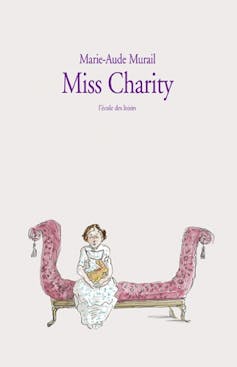
Among his most famous novels—such as *Oh, Boy! * (2000), *Simple* (2004), *Vive la République! * (2005), and *Miss Charity* (2008), she also created a series of books: *Émilien* (1989–1992), *Nils* (1991–1998), and *Malo de Lange* (2009–2012) won the hearts of teenagers, *L’espionne*, published by Bayard since 2001, has won over younger readers.
Today, *Sauveur & Fils*, centered on a psychologist who helps troubled young people, is in its seventh season, the second installment of the comic book adaptation of *Miss Charity*, chronicling the adventures of a curious little girl from19th-century English high society, is set to be released soon, and there are now three detective stories set in the streets of Le Havre (co-written with his brother Lorris): *Angie*, *Remember September*, and *At the Why Not Hotel?*.
Is it really so original to recommend Jean-Claude Mourlevat’s children’s books? A former German teacher who made his mark in the theater as both an actor and a director, his works have been translated into some twenty languages as well as into Braille, and he was awarded the prestigious Astrid Lindgren Prize in 2021; he enjoys international renown.
Many adults have read some of his memorable books to their children and grandchildren, or had their students read them. At the end of elementary school, students can read *L’Enfant Océan*, a retelling of Perrault’s *Le Petit Poucet* transposed to the present day, combined—specialists refer to this as “contamination,” when multiple literary sources are interwoven—with echoes of the Brothers Grimm’s *Hansel and Gretel*. But the author’s true feat lies elsewhere. He replicates Faulkner’s feat in his polyphonic novel *Tandis que j’agonise*. Mourlevat writes within the silences of Perrault’s tale, giving voice to all the characters—including, with virtuosity, all the brothers of that taciturn little Poucet.
[Nearly 70,000 readers rely on The Conversation's newsletter to better understand the world's major issues. Subscribe today.]
Others recall having to read the chapter on the swearing contest from *La Ballade de Cornebique* to their children several nights in a row—children who were jumping for joy and eager to use those archaic and delightful insults themselves.
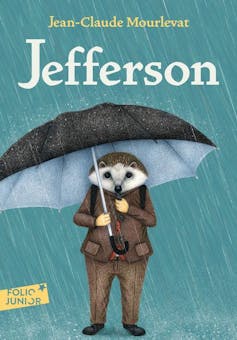
The recent novel *Jefferson*, aimed at children ages 9 and up, tackles serious topics with nuance and a tonal agility that shifts seamlessly from the most nerve-wracking suspense to outright laughter or subtle humor. The story begins in the wake of the murder of a barber—a badger named Edgar—for which the hero, Jefferson, a young hedgehog, is accused. The investigation, launched with his friend, Gilbert the pig, to clear his name of a wrongful accusation, forms the core of the plot. It only becomes linked to the animal rights cause later on: it turns out that the victim was secretly an activist for this cause, speaking out against the suffering animals endure in slaughterhouses.
The dialogues between the characters are worth their weight in gold, particularly because these animal characters frequently use human expressions, with figurative meanings reinforcing the literal ones. Thus, “the old she-goat” is an old goat, the wife of a judge…
Claude Boujon was also a painter, sculptor, and puppeteer. As an author and illustrator, he is one of the most influential figures among young readers, particularly those in preschool. What stands out in both his writing and his drawings is their simplicity, combined with great expressiveness. It all comes down to a pose, a glance, or an onomatopoeia.
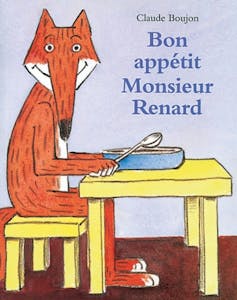
His world is incredibly rich and deceptively simple, because stepping into a C. Boujon picture book is like stepping into literature—passing through a small door to discover the relationships between characters, the power of words, and the reader’s questions. It is the reader whom the fox is looking at, straight in the eyes, on the cover of *Bon appétit! Monsieur Renard*.
The opening lines set off a quest, always with a touch of humor: “Once upon a time, there was a young wolf who didn’t know he was a wolf,” in *The Wolf Apprentice*, or “When the witch Ratatouille compared herself to the photo in the magazine, she thought she looked ugly,” in *Ah! Those Good Soups*.
Claude Boujon’s work explores the theme of living together, as in *La brouille*, a delightful story about neighbors, and in *L’intrus*, where the Ratinos face a “mountain of flesh.” It also explores the theme of books, in *Un beau livre* and in *Le Crapaud perché*, where the hero “could have spent entire days with his nose in a book.” One of his funniest stories, *La chaise bleue*, is a tale of friendship and an ode to the imagination, because “A chair is magical. You can transform it.”
Born in the United States in 1945 and writing since the late 1970s, Susie Morgenstern is a leading author in children’s literature. Her works are both touching and complex. Having written extensively for elementary-school-aged readers, she has turned in recent years to a more mature audience with stories about adolescent desire, such as *Touche-Moi*, published in 2020, as well as works exploring technology and intergenerational relationships, such as *iM@mie*.
His most iconic works are aimed at readers ages 8 to 12, with The Sixth, Joker, Love Letters from 0 to 10, or even The Two Halves of Friendship. While the first two books focus on school, the last two on the list are beautiful reflections on love and friendship across generations and between religions.