


But since when has a character with a disability been a child or a teenager? We might think of Pinocchio, Carlo Collodi’s hero, who has captivated young readers since the late19thcentury and whose unusual features highlight his difference from other children. He is made of wood; he has no ears (because Gepetto forgot to carve them); his nose grows disproportionately long whenever he lies; his feet burn in the fireplace when he doesn’t follow the advice of Jiminy Cricket…
But beyond this classic, how does children’s literature portray disability today? A common thread in most contemporary books is that disability is presented as a characteristic of the character rather than as a deficiency, with the aim of fostering feelings such as solidarity and tolerance, and instilling respect for differences.
In an interview with David Tolin in 2009, Marie-Aude Murail said she created the character of Simple to make him likable and to convey that this boy with an intellectual disability is a blessing for others, because even though life with Simple is complicated, it helps everyone find their own truth.
Various research studies and recent journal articles, such as Lecture jeune in June 2023 and Nouvelles du livre jeunesse from the last quarter of 2022, show us how contemporary children’s literature addresses all types of disabilities. Furthermore, in France, we can observe an increase in the portrayal of these issues over the past thirty years.
Law No. 2005-102 of February 11, 2005, “on equal rights and opportunities, participation, and citizenship for people with disabilities,” and subsequent laws such as Law No . 2013-595 of July 8, 2013, “on guidelines and planning for the overhaul of the Republic’s school system”—which calls for an inclusive school system—promote acceptance, a principle that also underlies children’s literature featuring characters with disabilities, regardless of the nature or severity of those disabilities.
From picture books to novels, from comic books to plays, these works help young readers better understand disabilities and encourage them to reflect on their own identity and that of others.

*Anatole’s Little Pot* by Isabelle Carrier, published in 2009, addresses disability in a simple and vivid way by representing it through an everyday object: a red pot that is attached to the main character, Anatole. This pot prevents him from living his life like everyone else and causes him problems—until he meets an “extraordinary person” who teaches him how to come to terms with his disability.
The illustrations in the book are very minimalist, using only three colors—black, red, and green—and the text is kept to a minimum, making it easy to read and understand. In addition, a short film directed by Eric Montchaud in 2014, based on Isabelle Carrier’s work, offers another way to engage with the story through a different medium.
This book can also be recommended for elementary school students in Cycle 2. Numerous lesson plans have been developed based on this work, such as the one posted online by the Nice School District and designed for second-grade students.
Sometimes, the characters themselves don’t have a disability, but they support others who do, like Manu, the protagonist of Frédérique Niobey’s young adult novel *En roue libre*, whose mother is in a wheelchair and has lost all will to live. The heroine doesn’t know how to cope with this situation. When asked what her mother does, she doesn’t know what to say or gets upset: “Should I stick a label on my face that says ‘Daughter of a disabled person?’ So everyone can feel sorry for me? Thanks a lot. Is that supposed to stop me from laughing? From singing? From dancing? What do you think? My body—it moves!”
In other cases, characters with disabilities are the heroes of the story, as in Grégoire Solotareff’s picture books *Mimi the Ear* and The Rabbit on Wheels.
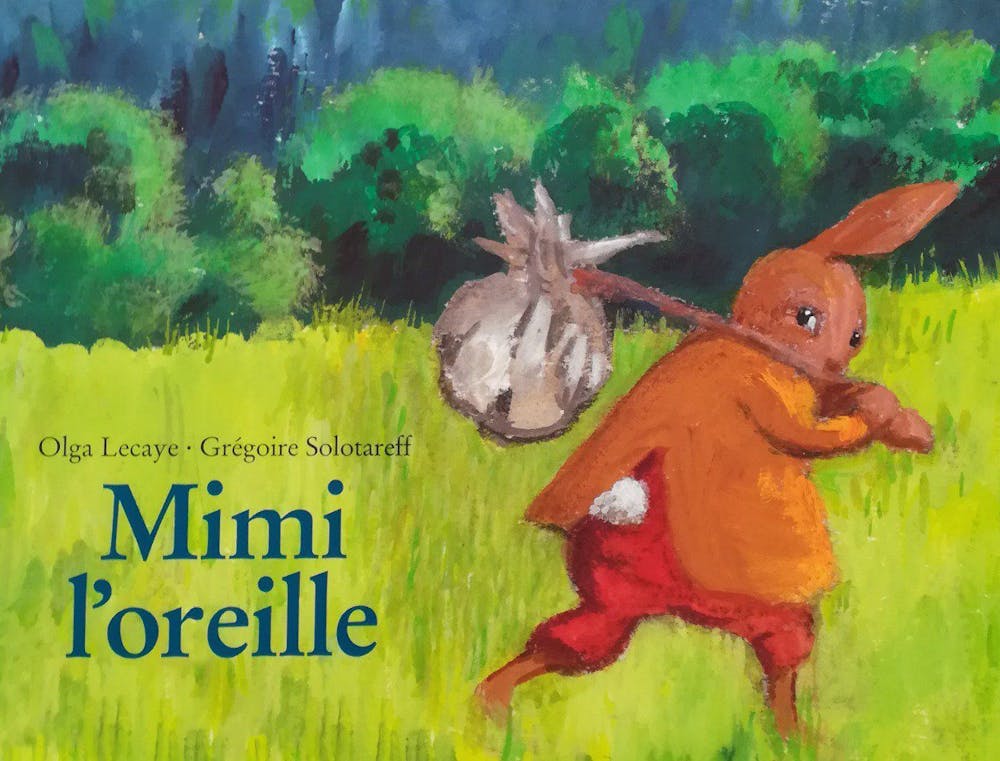
In the first book written by Solotareff and illustrated by his mother, Olga Lecaye, Mimi is a rabbit who wishes he had two ears like everyone else, so he can hear everything and understand how the world works. Even though people tell him that you can still understand everything with just one ear, he sets out to find a second ear to have sewn on.
In the second story, Jil is a rabbit who is “not quite like the others” because he uses two boots equipped with wheels and brakes to walk—until a bear throws them away. But this encounter helps both characters reflect on their identities, their circumstances, and their relationship with one another. A beautiful story of friendship.
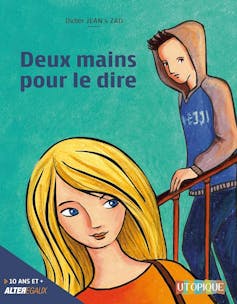
Among the most common portrayals are those of sensory disabilities, especially in books for children and preteens. Characters who are deaf or hard of hearing, blind or visually impaired, mute, or deaf-mute are not uncommon.
In Jean Didier’s novel *Deux Mains pour le dire*, Manuel meets his new neighbor, Lisa, who gestures with her hands instead of speaking. When he learns that she is hard of hearing, Manuel changes his attitude and decides to learn sign language for her.
Like Manu, Casimir, the protagonist of the novel for preteens The Girl Across the Street by Malika Ferdjoukh, also finds himself facing a new neighbor. Curious, Casimir spends his days watching this young girl who doesn’t go to school and moves in strange ways. Why? One day, he goes to visit her and discovers that Stella is blind. As they move beyond their differences, a beautiful relationship blossoms between them.
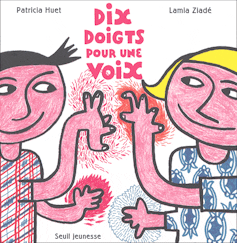
Friendship is also at the heart of two children's books Ten Fingers for One Voice by Patricia Huet and *Noir/Voir* by François David. In the first, Nina, who is deaf and mute, communicates with her fingers, and “with her dancing hands, she can say what she’s thinking.” A beautiful book that tells the story of a friendship between two little girls and overcoming differences, because even though Nina has no voice, they both have ten little fingers.
In the second one, a wonderful black-and-white picture book, three girls are playing hide-and-seek in the dark. One of them is blind and decides to challenge her friends by playing in the dark, where she has an extraordinary ability to sense her surroundings. “I waited a few moments. Then I replied, ‘And you, Jessy, who’s lucky enough not to be blind—are you sure you can see, see well, see everything, really see, when it’s not dark?’”

The Curious Incident of the Dog in the Night-Time by Mark Haddon immerses the reader in the mind of a teenager with Asperger’s syndrome, Christopher Boone. Written in the first person, this mystery novel—in which Christopher and the reader try to figure out who killed the neighbor’s dog—offers a deeper understanding of disability by showing the world through the eyes of a person who is both autistic and gifted. The numerous references to sensory overload, communication difficulties, and the strategies developed by Christopher and those around him lead the reader to a new understanding of disability. Furthermore, the disability itself is never explicitly named in the text, which challenges our perceptions of disability and normality.
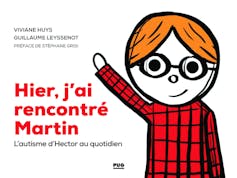
Yesterday I met Martin is a children’s book that offers two levels of interpretation. The right-hand page features a simple illustration and a short text tailored for children, while the left-hand page contains a longer explanation intended for adults that clarifies the manifestations of a disability—in this case, autism. The story follows a typical day for Hector, the main character, from morning to night, illustrating his needs as well as the accommodations made to help him manage sensory stimuli (music, repetition, set schedules, counting down, etc.). The illustrations are in black and white with touches of brown (for Hector’s hair, which makes it easy to spot him in the picture) and red, which highlights the details the protagonist is focusing on.
The young reader thus sees the world in the same way as Hector, because—just like the character—their attention is first drawn to the splashes of red. Furthermore, the first-person singular narrative makes the reading experience even more immersive for the young reader. The left-hand page offers a more adult perspective and explains the behaviors as well as the strategies implemented by parents and the school, which can help answer readers’ questions more easily and deepen their understanding of autism spectrum disorders.
The works we have discussed here show how children's literature addresses the topic of disability. Their number is growing, even though they still represent only a small proportion of the new titles that appear each year on the children's shelves in our bookstores.