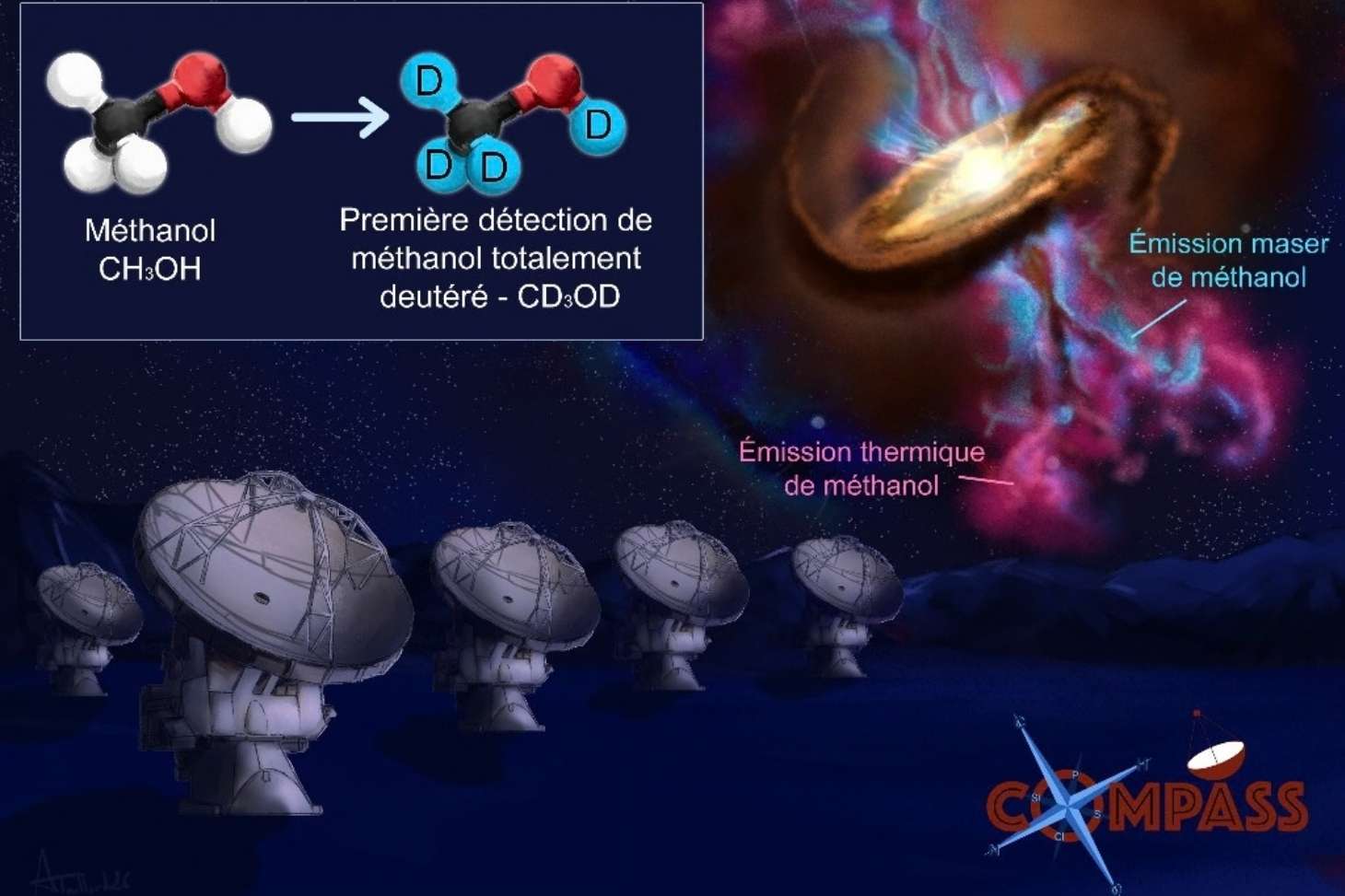
A rare form of methanol has been detected for the first time in space, near a nascent star. Credit: Angèle Taillard.
A major international program to observe very young stars—involving scientists from the Grenoble Institute of Planetology and Astrophysics—has released its first results. Using observations from the ALMA radio telescope array in Chile, the scientific team has detected molecules and their traces in places where they were thought to be rare or even nonexistent. These findings are presented in an initial series of seven papers published in *Astronomy & Astrophysics* on October 7, and will ultimately help us understand the origins of the differences in the chemical composition of these protostars.
What are forming stars made of? This is one of the central questions of the international COMPASS program (short for “Complex organic molecules in protostars with ALMA spectral surveys”), which involves scientists from the Institute for Research in Astrophysics and Planetology (IRAP-OMP, CNES/CNRS/UT) and the Grenoble Institute of Planetary Science and Astrophysics (IPAG - UGA/CNRS). To answer this question, the team conducted observations using the ALMA radio telescope array, located in the Atacama Desert in Chile.
Eleven Stars Forming Under ALMA’s Watchful Eye
To do this, 11 protostars similar to the Sun were targeted. These forming stars consist of immense masses of gas and matter that coalesce over long periods—ranging from hundreds of thousands to several million years—until a star forms at their center. This is one of the strengths of the COMPASS program: the protostars observed span different evolutionary stages of star formation and originate from a variety of environments, ranging from regions rich in protostars to more isolated ones.
Thanks to ALMA’s exceptional resolution, scientists have been able to probe the inner regions of these systems at scales comparable to those of the nascent Solar System. The value of these observations, known as large-scale spectral surveys, is twofold: they allow both an inventory of the molecules present and a more robust determination of their abundances.
An Unexpected Chemical Signature
One of the major findings concerns the deuteration of methanol (CH₃OH)—the process by which one or more hydrogen atoms are replaced by deuterium—which was studied in two of the observed protostars. "The ALMA data allowed us to detect numerous deuterated forms of methanol.", says Audrey Coutens, assistant astronomer at IRAP and co-principal investigator of the COMPASS project. "This highlights the effectiveness of chemical deuteration in these environments. The first detection of fully deuterated methanol (CD₃OD) in one of the protostars is particularly remarkable."
This species is expected to be extremely rare in the universe due to the low cosmic abundance of the deuterium isotope. Its detection suggests that chemical reactions on the surface of interstellar ice grains can efficiently lead to the formation of heavily deuterated organic molecules at very low temperatures and poses a significant challenge to chemical models of the formation of these species.
Radio "beacons" more frequent than expected
Another important result from these spectral observations is the detection of a methanol maser line in more than half of the sources studied. "These maser emissions, which can be thought of as natural radio 'beacons,' are produced by certain molecules when they are excited by shock waves in the gas that forms stars. They are common around massive stars in the process of forming, but until now it was thought that they were rare around solar-type protostars.", explains Sébastien Maret, a CNRS research fellow at IPAG. The new observations suggest, on the contrary, that they may be much more common than expected, especially in the youngest protostars.
These initial results are only a first step. Analysis of the COMPASS dataset will continue in order to expand the study to include all detected species and all eleven sources, with the goal of determining whether variations in chemical composition among protostars are due to environmental factors or to evolutionary processes during star formation.
To analyze data from the COMPASS observation program, Sébastien Maret relied on Gricad, the high-performance computing and data infrastructure of the University of Grenoble-Alpes (UGA), the CNRS, Grenoble INP–UGA, and the UGA Inria Center. Using the IMAGER software, developed by the Bordeaux Observatory, he was able to process the program’s entire dataset in record time.
Published on 30 September 2026
Updated on 7 October 2026
Share the linkCopyCopiedClose modal windowShare the URL of this pageI recommend this page:Available at this address:The page will then be accessible from your "My Favorites" menu.Stop the videoPlay the videoMutePlay soundChat: Have a question?Robo Fabrica ChatbotMatomo Traffic StatisticsX (formerly Twitter)