Learning to Adapt in a Changing World: An Immersive Experience for UGA Students
Education, Educational Innovation, Sustainable Development
June 23, 2026
The area around Mont Aiguille, where the students were able to test the equipment they developed during the Low-Tech Week workshop - Shutterstock
For its second edition, Low-Tech Week—organized by the UGA Design Factory—invited students of all levels and majors to imagine a different way of experiencing the mountains. By designing and then field-testing equipment made from reused materials, they explore simpler, more accessible, and more sustainable solutions. This immersive experience serves as a true learning laboratory where students develop the skills needed to tackle the challenges of environmental and societal transitions: creativity, cooperation, autonomy, adaptability, and collective problem-solving of complex issues. This approach illustrates theUniversité Grenoble Alpes ’s commitment to training citizens and professionals capable of taking action in the face of major contemporary challenges.
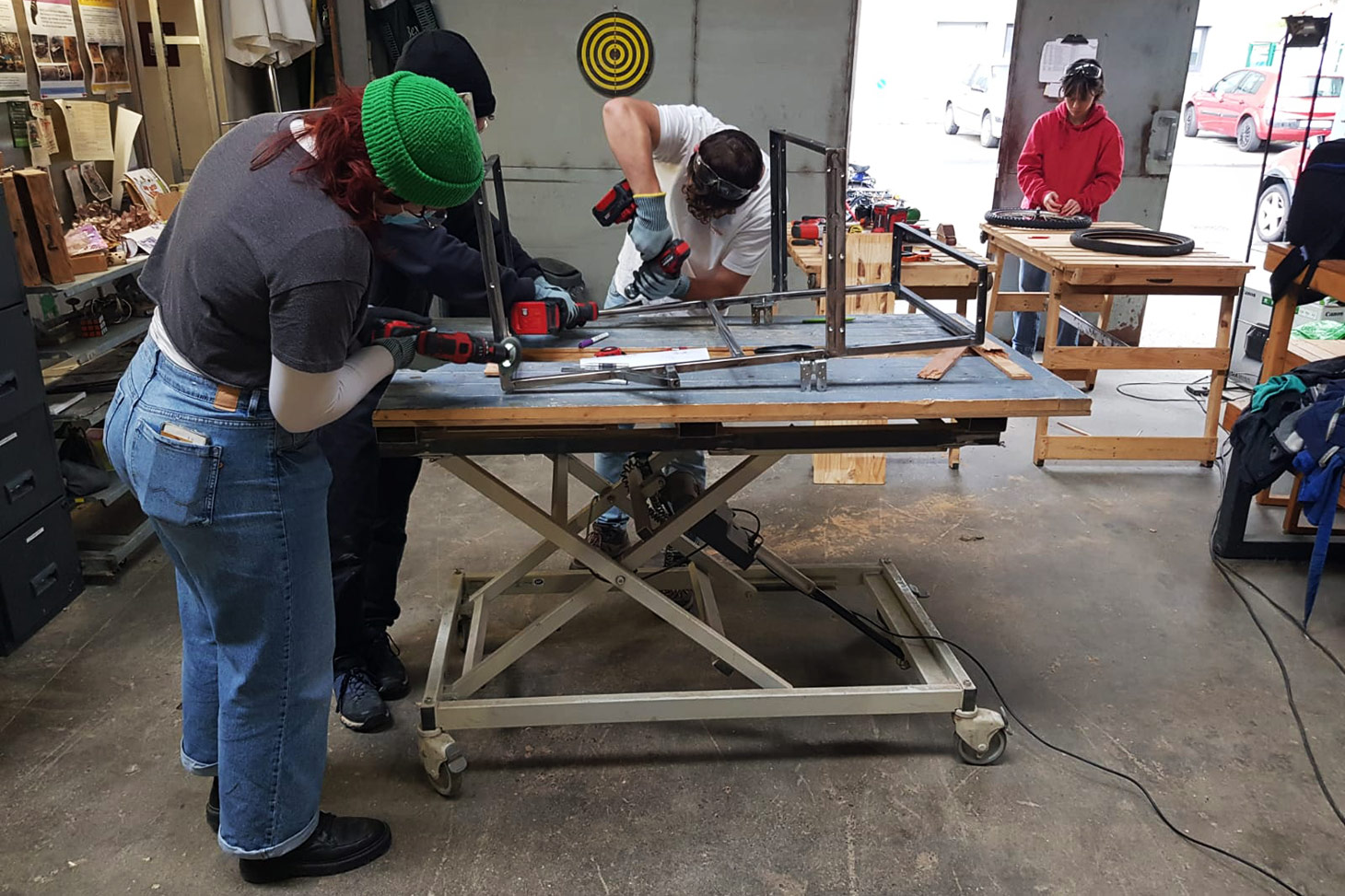
In October 2025, thirteen students—ranging from undergraduates to doctoral candidates—participated in a low-tech prototyping workshop organized by the UGA Design Factory at the university’s MASTIC Fablab. Over the course of a week, they designed and built some of the equipment needed for a mountain camping trip: headlamps powered by recycled batteries, solar chargers, wood-burning stoves made from tin cans, portable Norwegian cooking pots, and bike bags and trailers made from reused materials.
Students hard at work making low-tech camping gear.
Bringing together students from fields such as electronics, energy and the environment, earth sciences, transition design, engineering, the humanities and social sciences, and architecture, the project serves as a true learning-by-doing experience. This pedagogical approach enables students to develop technical, creative, and collaborative skills by addressing real-world challenges.
The initiative also relies on a network of partners, including the organizations G'Récup and Low-Tech Lab Grenoble.
Envisioning a mountain that is simpler and more accessible
The project began with a reflection on the environmental impact of recreational activities in the mountains and on our relationship with adventure.
“After a hike in Ailefroide, I noticed dozens of gas canisters in a dumpster near the guide office. We’re becoming increasingly aware of the damage humans cause to nature and the importance of taking our trash home with us. Since more and more of us are enjoying the mountains, I always ask myself: how can we reduce our environmental footprint? Reuse seems like a relevant tool for empowerment, mutual aid, and a desirable path toward building a better society… This project was born out of this observation and simply aims to raise questions and explore exciting, sustainable avenues with the younger generation; it’s not about lecturing, but about sharing our initiative.” explains Martial Balland, an associate professor at UGA and the project leader.
The goal is not just to manufacture gear differently, but to offer a new narrative for mountain adventures: one that is less focused on performance and the consumption of specialized equipment, and more oriented toward simplicity, accessibility, the sharing of expertise, and the collective experience.
This low-tech approach raises a simple question: What do we need to thrive collectively in a world with limited resources?
A full-scale laboratory in the Trièves region
The second phase of the project took place on June 13 and 14 in the Trièves region. Eight students spent two days at the foot of Mont Aiguille to test the equipment developed during the workshop.
Accompanied by high-mountain guides from the University Physical Education and Sports Service (SUAPS) at UGA, their supervisors, and students from the Audiovisual Professions BTS program at the École Alpes Performance in Grenoble—who will document the experience as part of their training—they traveled to the site using low-impact modes of transportation: buses, walking, and bicycles equipped with trailers built during the workshop. The film produced for this occasion is intended to be screened at future editions of the Rencontres Ciné Montagne in Grenoble and other festivals dedicated to mountaineering.
This immersive experience made it possible to evaluate the solutions developed under real-world conditions while fostering essential skills for ecological transitions: cooperation, self-reliance, the ability to envision sustainable futures, and the capacity to collectively develop responses to environmental challenges.
Published on June 23, 2026
Updated on September 11, 2026
The UGA Design Factory
UGA Design Factory is the research lab of theUniversité Grenoble Alpes. It develops, integrates, and applies creativity- and design-based methods to understand and address socio-environmental transitions.
Share the linkCopyCopiedClose the modal windowShare the URL of this pageI recommend this page:Available at this address:The page will then be accessible from your "My Favorites" menu.Stop the videoPlay the videoMutePlay audioChat: Have a question?Robo Fabrica ChatbotMatomo Traffic StatisticsX (formerly Twitter)