

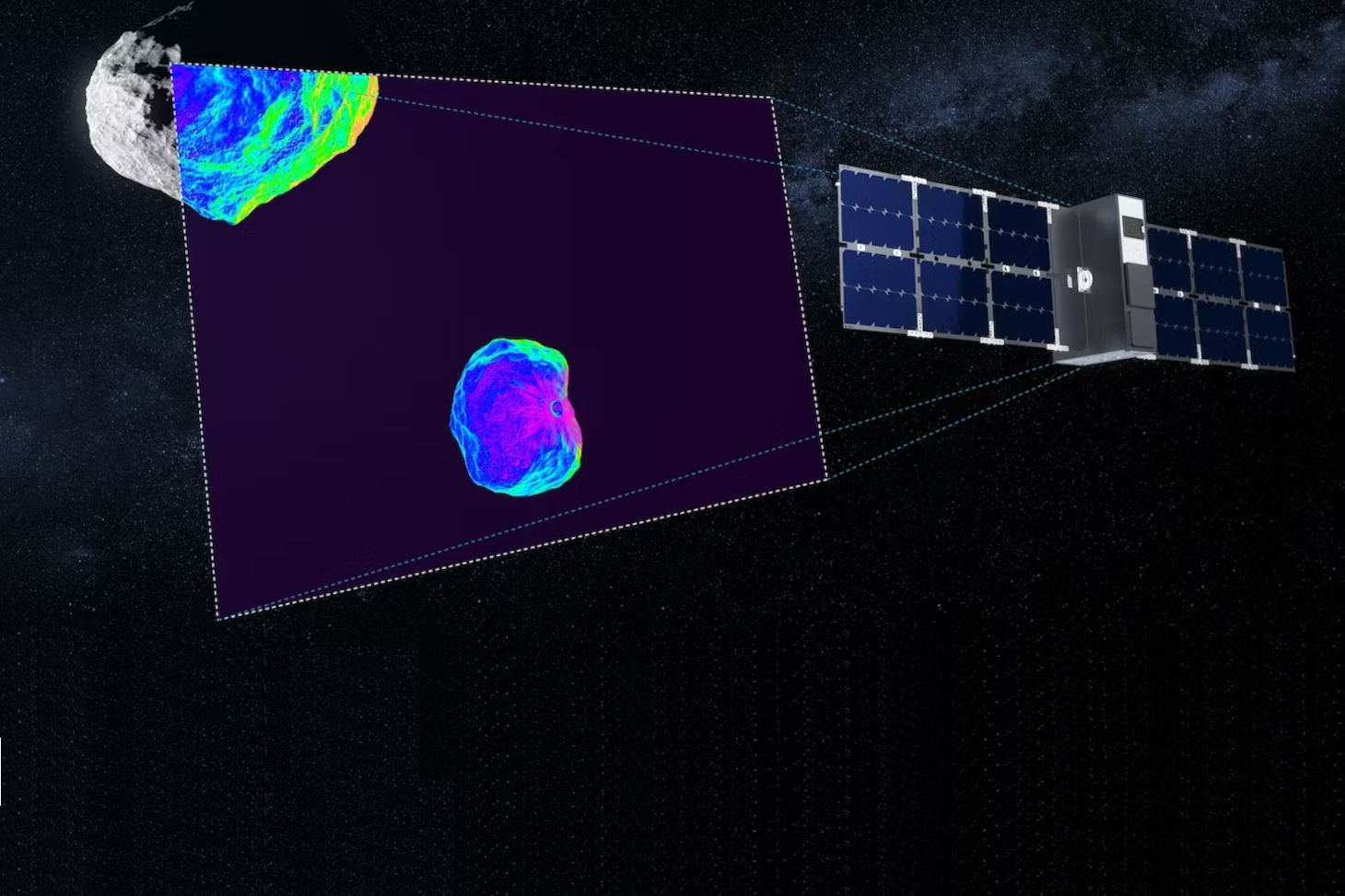
At 1:14 a.m. tonight, the DART probe will strike Dimorphos, a small asteroid, at very high speed. This impact is not an accident, but rather an attempt to deflect an asteroid’s trajectory… in order to determine whether we could use this method to protect ourselves from objects that might collide with Earth—an event that is highly unlikely but could have disastrous consequences.
In fact, previous missions to asteroids have shown us just how wrong our assumptions can be. Our understanding of the impact process is currently based on laboratory impact experiments on targets measuring just a few centimeters in size. Thanks to the DART mission, which launched on November 24, 2021, and the Hera mission, scheduled for launch in October 2024, we will have the means to verify our numerical models with data on a truly relevant scale. This will allow us to use these models with greater reliability in the (highly unlikely) event that an asteroid is heading toward Earth. We are trying to avoid the scenario depicted in the movie “Don’t Look Up”—which aims to expose climate change denial but presents a perfectly plausible scenario regarding the subject at hand.
To date, several techniques have been proposed to deflect an asteroid, but none have been tested. Destroying the asteroid is not a practical option, since it is impossible to know how many fragments would be created, and we would risk ending up with a multitude of fragments that would still eventually fall to Earth. The method to be tested as part of NASA’s DART mission, in cooperation with the European Space Agency’s Hera mission, is called the “kinetic impact” method: it aims to deflect the asteroid from its original trajectory and measure the resulting deviation.
Basically, we’re playing pool. But asteroids aren’t hard spheres like billiard balls, and we don’t know how they react to impacts. To make sure we don’t send the target off on the wrong trajectory after the impact, we’ve chosen to strike the small moon of a binary asteroid, which is barely 160 meters in diameter.
The high-speed impact will disrupt the orbit of the “asteroid moon” Dimorphos around its parent body, Didymos. The moon is much smaller than Didymos, so no matter what happens, we will not alter the asteroid pair’s orbit around the Sun. But we will be able to make a precise measurement of the moon’s change in velocity.
Furthermore, Didymos will pass close enough to Earth at the time of impact (11 million kilometers) for ground-based telescopes to measure the change in Dimorphos’s orbital period around its parent body, both before and after the impact.
For now, this period is 11.92 hours, and we expect a change of at least 73 seconds—which is detectable from Earth. This is a minimum estimate, because in reality, the change depends on how the asteroid-moon will react to the impact, which in turn depends on its physical properties… which we do not know. The only thing we know about Dimorphos at this point is its size.
DART will therefore have to detect Dimorphos with its DRACO camera as it approaches, automatically measure its shape, and navigate itself to collide with the asteroid. The probe will not truly begin to resolve the main body (that is, with more than one pixel) until a few hours before impact, and Dimorphos itself until one hour before impact.
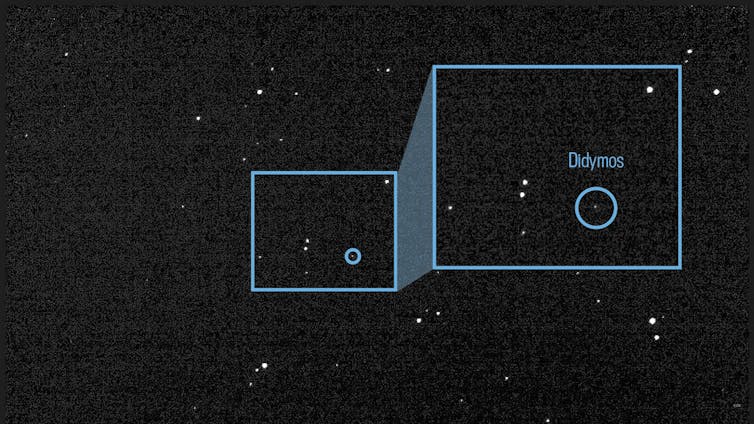
DRACO’s images will be broadcast live on NASA TV up to 3 seconds before impact, giving the public the opportunity to discover this new little world alongside us. This will provide us with information about the geological characteristics of the impact site: Will it be flat, or covered with rocks or gravel? Will there be slopes?
This information is crucial for interpreting the impact results and will serve as the initial conditions for numerical simulations aimed at modeling the impact. The Italian CubeSat LICIACube, deployed by DART a few days ago, will transmit images from the first few minutes after impact, providing us with information about the initial material from the asteroid that may have been ejected as a result of the impact. Next, ground-based observatories, along with the James Webb Space Telescope and Hubble from space, will observe the binary system to measure the difference in orbital period.
This will allow us to confirm that DART successfully struck the asteroid and to quantify part of the result. However, we will lack measurements of the properties of the crater produced by the impact (its size and depth) and the amount of deflection produced—which depends on the mass of Dimorphos, something DART will not be able to measure—and which would allow us to fully validate the technique. That is the role of the Hera mission.
Interview in the CNRS Journal.
What’s truly fascinating is that, based on our current “pre-impact” knowledge—that is, what our numerical models predict based on the assumed physical properties of Dimorphos, since those properties are unknown—a whole lot of things could happen.
For example, if Dimorphos is a hard rock, the impact could create a crater about 10 meters in diameter. If it is very porous, DART could sink into it like a sponge, and the deflection would be minimal. And if it is not very resistant, there might not even be a crater, and the impact could completely deform the asteroid, resulting in a greater deflection.
Hera plays a crucial role in this deflection test by documenting it. In fact, three things are needed to verify the validity of asteroid impact models: first, the initial conditions and information about the first moments after impact, provided by DART, LICIACube, and observations from Earth; second, the detailed final results regarding the crater size or deformation of the object and the amount of deflection; and finally, the physical properties of the asteroid that influence the outcome of the impact.
Hera will measure the mass of Dimorphos, thereby directly quantifying the amount of deflection. If a crater has been formed, it will measure all of its characteristics. If Dimorphos has been deformed, it will compare this deformation with the images provided by DART prior to impact. Most importantly, it will deploy two CubeSats, Milani and Juventas, whose mission will be to study the asteroid’s composition and, for the first time, characterize its internal structure.
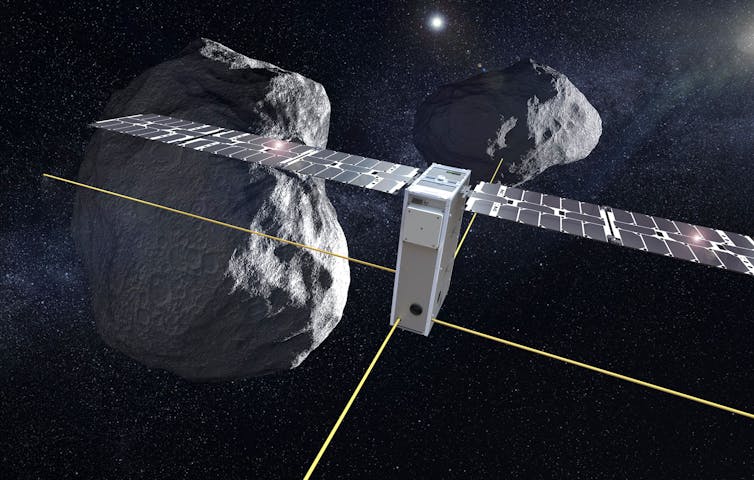
Such a measurement has never been taken directly, and everything we know about the asteroid’s interior comes from interpretation or theoretical modeling. Is Dimorphos a monolithic rock or an aggregate? How heterogeneous is its interior? This information is crucial because it determines how the asteroid reacts to an impact. With Hera, we will thus gain detailed knowledge of the geological properties of the smallest asteroid ever visited—information that cannot be obtained any other way. This has numerous scientific implications, including insights into the formation of binary asteroids, which account for 16% of the overall asteroid population. Finally, collisions have played a major role in the history of the solar system: understanding this process makes an essential contribution to our understanding of that history.
Of all the asteroids we know of, none pose a threat to us for at least the next century: the catalog of near-Earth asteroids larger than one kilometer in diameter (which is the size threshold for a global-scale catastrophe) is nearly complete; and we are now working to catalog all those larger than 140 meters (the threshold for a catastrophe affecting a region or a small country). We currently know of only 40% of them, and NASA is seeking to finalize funding for a space telescope called NEO Surveyor, which could complete the catalog in ten years from space.
Fortunately for us, the impact frequency of asteroids of this size is about once every 10,000 years, so the probability of one hitting us in the short term remains very low. Admittedly, the smaller the objects, the more numerous they are, so the impact frequency increases; but they also cause much more localized damage, with a greater likelihood of occurring over deserts and oceans.
The risk of an asteroid impact is therefore a risk with a very low probability but also high consequences… and one that we know will occur again over the long term.
The idea is to be able to anticipate the arrival of an asteroid and provide future generations with a robust plan so that they won’t have to improvise when the time comes. To develop a robust planetary defense plan, we must take into account numerous parameters that DART and Hera will help clarify.Europe is playing a pioneering role in these efforts, and discussions are also underway withinthe UN to develop a coordinated international response. There is still a long way to go, but we are covering all aspects—technical, scientific, political, legal, and communication-related.
The Dinosaurs would certainly have enjoyed it What an approach!