

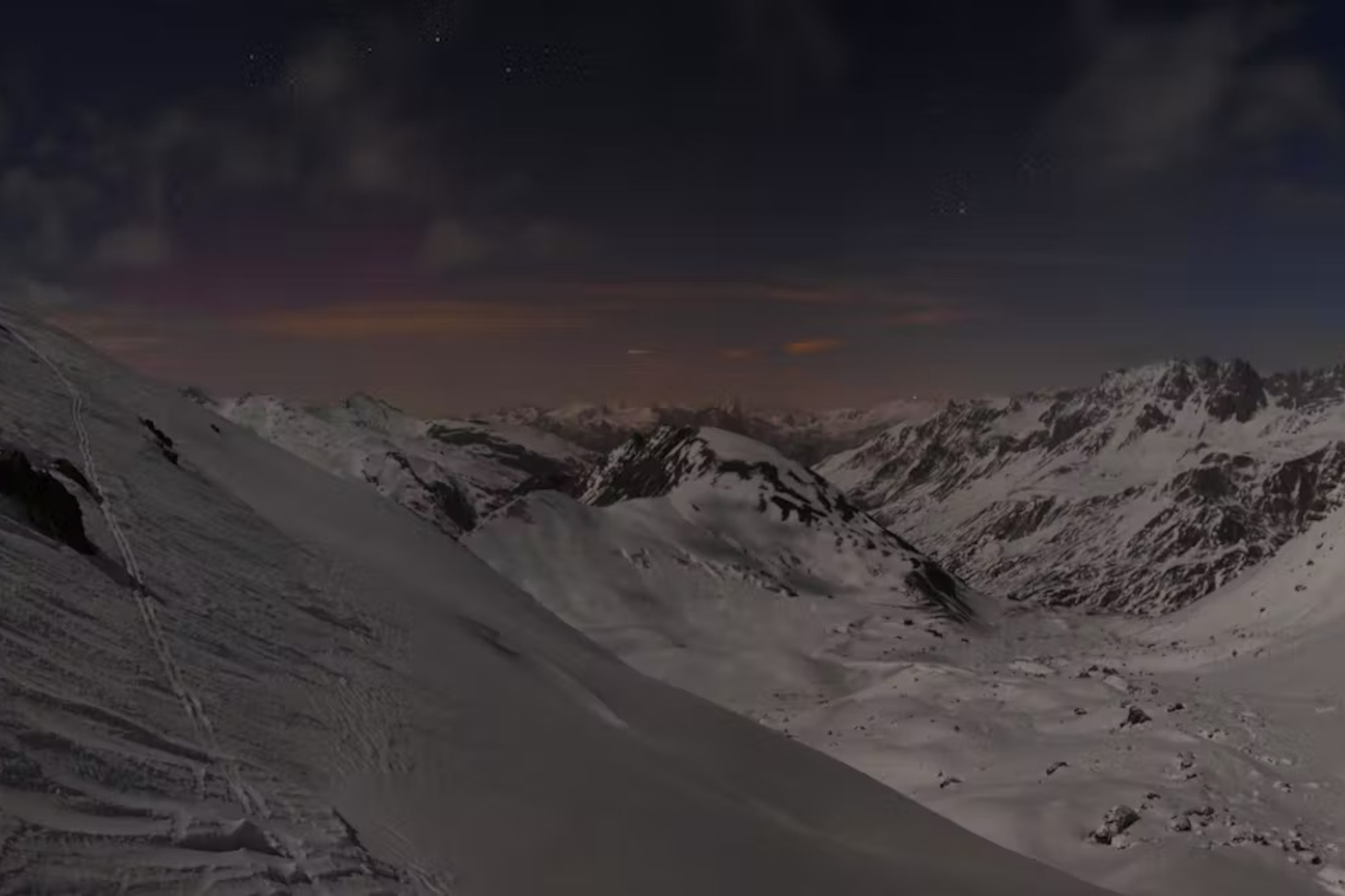
It was around 10:00 p.m. on Monday, February 27, when the 360° camera at the Col du Galibier captured a pinkish-red glow above the summit of the Grande Chible (2,931 m) between Valloire and Albiez-Montrond in Savoie. It was indeed the Northern Lights, a very rare occurrence in this region. At the same time, other people watching the webcam at the Collet d’Allevard (Isère) saw the same glow, confirming the phenomenon. In Brittany, people also photographed some beautiful red glows. One of them, taken near Mont Saint-Michel, was widely shared.
�������������� ���������������� ���� �������� ����������-������������ - February 27, 9:59 p.m.,
— Mathieu Rivrin - Photography (@mathieurivrin) February 28, 2023
Hard to believe—a fleeting display of the Northern Lights swept across the Normandy sky above Mont Saint-Michel last night, creating a magical and unforgettable moment.#auroreboreale #montsaintmichel pic.twitter.com/sjVXGrJMlb
What happened? What causes the Northern Lights? And why is it rare to see them at these latitudes?
In addition to sending us light, the Sun continuously emits electrically charged particles (primarily protons and electrons). This stream of particles, known as the “solar wind,” varies greatly over time. During solar flares, when the Sun suddenly emits a massive stream of particles, the solar wind becomes more intense.
As a result, there are more particles, and they are moving faster. On February 25, a powerful solar flare ejected a large stream of particles from the Sun toward Earth.
These particles travel at speeds ranging from 300 to 500 km/s, and sometimes as high as 1,000 km/s or more during major eruptions. It takes them between 2 and 3 days to reach our planet. As they approach, they “encounter” Earth’s magnetic field and follow a complex path that leads them along an oval centered around Earth’s magnetic poles, which are slightly offset from the geographic poles. The size of this oval varies depending on solar activity. There is one in the north and another in the south. The boreal oval, which is the most frequently observed, usually passes over northern Scandinavia, Iceland, central Greenland, and northern Canada. Over Russia, it is shifted due to the tilt of the magnetic field and instead passes over the Arctic Ocean.
On February 26 and 27, the particle stream reached Earth, and we began to observe its effects. The oval expanded, and the auroras intensified. The southern boundary of the northern oval extended as far south as the latitudes of England and the Canada-U.S. border.
How was it possible to see the aurora in Brittany and at the Col du Galibier? Auroras occur at very high altitudes—between 100 km for the green aurora and 220 km for the red one. A simple geometric calculation shows that the aurora seen at the Col du Galibier was actually above Sheffield, England, about 1,000 km from our mountains. The auroras seen from Brittany—captured by a photographer above Mont Saint-Michel—were undoubtedly part of the same auroral structure.
In both cases, the projection effect caused by the Earth’s sphericity explains why we see only the red light, which is emitted at a higher altitude. In other words, when viewed from France, the green light is at too low an altitude and lies below the horizon.
This extension depends on geomagnetic activity and, therefore, on the quantity and energy of the particles arriving in the vicinity of Earth. Research in these areas is advancing significantly. Statistical models are now capable of calculating the position of the oval with fairly good accuracy. One example is the American OVATION model developed by the NOAA (National Oceanic and Atmospheric Administration, United States).
However, the relationship is complex, and these models remain imprecise, providing only the general outline of the oval. It is very difficult to know exactly where and when the auroras will occur. While we can tell from images of the Sun whether a coronal mass ejection has occurred, it is still difficult to know exactly how and when the Earth will be affected.
Artificial intelligence is extremely helpful for this type of question, and numerous studies have significantly improved these forecasts using data from satellites located upstream of Earth on the Earth-Sun segment at the L1 Lagrange point, which record solar wind parameters (velocity, density, magnetic field, etc.).
This point is a gravitational equilibrium point between the Earth and the Sun, a point at which the gravitational forces of the Sun and the Earth, as well as the centrifugal force, balance each other out. A satellite in this position remains constantly on the Earth-Sun line, approximately 1.5 million kilometers from Earth, and can detect particle fluxes that will reach Earth 30 to 40 minutes later. The two main satellites in this location are ACE (Advanced Composition Explorer) and DSCOVR (Deep Space Climate Observatory).
This event is rare, but not necessarily exceptional. It typically occurs once every 10 years. In fact, it is more accurate to say that the probability of it occurring is 1/10 per year. There may be even more intense events. For example, on the night of March 12–13, 1989, auroras were reported over the Touraine region in France. These eyewitness accounts describe green colors forming an oval shape above these regions at 47° latitude.
In the United States, the auroras were visible in Florida, and the auroral oval extended as far south as 42° latitude—the latitude of Washington, D.C. This shift makes sense, since the auroral oval is offset toward the Americas due to the difference between the magnetic pole and the geographic pole. Auroras were also visible in the Southern Hemisphere at similar latitudes, such as in Australia and New Zealand. This event was not without consequences: at around 2:44 a.m. local time in Quebec, the power grid went down due to strong induced currents that overloaded central transformers—currents that were themselves caused by this extremely high level of geomagnetic activity. It took about 10 hours to restore power, at a cost of several million Canadian dollars. Even more intense was an event in 1859, when a series of solar flares created auroras visible as far away as Cuba and India. There was no power grid at the time, but telegraph stations in the United States operated “on their own,” and some caught fire.
This shows how important it is to study them, because these particles—in addition to producing magnificent auroras—can disrupt our technology, power grids, satellites, GNSS, communications, and more. This field of study is called space weather.
So will we see more of these soon in our part of the world? It’s not impossible, since the Sun—which has an 11-year activity cycle—is entering an active phase and could produce other major eruptions in the coming months. The next solar maximum is predicted for 2025, but the Sun seems to be getting a head start on that cycle. We don’t know yet whether this cycle will be particularly active, but just in case: grab your cameras!