

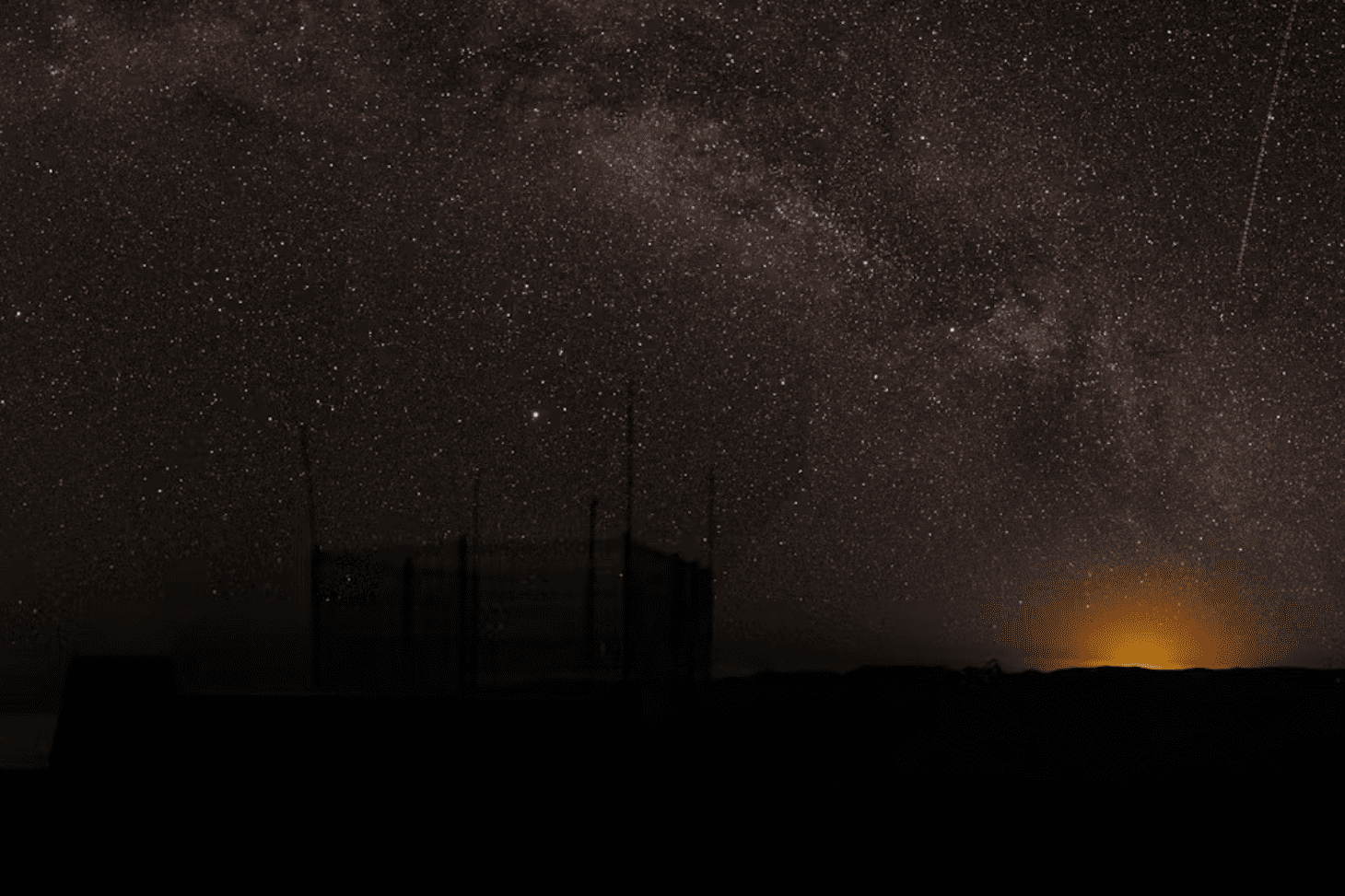
In the Atacama Desert in northern Chile, an industrial project to produce hydrogen using renewable energy threatens to compromise the quality of the sky for the world’s largest astronomical observatories, the Very Large Telescope (VLT) andthe Extremely Large Telescope (ELT, currently under construction).
It creates tension within the scientific community, which is often at the forefront of calls for our society to decarbonize— particularly in the field of astronomy. The question arises of how to balance the development of renewable energy with the preservation of the cultural heritage represented by the starry sky.

Let’s set the scene. We’re on Mount Paranal, at an elevation of 2,600 meters, in the world’s driest hot desert. The Pacific Ocean lies about ten kilometers to the west, and the nearest major city, Antofagasta, is 120 kilometers to the north. As professional astronomers, we’ve had the good fortune to explore this site during observation nights—and even to work here for several years. With no moon in the sky and after a few minutes of adapting to the darkness, the Milky Way, the galactic center, and thousands of stars become visible above our heads, while the nighttime landscape of the Atacama Desert seems illuminated solely by the starry sky.
The sense of wonder that every visitor to the VLT experiences translates into measurement quality unmatched anywhere in the world. The site was chosen in the 1980s by astronomers fromthe European Southern Observatory (ESO) following an extensive testing campaign. Mount Paranal and its neighbor, Mount Armazones— where the ELT is currently under construction—combine several unmatched advantages, the first two being low atmospheric turbulence, which improves angular resolution (the ability to distinguish between two very close points in the sky); and low humidity, which is ideal for infrared observations.
In 2004, the first image of an exoplanet was captured at the VLT, the 2011 Nobel Prize in Physics for the accelerating expansion of the universe was awarded for observations made in part at the VLT, and the 2020 Nobel Prize in Physics was awarded for research conducted with the VLT telescopes on the supermassive black hole at the center of our Milky Way.
It is no coincidence that the major astronomical observatories were built on the western coasts of the continents (Pic du Midi in France, the West Coast of the United States, Chile) or on the summits of volcanic islands formed by hotspots (Hawaii, the Canary Islands) located west of these continents.
In fact, at a certain altitude (9–15 kilometers), air movement corresponds to the atmospheric circulation system generated by the Earth’s rotation, which flows from west to east. Because of this rotation, the air reaching the western facades has been minimally disturbed by convection over land heated by the Sun, and thus the flow is laminar—that is, with less turbulence.
[More than 120,000 readers rely on The Conversation’s newsletters to better understand the world’s major issues. Subscribe today]
In addition, observatories located at altitudes of more than 2,000 meters—as is the case in Chile—are situated above the “temperature inversion” layer, which keeps clouds at lower altitudes in place. Thanks to their high-altitude location, they enjoy an unmatched number of clear, calm nights.
In the case of the Atacama, this exceptional situation is further reinforced by the Andes mountain range to the east—a barrier over 6,000 meters high that blocks weather systems that might enter from the east (Argentina) or the northeast (Bolivia)—hence the region’s aridity.
But these advantages would be rendered meaningless without the darkness of the sky, which is due to the absence of human settlements within a radius of several tens of kilometers.

The observatory enforces strict rules regarding light emissions in the vicinity of the site: the few vehicles that travel at night are allowed to use only their parking lights or hazard lights, and the curtains must be drawn in the residence’s bedrooms and dormitories before the lights are turned on.
Today, ESO's observatories at Paranal and Armazones are among the darkest places on Earth, with light pollution far lower than at other observatories.

And yet, even in this unspoiled landscape, we astronomers can see on the horizon the light pollution from the city of Antofagasta, and even that from the world’s largest open-pit copper mine, La Escondida, about 100 kilometers to the northeast. Although telescopes generally do not point below an altitude of 30º due to high atmospheric absorption and greater turbulence, certain phenomena such as zodiacal light—a faint glow above the horizon in the plane of the ecliptic—are already affected by this halo, limiting the scope of possible research.
In December 2024, the company AES Andes initiated environmental audit procedures in preparation for the construction of a megaproject, named INNA, which would cover an area of approximately 3,000 hectares and be located between 5 and 12 kilometers from Mount Paranal. The project involves producing hydrogen and ammonia through the electrolysis of seawater (which is first desalinated). This energy-intensive process would be powered by electricity generated by wind turbines and solar panels, supplemented by energy storage batteries, and would consume 1.7 gigawatts, according to AES Andes. In total,the investment amounts to approximately $10 billion and includes an industrial port for exporting the produced goods.
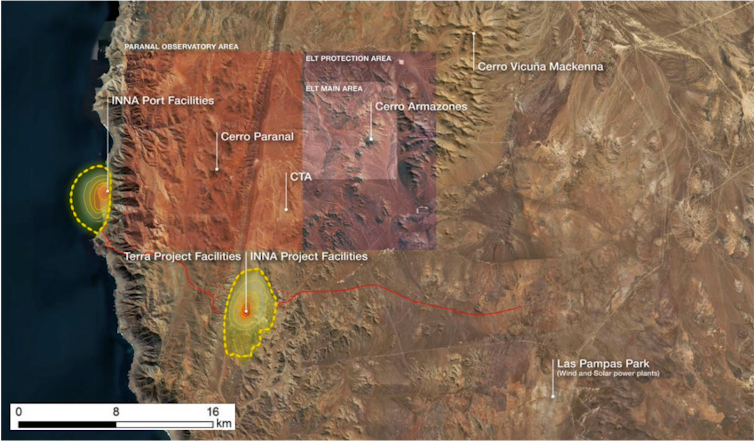
A new industrial site—admittedly less sprawling than the city of Antofagasta or the La Escondida mine, but ten times closer— would inevitably have a major impact on sky quality at the VLT and ELT sites. On Earth, the majority of light pollution is often caused by the private sector (primarily businesses but sometimes individuals), with street lighting accounting for only a small fraction, even in cities. A study conducted in Tucson, Arizona, showed, for example, that streetlights account for less than one-fifth of the sky’s brightness—with floodlights installed at industrial sites, businesses, and private gardens accounting for the rest.
If light pollution were to increase to two or three times its current level, not only would the Paranal and Armazones observatories lose their status as having the clearest skies in the world, but certain objects in the night sky would simply no longer be visible enough from the Earth’s surface to be studied—such as very distant galaxies, which are currently visible only by combining about 100 hours of observation.
Dust and aerosols released into the atmosphere by industrial activity (during the construction phase or as a result of the stirring action of wind turbines) are thought to amplify light pollution, as these particles scatter the artificial light emitted from the ground.
But this also threatens the future Cherenkov Telescope Array (CTA), which has chosen the valley between the Paranal and Armazones mountains to detect gamma rays from the most energetic astrophysical phenomena (supernova explosions, black holes, etc.). This type of optical telescope uses the Earth’s atmosphere as a detector, so the presence of aerosols or any source of light pollution is particularly detrimental to these observations.
The question is valid, but it is unclear whether it is relevant here. AES Andes points out that the construction phase will employ approximately 5,000 people, but only between 500 and 600 workers are expected to be on site during normal operations. The company states that it aims to employ at least 20 percent “local” workers from the small towns of Paposo and Taltal, as well as from the larger city of Antofagasta.
Nevertheless, one might question the actual impact on the region’s economy. The example of the countless mines in the Atacama Desert shows that companies generally prefer to hire skilled workers who live in the central part of the country and fly in to work for periods of a few weeks —rather than having to train local staff.
Above all, one might wonder whether the vast Atacama Desert might not offer other sites besides this one, which is literally right next to the astronomical observatories. It raises questions that an industry that claims to be “green” would begin by showing indifference to the degradation of a precious environmental resource—the darkness of the night sky.