

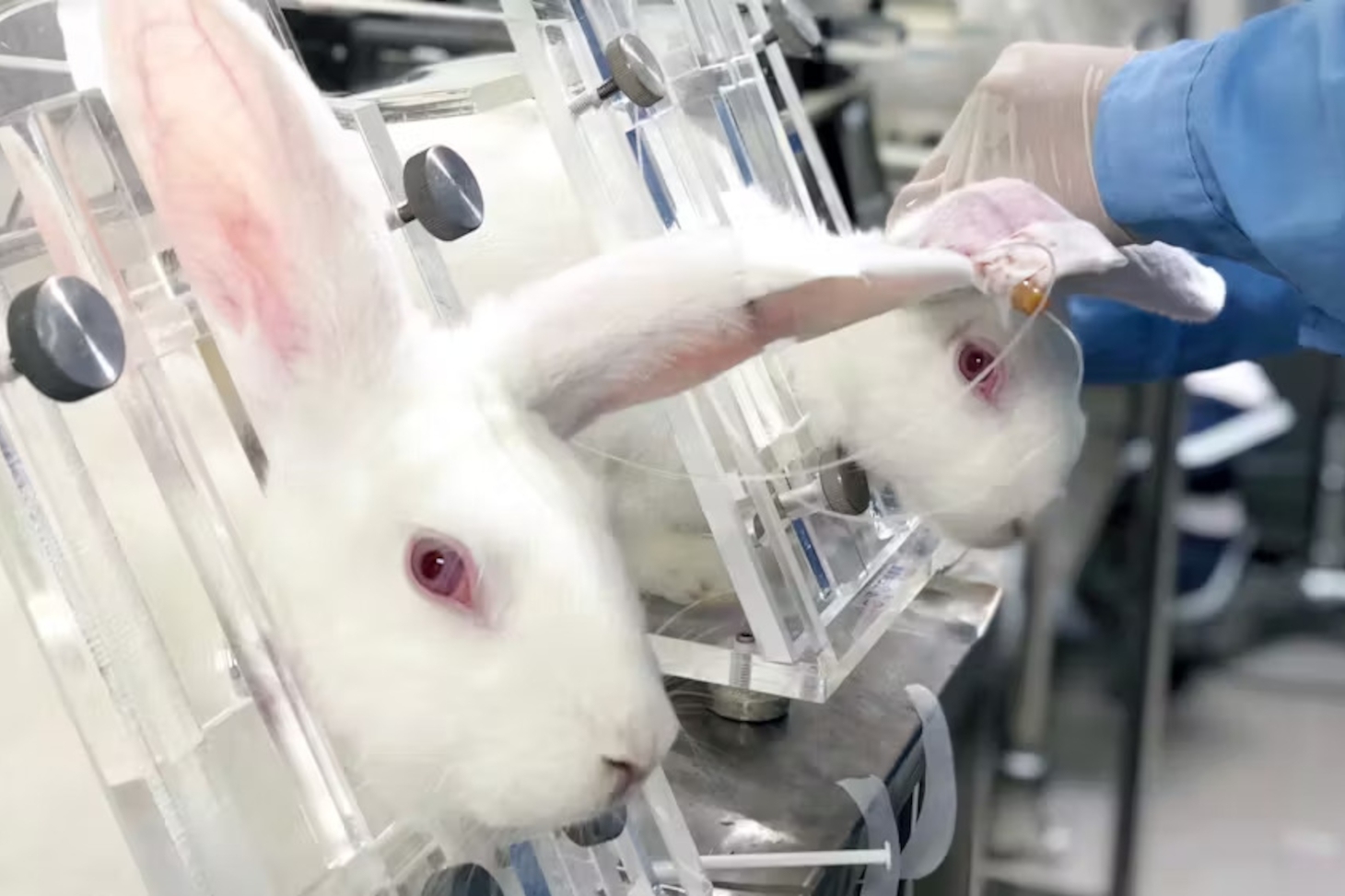
It is estimated that more than 190 million animals are used in laboratories worldwide each year (including more than 2 million animals in France). By using non-human animals, animal testing allows us to conduct experiments that we do not want to perform directly on humans, whose well-being is of greater concern to us.
The severity of the tests conducted varies widely, ranging from simple blood draws or feeding trials to more extreme scenarios, such as simulated drowning to test antidepressants or the induction of painful tumors to study their progression.
Despite incentives to use alternative methods, this practice is still viewed as necessary—not only by the scientists who perform it, but also, under certain circumstances, by the general public, who may perceive the suffering it causes as justified if benefits to human health are anticipated.
However, numerous polls indicate that the public is increasingly opposed to the exploitation of animals. For example, in France, animal experimentation is a source of concern, and the public overwhelmingly rejects it. There is therefore a strong ambivalence between the perceived necessity of this practice for human health and our sensitivity to the suffering of animals, particularly those that most resemble us. But then, how do we resolve this apparent paradox, and how do we react when confronted with what laboratory animals endure?
If animal experimentation troubles us, it is because the animals used in laboratories (mostly small mammals) possess mental capacities and are therefore capable of experiencing suffering. For example, when people are asked to imagine the emotional life of a lobster, they are more opposed to it being mistreated. Conversely, there are several ways to suppress our empathy toward laboratory animals and thus legitimize animal experimentation. One such method, which is very common, is to downplay their mental capacities.
It is in this context that a new study published in the *Journal of Experimental Social Psychology* examined whether simply presenting an animal as a laboratory animal would lead to the denigration of its cognitive abilities. Photos of animals (rabbits, hamsters, dogs, macaques) were shown to 3,405 participants, accompanied by descriptions that either presented the animal with descriptive characteristics—such as the color of its fur or its size (control group)—or presented the animal as a laboratory animal (experimental group). Participants were asked to rate the extent to which the animals depicted possessed 15 mental capacities (e.g., hunger, joy, fear, pride, suffering, or planning).
This protocol showed that participants consistently attributed fewer mental and cognitive abilities to animals described in a laboratory setting compared to animals presented solely through their physical characteristics. It is particularly interesting to note that this effect of downplaying cognitive abilities was consistently replicated across the various studies conducted, despite experimental variations. The results are similar when participants view photos of different animals (a hamster, a mouse, or even a beagle) or in different scenarios (a laboratory animal in distress versus a laboratory animal not in distress).
It had already been documented that the use of euphemisms is common in laboratories, where animals are no longer “killed” but “sacrificed,” and that it is also common not to refer to them by name in order to more easily objectify them. This new research now demonstrates that we are also inclined to deny animals’ cognitive abilities once they are labeled as “test subjects.” The use of euphemisms, the failure to name animals, and the downplaying of their cognitive abilities ultimately serve the same purpose: to erase any traces of the animals’ individuality in order to reduce them to the status of test subjects, thereby facilitating and justifying their “sacrifice.”
This study supports the idea that categorizing laboratory animals as nothing more than “hairy test tubes” devoid of cognitive abilities facilitates psychological detachment. This helps justify their use in scientific experiments, thereby cutting short any internal moral conflict. Thus, if animal experimentation disturbs us, objectifying test animals and denying them mental capacities is psychologically more comfortable.
This research adds to other studies showing that simply presenting an animal as destined for the meat counter will automatically lead to the denigration of its cognitive abilities in order to justify meat consumption.
Many factors influence people’s attitudes toward animal experimentation and the perceived legitimacy of this practice, such as gender differences and enthusiasm for science. However, this study is the first to demonstrate that simply categorizing an animal as a laboratory subject will inevitably lead to the denigration of its mental abilities.
The benefits of animal experimentation are hotly debated. For example, out of 20 comprehensive systematic reviews of the biomedical literature, only two concluded that animal experimentation is useful. One of the limitations is the low reproducibility of the research. This lack of consistency in scientific results is extremely costly to society.
In conjunction with the ethical principles aimed at limiting the use of laboratory animals, or even political initiatives aimed at accelerate the transition toward research without animals, or even toward ban, we must continue to question animal experimentation. Indeed, their mere presence in laboratories may be enough to make us believe that their sacrifice is no sacrifice at all: who cares about mere furry test subjects?