


Let’s say I show you two objects, one round and the other pointy. Which one, in your opinion, is called “bouba” and which one “kiki”? Your answer is usually immediate: the round one is “bouba,” and the pointy one is “kiki,” of course. Since its discovery a century ago, this “bouba-kiki effect” might seem trivial. On the contrary, this phenomenon actually reveals several intriguing paradoxes regarding what we know about language and our perception of the world.
The first paradox is that it suggests that, for certain words, there is a connection between the sounds they contain and their meaning. Yet for most words in the world’s languages, there is no such connection.
The second paradox is that, although this effect is inherent in language, it is universal: it can be found across a wide range of different languages and cultures.
Finally, my research on infants suggests a third paradox: although universal, the bouba-kiki effect does not appear to be present at birth. It is not genetically encoded (which might explain its universality), but rather learned.
So how can we learn that “bouba” is round and “kiki” is pointy? Regardless of the languages and cultures we have at our disposal?
We recently resolved all three of these paradoxes at once by demonstrating that the “bouba-kiki” effect does not stem from language, but from the physics of objects. First, we showed that, upon closer examination, the word “bouba”—perceived as round—is in fact composed of lower-pitched and more continuous sounds than “kiki,” which is perceived as sharp. Next, we showed that, indeed, when they roll across the floor, round objects produce lower-pitched and more continuous sounds than pointed objects. It is therefore by integrating these physical properties of objects into language that, for humans, “bouba” has come to be universally associated with roundness across languages and cultures.
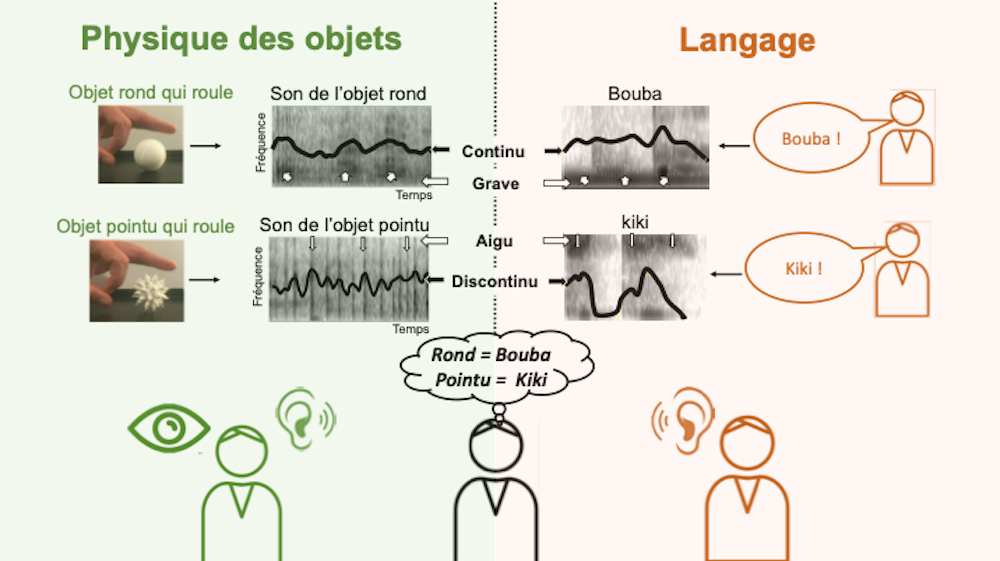
To analyze speech stimuli, we first turned to phonetics, a branch of linguistics. Using a model that replicates what the human ear hears and what our brain perceives, we were able to show that speech sounds such as “bouba” or “malouma” contain sounds that are more continuous and lower in pitch than “kiki” or “takété,” which are more discontinuous and higher in pitch.
[Nearly 80,000 readers rely on The Conversation’s newsletter to better understand the world’s major issues. Subscribe today]
When we talk about continuity, we’re referring to whether or not the sound stops. That’s something we can hear pretty clearly: “bouba” and “malouma” are softer to the ear (and therefore continuous) than “kiki” and “takété,” which are sharp and abrupt.
Let’s move on to the low or high pitch of the sounds “bouba” or “kiki”: this is harder to hear. What we generally hear clearly is the main low or high pitch of the sound: in speech, this comes primarily from the vibration of the vocal cords—our voices are more or less low or high, and we each have our own “fundamental frequency.”
What the ear also hears are the pitch variations in our voice depending on the speech sounds we produce. Our vocal cords vibrate, and the sound is then modulated based on the shape of our mouth and the position of our tongue when we speak. This is called the “spectral frequency” of the sound. And it is this specific low-to-high-pitched variation that distinguishes “bouba” from “kiki,” even when spoken by the same voice.
The model we used first simulates how speech sounds are processed by the human ear. Next, for each speech sound—such as “kiki”—our model extracts two features that simulate certain processing steps carried out by our brain. In our model, the first feature—the low-to-high frequency balance—corresponds to the balance between the low and high (spectral) frequencies of each sound.
The second index “calculated” by our brain is the continuity index, which mathematically corresponds to the difference in intensity between the loudest and softest sounds in each stimulus. Finally, this model combines these two indices to predict the extent to which each speech sound should be perceived as more rounded or more sharp. We then compared these “roundness scores” generated by the model with those provided by nearly 400 adults (speaking different languages) for more than 1,000 speech sounds. The model produced scores very close to human judgments, confirming that these two indices (low-high pitch and continuity) are indeed responsible for the bouba-kiki effect.
We then turned our attention to the fields of physics and mathematics to analyze the characteristics of the sounds produced by everyday objects. We found that the sounds produced by round objects as they roll across the floor—such as the speech sounds for “bouba” or “malouma”—consistently have a more continuous sound and a lower spectral frequency than the sounds produced by pointed objects of the same size. As for continuity, it’s pretty easy to hear: a round, smooth ball rolling will tend to produce a continuous “whooooouuuuuu” sound, whereas a ball with spikes is more likely to produce a discontinuous “tak tak tak tak” sound.
When it comes to low and high frequencies, it’s not as easy to hear, but a relationship between an object’s shape and the spectral frequency of the sound it produces has been mathematically demonstrated. More specifically, it has been shown that, for objects of equivalent size, it is the perimeter of a shape (the path around the shape) that determines the spectral frequency of the sound produced by that object: the shorter the path, the lower the sound that can be produced by that shape, and vice versa. However, between a round shape and a pointed shape of the same size, the perimeter of the pointed shape is always greater.
It is because humans have incorporated these physical properties of objects into language that “bouba” has come to be universally round. This discovery is important because it shows that human language is not “insulated” from its environment. On the contrary, it seems that our language is influenced by its environment, particularly by the characteristics of the objects in our daily lives.
Furthermore, these findings also have important implications for language acquisition in children. Indeed, they show that language is not learned independently of other forms of learning, but rather through constant interaction with other areas of development. In other words, these findings suggest that the sensitivity to certain physical properties of objects, which develops during the early years of a child's life, appears to interact with the learning of their native language.