

Implantable brain-machine interfaces hold the promise of major advances, both in understanding how the brain works and in compensating for or replacing functions lost as a result of an accident or a neurodegenerative disease: primary vision, motor function, speech synthesis, or digital writing.
While these interfaces are still far from being truly operational in clinical settings, they nevertheless already represent, for some, the hope of enhancing human capabilities, with applications that are both sensory (night vision, for example) and functional (enhanced memory or intellectual abilities, for example). Although many of these applications are still the stuff of science fiction—such as the transmission of sensations or the enhancement of our intellectual performance—others do not seem out of reach, such as infrared or ultraviolet vision, for example.
[Nearly 80,000 readers rely on The Conversation’s newsletter to better understand the world’s major issues. Subscribe today]
Although ethical questions surround the development of brain-machine interfaces at Neuralink, Elon Musk’s highly publicized company, the purpose of this article is to explain how they work technically, the technological challenges involved, and the contrast between the hopes they inspire and what they are currently capable of achieving.
In fact, current devices face numerous technological and conceptual barriers. Technical constraints currently limit their use to specific clinical cases, where the risks associated with implant insertion are offset by the anticipated immediate or future benefit to patients. We are therefore still a long way from being able to use these implants in routine clinical practice and in everyday life—let alone for recreational applications or to enhance human capabilities.
In terms of medical applications and understanding the brain, the interfaces currently being developed in academic and industrial laboratories already offer promising prospects. However, few academic tools currently offer a fully implanted solution with as many electrodes and as much data as Neuralink’s interface.
The goal is to develop an implantable brain-computer interface that can be set up in a single morning—both for medical use by people with paralysis and to enable anyone to control their smartphone or a video game, or, eventually, to enhance human capabilities. To achieve this, the project is pursuing a brain implant technology capable of recording activity from a large number of neurons, one that would have no aesthetic impact and pose no danger—such technology does not currently exist.
If the Neuralink implant proves to be reliable and receivesapproval from health agencies for use in humans, it could pave the way for more accurate decoding of neural activity, the development of clinical neuroprostheses, and a better understanding of brain functions that have been inaccessible until now.
In the literature and news reports, the terms “brain-machine interface,” “neuroprosthesis,” and “neural implant” are often used interchangeably. A “neuroprosthesis” is a type of brain-machine interface designed to supplement or replace a lost function. Just as the nervous system sends and receives information from its environment, neuroprostheses capture information from our environment through artificial systems and relay it back to the nervous system, or capture information from the nervous system and relay it—either back to the nervous system itself or to our environment—using artificial devices.
A neuroprosthesis, or brain-machine interface, consists of several components. As the signal travels from the neural system to a human-readable interface (such as a computer screen), the components of a neuroprosthesis are as follows: 1) a network of electrodes in contact with neural tissue, 2) a connection system that links the electrodes to an electronic system, 3) a communication system for sending signals to the electrodes or receiving signals collected by the electrodes, 4) a data recording system, 5) a data processing and decoding system, 6) a system for sending information to one or more effectors, such as a robotic arm. The implantable component—the “neural implant” proper—currently consists of parts 1–2 or 1–2–3.
The current goal is to develop a neural implant with a large number of recording or stimulation electrodes that remains effective for decades. Although more than thirty years of research have passed, this goal has not yet been achieved because it involves numerous major challenges, including:
The implantation surgery must be as minimally invasive as possible and, in particular, must not damage the microvessels in the cortex, as this could trigger a severe inflammatory reaction.
The implant must be as thin as possible—or even flexible—so as not to cause excessive trauma or a rejection reaction in the brain during insertion. Furthermore, over time, the protective sheath formed by the nervous system may prevent communication between the electrodes and the neurons.
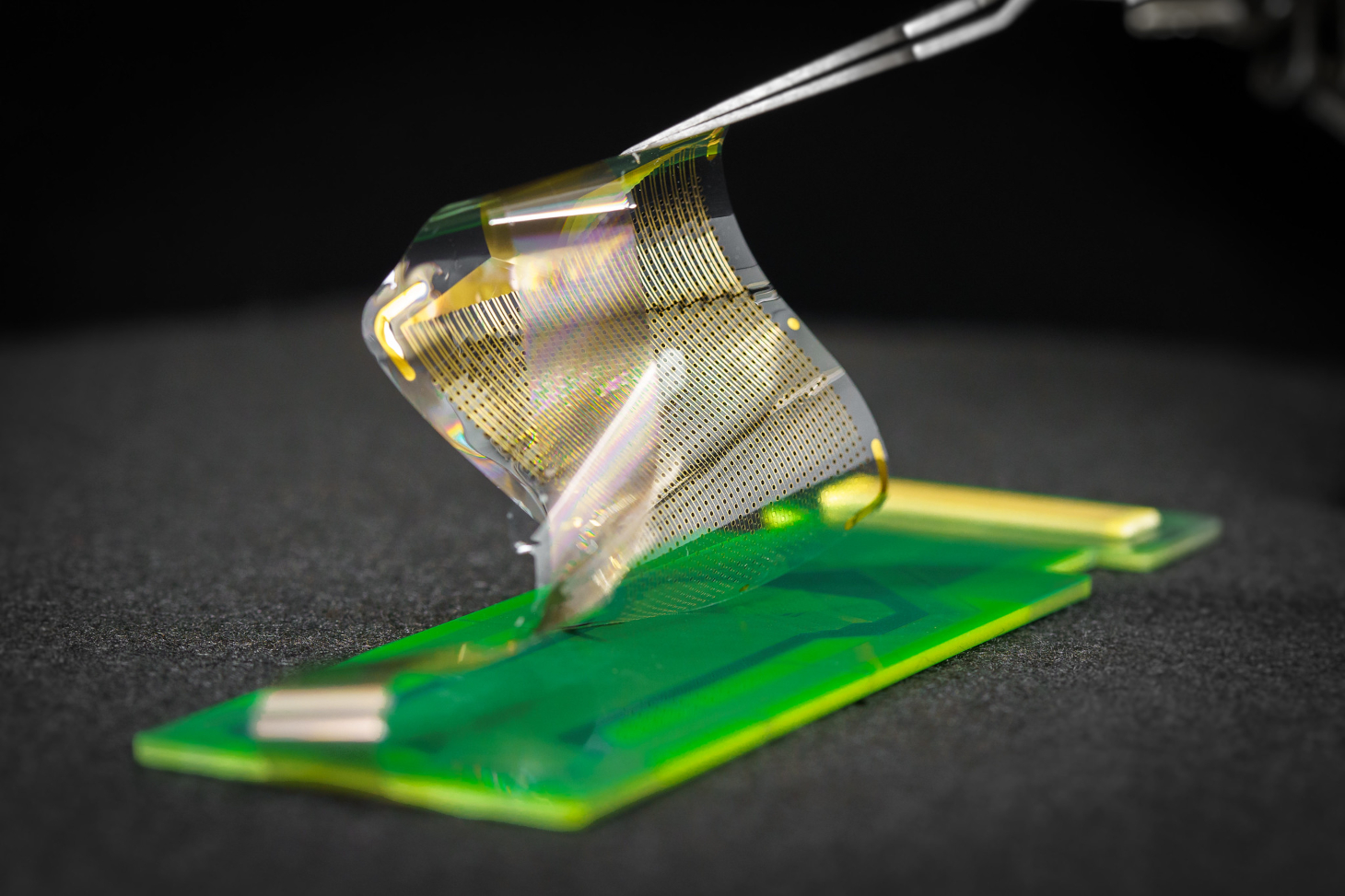
To record from or stimulate as many neurons as possible, it was necessary to develop microfabrication methods for flexible microdevices in order to integrate as many electrodes as possible into a very small space. Current electrodes can be as small as 5 to 10 micrometers.
Many new electrode materials have been developed to detect the very weak electric fields generated by neurons or to stimulate them—something that conventional metals such as platinum were unable to do. Today, electrode performance has been greatly improved, particularly through the introduction of porous materials.
The implant must maintain its electrical performance over time, but current flexible technologies are susceptible to water damage over the long term, which affects the implants’ lifespan. This issue is one of the major technological barriers.
In order to function normally outside a laboratory or hospital, implants must be able to communicate and receive power wirelessly. However, current radiofrequency signal transmission technologies, when used with a large number of electrodes, cause a localized rise in temperature that is harmful to neural tissue—another major technological hurdle.
In an effort to address these issues, the company Neuralink, for example, has designed a network of electrodes to stimulate or record neural activity, distributed across several flexible polymer filaments that incorporate microelectrodes. The materials used are biocompatible, and layers of silicon carbide—which help ensure the electronic integrity of the implants— appear to be under investigation (a concept developed in research laboratories at the University of California, Berkeley, and also currently being developed in France as part of the ANR-funded SiCNeural project). Finally, each filament is connected to an electronic chip that records neural activity or generates electrical impulses for stimulation.
In addition, the company is developing an autonomous robot capable of performing all stages of implant surgery, from trepanation to implant insertion.
Inserting flexible implants into the brain is indeed not straightforward, and several strategies have been developed by various laboratories, such as temporarily stiffening the implant using a resorbable polymer,using a rigid guide, or employing a robotic approach resembling a “sewing machine, ” also developed at Berkeley, which threads a needle through a hole at the tip of the flexible implant to push the implant into the brain and then removes only the needle. This latter method is being used by Neuralink, which combines it with a camera system that identifies areas of the cortical surface with little or no blood supply where the implants can be inserted while minimizing microbleeds.
As for the issue of localized heating caused by data analysis and wireless transmission, two technologies had been used in humans up to that point.
The first is the approach taken by BlackRock Neurotech, which relocates the circuits for processing and transmitting signals above the skull. This raises aesthetic concerns as well as the risk of infection due to the wires running from the skin to the brain.
The second technology comes from the CLINATEC laboratory at CEA Grenoble, which collects only signals that do not require high-precision digitization and records information from no more than 64 electrodes simultaneously. This laboratory has thus developed the first wireless neural implant with this many channels, fully integrated under the skin. It is inserted to replace a portion of the skull bone. Neuralink, for its part, offers a smaller chip—also inserted into the skull bone—that processes more than 1,000 channels but transmits only certain characteristics of the neural signals, identified as important by onboard algorithms.
As for the implants’ lifespan, we’ll have to wait a little longer to see if the strategy is effective and can provide a stable interface over several years. Once that limit is exceeded, we’ll certainly need to focus on collecting an even greater number of signals. At present, it is estimated that Neuralink’s technology can record signals from up to approximately 3,000 neurons using its 1,024 electrodes: this is impressive by current standards, but far from sufficient to capture the vastness of brain signals.
Conceptually, despite a very high degree of miniaturization, it will be very difficult to record millions of individual neurons using this technology without the implant and its associated connectors taking up too much space in the brain. Other concepts may need to be developed to overcome these limitations.