

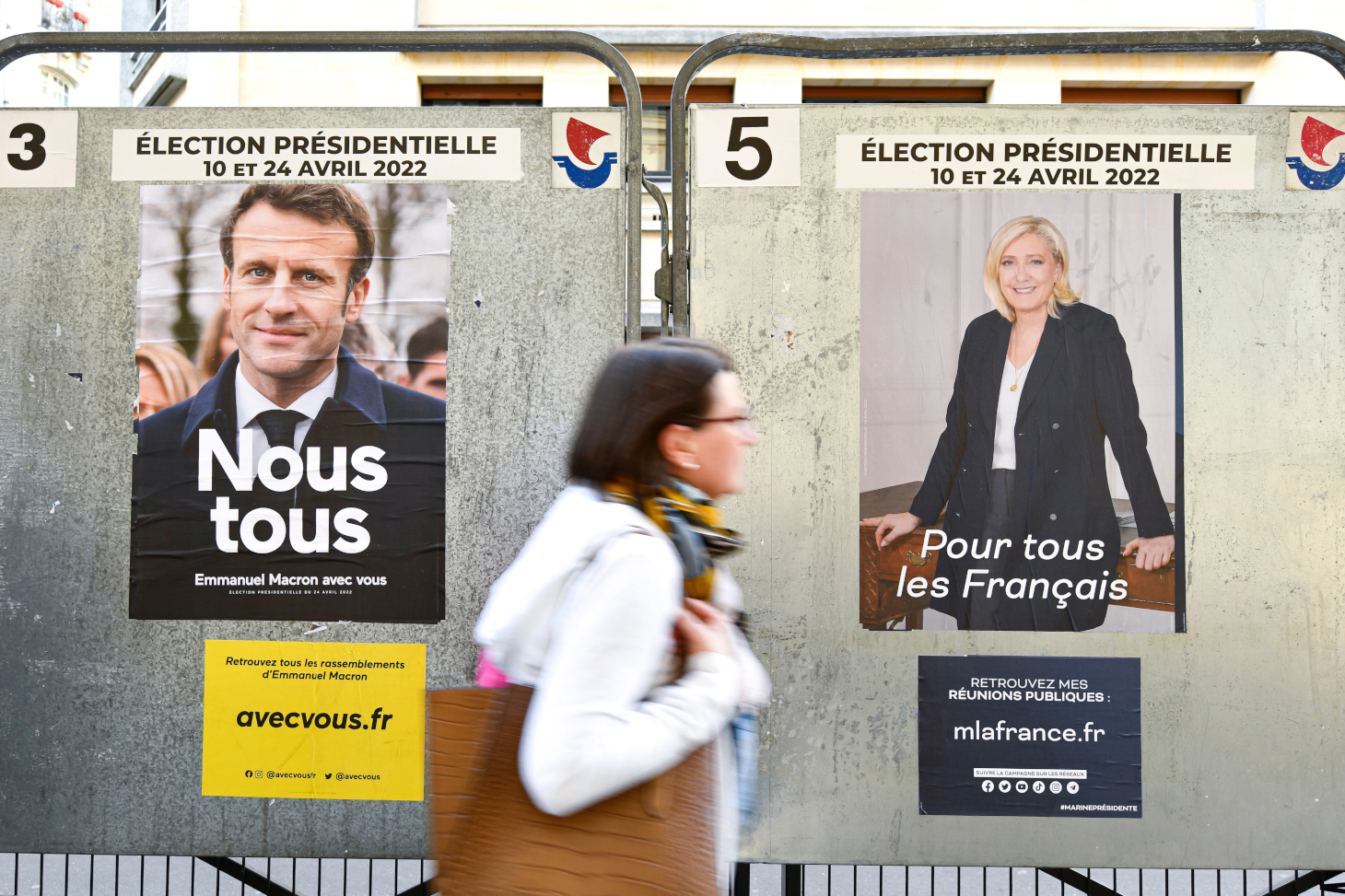
On one side, Emmanuel Macron, literally overplaying the role of the aggressive, contemptuous, arrogant man; on the other, Marine Le Pen, embodying with equal zeal the prim and proper lady—no doubt to smooth over certain all-too-visible rough edges, such as her affiliation with the far right. On one side, a belligerent strategy aimed at destroying her opponent’s political ground; on the other, a more defensive strategy aimed at concealing embarrassing aspects of that same political ground (for example, regarding her party’s funding).
With reference to the unspoken rules of politeness that have traditionally characterized Western society, we cannot help but point out how, in our view, last night’s performance was extremely violent.
For two and a half hours, we witnessed a demonstration: politics is a physical battle where anything goes. In this face-to-face clash, Emmanuel Macron’s strategy was clear: to physically display his contempt for an opponent whose ideas he does not respect—even going so far as to use explicit nonverbal cues, such as resting his elbows on the table, feigning boredom, or slouching—all hallmarks of arrogance—to highlight the ridiculous and pathetic nature of her ideas. But on the substance of the matter, should we find it normal or acceptable to watch a man who dramatizes all the codes of aggressive masculinity in order to bring down his opponent?
From a tactical standpoint, Emmanuel Macron undoubtedly employed the right strategy; through his body language, he made it very clear: “I physically despise you because I oppose your ideas.” He had no problem embracing this physical contradiction, which was summed up by his closing words: “I respect you.”
However, such behavior is not easily acceptable. Indeed, building on the work of sociologist Ervin Goffman —which was further developed by French linguist Catherine Kerbrat-Orecchioni in her analytical model—the rules of interaction are precise. We can therefore say that the rules of politeness generally observed during a public debate are reversed here: they consist of not encroaching on another person’s personal space, not causing them to lose face, and not seeking to humiliate them publicly. Last night, Emmanuel Macron clearly did not respect them. In particular, his choice of posture—elbows on the table—combined with that bored pout, which was widely shared on Twitter, drew heavy criticism for being blatantly provocative.
According to Erving Goffman, interaction in a Western society characterized by the restraint of manners—as described by Norbert Elias—is based on rituals that have a single objective: to preserve peace in the relationship and avoid conflict. The behavior of a socially integrated individual must conform to rules that are part of forms of politeness specific to each culture. To this end, the modern individual engages in a performance of self, which Goffman termed “face work.” This expression refers to an emotional performance designed to protect the interactants and demonstrate mutual respect by maintaining direct eye contact, a composed posture, serious facial expressions, and a genuine interest in one’s conversation partner.
More specifically, during the course of a “dyadic interpersonal interaction (a duel),” the performance of an emotional self can be understood as a four-sided game:
to defend one's own physical territory and protect that of others
to present a self-image appropriate to the situation and preserve the other person's image
Every culture has its own rules of politeness, defined as a set of behavioral norms—both verbal and nonverbal—whose purpose is to mitigate the potential threat posed by social interaction. Interactions with others are, in fact, always potentially anxiety-inducing and threatening. These codes are observed precisely to limit the risk of discomfort triggered by mere physical proximity. This type of discomfort was almost physically palpable to viewers last night during the confrontation between the two candidates on stage.
The “performance of self” in everyday life described by E. Goffman constitutes a binding ritual. These rules governing “face work” manifest themselves both verbally and nonverbally. In particular, two sociolinguists, Penelope Brown and Stephen C. Levinson, proposed a universal model of politeness that was later adopted by Catherine Kerbrat-Orecchioni. There are said to be two types of politeness leading to the production of different types of speech acts. Drawing on the work of these sociolinguists, Catherine Kerbrat-Orecchioni synthesized universal rules of politeness into various strategies known as positive or negative politeness. Positive politeness consists of enhancing face through face-flattering acts (FFAs), while negative politeness consists of avoiding face-threatening acts(FTAs).
This game of facial expressions aims either to contain the emotional stakes of the relationship or, on the contrary, to exacerbate them. From a cultural perspective, what matters is appearances, and last night we observed a game of facial expressions that was at odds with one another.
On one side, a composed candidate who carries herself well, is mindful of her every movement, and looks her interlocutor in the eye when he speaks. On the other, a candidate who adopts an obviously insolent posture, showing contempt through his rudeness when his interlocutor speaks, and who looks at the reporters or lowers his gaze slightly to avoid looking her straight in the eye.
We said “not arrogant” ;-) #NonverbalCommunication pic.twitter.com/8MlNweZ65r
— Prof. Virginie Martin (@VirginieMartin_) April 21, 2022
The context of the interaction is a battle, regardless of whether the participants are men or women. As spectators of this physical duel, we cannot help but observe that politics remains a context for interaction where all the rules of civilization disappear as soon as the battle of ideas begins. And apparently, nonverbal violence perpetrated by a man against a woman doesn’t matter. That is the lesson Emmanuel Macron taught us last night. It’s a harsh reality for those who dream of a peaceful political world.