


The most recent presidential election has reignited discussions about whether there are geographical roots to the political divide among the French. According to some participants in the public debate, there is a contrast between the France of major metropolitan areas on one side and the France of suburban and rural areas on the other.
This issue is at the heart of the discussions within many political parties today, particularly on the left, as evidenced by the controversy sparked by the title of one of the roundtable discussions organized by the Socialist Party (“Is peri-urban France the France of rednecks?”).
Numerous academic studies show that support for the National Rally (RN) is stronger in rural and suburban areas than in large metropolitan areas, while, conversely, support for LFI is much weaker in those areas.
While there is a certain consensus on this descriptive observation—even though some researchers criticize these categories as being too general or qualify the extent of the divide—there is disagreement over the explanation that can be offered to account for this phenomenon. We noted in a previous article that this support for far-right parties certainly could not be reduced to the economic and social conditions in these regions. This article argues that the contrast between rural and urban areas involves a significant psychological dimension.
International political science research is increasingly highlighting psychological factors as explanations for the distinct political behavior of rural populations. This is particularly true of studies that draw on the analytical framework developed by political scientist Katherine Cramer to understand the political rise of a populist Republican governor in Wisconsin.
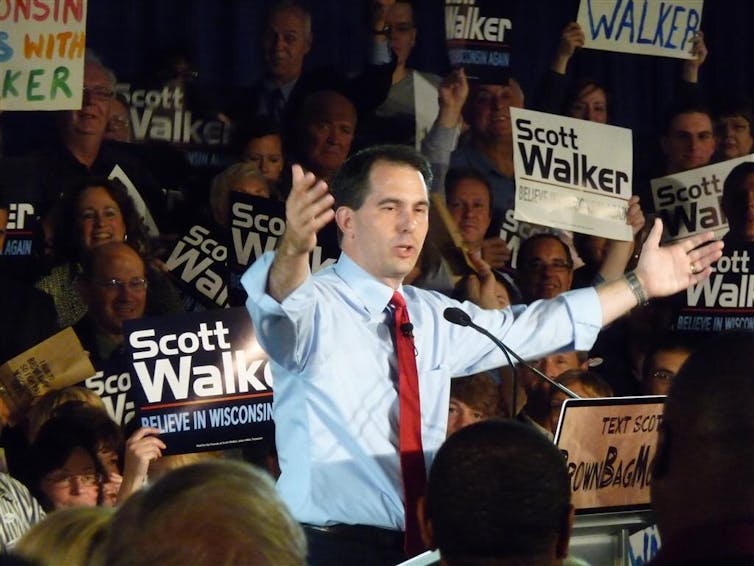
By reporting on conversations among residents, she shows that there is a genuine rural consciousness based on social identification with a place of residence and a resentment toward urban dwellers that takes on three forms.
First, the political aspect: rural residents feel that their concerns are not taken into account by political leaders and that they are underrepresented. Next, the economic aspect: they feel they are the last to benefit from public resources. Finally, the cultural aspect: the idea that their way of life is radically different from that of urban dwellers and that it is looked down upon.
[More than 85,000 readers rely on The Conversation’s newsletters to better understand the world’s major issues. Subscribe today]
Although the U.S. context differs in many respects, Katherine Cramer’s concepts seem relevant to us in shedding light on the French case for two reasons. First, because differences in voting behavior between rural and urban residents cannot be reduced solely to the economic and social composition of these areas. Second, sociological research indicates that in rural areas, there is a strong sense of identification with one’s place of residence linked to residents’ membership in localized networks of mutual acquaintance, which are defined in part in opposition to other geographic groups.
Our questionnaire-based survey for the European project “Rural Urban Divide in Europe” (RUDE), conducted in France among 4,000 respondents in October 2022, reveals a geographic divide in the resentment that individuals feel toward residents of other geographic areas.
The difference in the level of resentment between rural and urban residents is particularly pronounced when it comes to political power. Indeed, as Figure 1 shows, 72% of rural residents feel disrespected by the elites, compared with nearly half that number among urban residents.
Furthermore, this divide is even more pronounced when it comes to political representation, since only 36% of urban residents believe there are too many rural lawmakers who do not represent the interests of urban residents, whereas, conversely, 82% of rural residents believe there are too many members of Congress from urban areas who do not represent the interests of those living in rural areas. It is interesting to note that this perception does not correspond to the actual representation of members of Congress in the National Assembly, where rural areas are actually overrepresented.
However, it is the level of resentment toward the allocation of public resources that represents the most significant divide between rural and urban residents. Residents of rural areas feel quite strongly that they receive fewer public resources compared to other geographic areas. Eighty-five percent of rural residents believe that the government spends too much money on urban development, while rural development is neglected. In contrast, only 23 percent of urban residents agree with the opposite statement, confirming the existence of a particularly strong feeling among rural residents that they have been abandoned by the government.
Here, too, this perception stands in stark contrast to the objective reality. The work of economist Laurent Davezie has repeatedly shown that not only does the government invest heavily in these areas, but there is also a form of fiscal redistribution from residents of large metropolitan areas to rural areas. Finally, this divide is also evident in terms of resentment toward differences in lifestyles and values across geographic regions.
To put it another way, people living in rural areas feel out of step and look down upon: 65% of rural residents believe that people from urban areas do not show enough respect for the lifestyle of people from rural areas.
All of these findings are consistent with those of sociologist Benoît Coquard, who concluded his survey of young people in rural eastern France by noting that they felt they “did not matter to the country or to those who govern it.” It seems quite clear that this asymmetrical geographical resentment could influence how rural residents vote.
Additional data from the RUDE survey, presented below (see Figure 2), provide insight into these political consequences. Rural residents are all the more likely to vote for the “National Rally” in an upcoming election the more resentment they feel toward urban dwellers.
In fact, the National Rally’s support is already 10 percentage points higher among rural voters than the average, but more than 22 points higher among rural voters who feel geographically marginalized. Thus, if an election were held soon, rural voters with geographic resentment would vote for the “Renaissance” party at half the national average rate, but for the “National Rally” at twice the national average rate.
These results lead us to draw several conclusions. First, it is important to emphasize the significance of the geographic context in explaining individuals’ political views. Second, we should note the existence—as in the United States—of a certain form of “rural consciousness” based on a “politics of resentment.” Finally, these results highlight a significant gap between the reality of regional inequalities and individuals’ perceptions of them.
The perceptions that individuals have of the regions where they live, as compared to others, play a crucial role. However, it is likely that these perceptions are partly shaped by media and political discourse. In this regard, the RN has succeeded in convincing a portion of rural voters that it is the party of a rural community that has been abandoned and looked down upon.
In light of this, other political forces should take this form of “rural consciousness”—rooted in resentment—into account in order to develop a different narrative that is neither pessimistic nor condescending, and that resonates with the perceptions of rural residents.
This article was co-authored with Blaise Mouton, a master's student at Sciences Po Grenoble.