

Another sign: In recent years, there have been calls for a more direct form of democracy, whether in the form of citizens’ assemblies or in the form of referendums initiated by the people—two mechanisms that are, however, very different.
How can this situation be explained? Without claiming to resolve a complex issue, we would like to highlight a factor that is both important and underestimated: the level of education.
The level of education in France, as in many countries, has risen sharply since 1945. While only 5% of a given age group earned the baccalauréat in 1950, the figure today is around 80%, half of whom earn the general baccalauréat.
A transformation of such magnitude—which observers such as Jean Fourastié and Ronald Inglehart have described as a “silent revolution”—is generally viewed as positive—and it is, to a large extent, because an educated society is a more prosperous one.
Furthermore, education is highly valued, especially in France, where it is considered a glorious legacy of the Revolution and the Republic.
But does education have only positive effects? Could it be that the widespread access to higher education and the diversification of educational levels are also a factor contributing to social division?
We must pay tribute to Pierre Bourdieu’s sociology, which accurately recognized that educational attainment reshapes the nature of social classes under the influence of cultural capital.
Subsequent studies have confirmed that educational attainment has a significant impact on politicization, political knowledge, and the sense of political competence. Voter turnout is also strongly influenced by educational attainment.
Data from the European Values Survey (EVS) help corroborate and further explore these findings on the political impact of education.
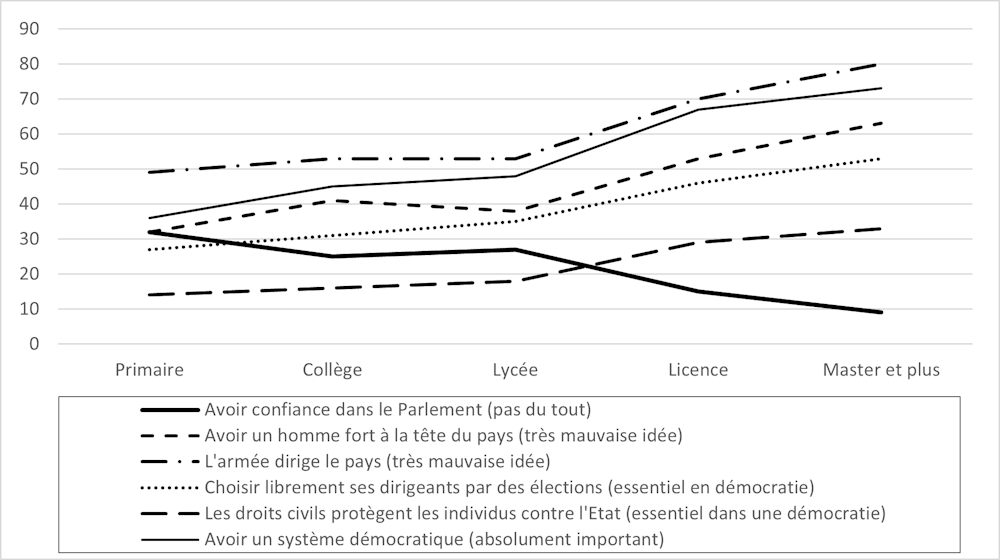
In fact, they show that commitment to democratic principles increases significantly with educational attainment (Figure 1). The lower one’s level of education, the more likely one is to accept the idea that the country should be led by a strongman or by the military (Figure 1). It is also worth noting that individual rights—which have become increasingly important in defining democracy—find more support among those with higher levels of education than among those with lower levels of education.
While the survey does not provide direct indicators of participatory democracy, it includes several questions on civic engagement and protest activism that, by extension, shed light on the French people’s potential for participation (Figure 2).

Once again, educational attainment appears to be a highly significant factor, including in terms of protest participation—which one might have expected to be higher in areas where material needs are greater.
It should be noted that this impact of educational attainment persists even when educational attainment is controlled for other variables (gender, age, income, or political orientation). Furthermore, the correlations with educational attainment tend to increase over time, a sign that the divide is widening.
How can we explain such differences? We can put forward a hypothesis: if college graduates support democracy, it is simply because it is in their best interest.
Graduates do, in fact, have specific interests. Academic success fosters self-esteem and a sense of control over one’s life. Confident in their abilities, graduates are inclined to demand greater freedom in their life choices. They therefore view individual rights positively, especially when those rights allow them to strengthen their autonomy. They view mobility as an ideal way of life, as shown by studies of students, while also being concerned about the quality of their living environment.
They also tend to embrace the values that Ronald Inglehart describes as post-materialist: feminism, multiculturalism, environmentalism, anti-racism, and post-nationalism.
The post-Cold War context has amplified these trends. Globalization and technology have opened up unprecedented opportunities for movement and exchange. The expansion of higher education—driven by competition among nations—has allowed postmodern ideals to take root more fully, thereby deepening the divide between the“winners” and “losers” of globalization, or between those who are “everywhere” and those who are “somewhere.”
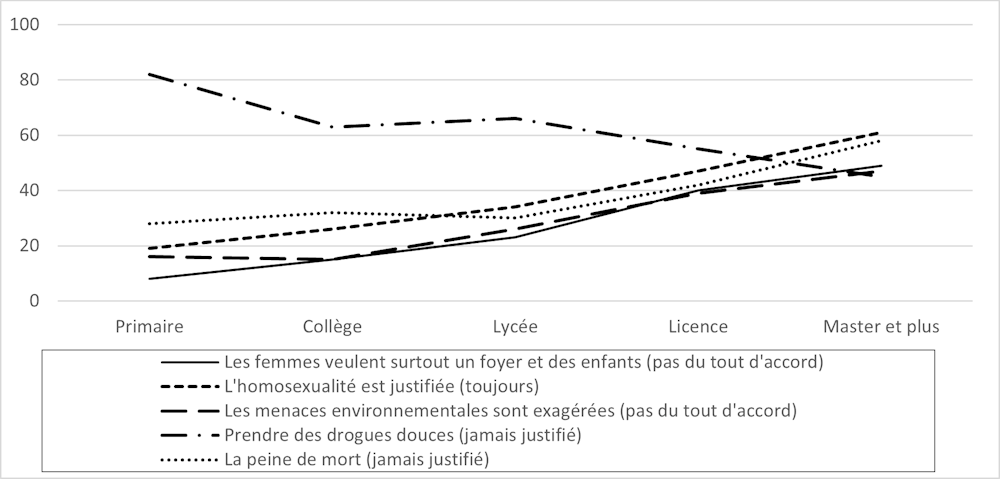
All of these findings are confirmed by the survey on values. The higher one’s level of education, the more supportive one is of gender equality, homosexuality, soft drugs, a less severe criminal justice policy, and environmental protection (Figure 3).
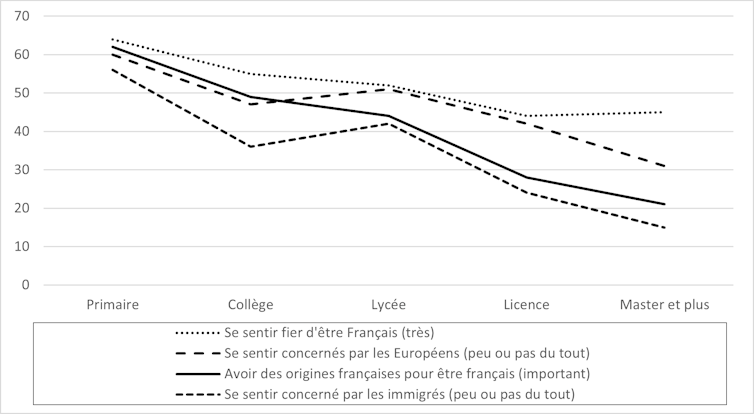
Similarly, college graduates are significantly more reluctant to say they are proud to be French (Figure 4). They are more concerned about the plight of Europeans and immigrants, and they more often criticize the genealogical conception of the nation (having French ancestors), which explains why the expression “native-born French” has fallen out of favor .
However, with the massification of higher education, coupled with the growing importance of degrees in social stratification, graduates find themselves in a position of strength to defend their interests. They are all the more successful in asserting their preferences because they are well represented among the political elite—particularly in the case of students from the grandes écoles.
Drawing on their ability to mobilize, graduates support participatory democracy-style mechanisms in which they know they can make their voices heard, while being more reluctant to support referendums, which have the drawback of treating all voters as equal.
We can see, then, that referendums such as the 2005 referendum on Europe or the 2016 Brexit referendum have drawn criticism for being elitist. Moreover, none of the last three presidents of the Republic has resorted to a referendum. The citizens’ initiative referendum (RIC) has even been explicitly rejected by the presidential party.
Conversely, groups with low levels of education suffer from a lack of political representation and resources. Feeling that democracy is slipping away from them in favor of an oligarchy, they experience a sense of powerlessness and disenfranchisement that leads them to doubt the value of universal suffrage: What’s the point of voting if the elites manage to impose their views and interests anyway?
Unlike college graduates, they are significantly less involved in participatory democracy initiatives, whose norms they do not fully understand. More inclined to favor referendums, they expect, above all, that those in power be effective. The call for a strong, Bonapartist-style government—one capable of bypassing the oligarchic and exploitative practices of the elites—is an acceptable option, especially in times of insecurity.
[Nearly 70,000 readers rely on The Conversation’s newsletter to better understand the world’s major issues. Subscribe today]
As philosophers have pointed out since ancient times, any political system runs the risk of an aristocratic elite seizing power for its own benefit, which leads to popular discontent.
Aren’t we currently in a cycle of this kind? The Trump phenomenon can be seen as a textbook example, with, on the one hand, Hillary Clinton’s haughty attitude—viewing Trump’s voters as a “basket of deplorables” and dismissing them as “racists, sexists, homophobes, and Islamophobes”; and on the other, the refusal to accept the change in administration, coupled with an attempt to destabilize institutions in January 2021, compounded by the Supreme Court’s recent reversal on abortion.
In France, the spring 2022 elections confirmed that there is a significant sociological divide between the presidential party—which enjoys strong support among college graduates—and the National Rally, which is well-established among working-class communities, with NUPES occupying a middle ground due to an electoral base drawn from both city centers and the suburbs.
It would be a mistake to pit an enlightened elite—the bearer of the democratic ideal—against a backward populace that aspires only to tyranny. On the one hand, participatory democracy can be seen as a form of sophisticated anti-parliamentarianism; on the other hand, the working class may have good reasons for not subscribing to the grand principles advocated by the elites.
For example, according to the EVS, 54% of people with few educational credentials say they cannot do more for the environment, compared with 22% of those with higher educational credentials. Similarly, 35% of those with few educational credentials believe that immigrants are taking jobs away from native-born citizens, compared with 10% of those with higher educational credentials, which serves as a reminder that opinions depend largely on social status.
In a fragmented society, the challenge is obviously to find solutions that satisfy everyone, while taking particular care to prevent a potential erosion of democracy.
A counterexample is undoubtedly the Citizens’ Climate Conference launched by Emmanuel Macron. This initiative can be seen as an attempt to meet the expectations of the educated elite, both in substance (the environment) and in form (participatory democracy). However, most of the final proposals were abandoned, often out of fear that they would be unpopular.
Ultimately, the current challenge is not very different from the one identified by classical philosophers: namely, striking a balance between the common people and the aristocracy, which is the only way to avoid both populist and elitist excesses.