

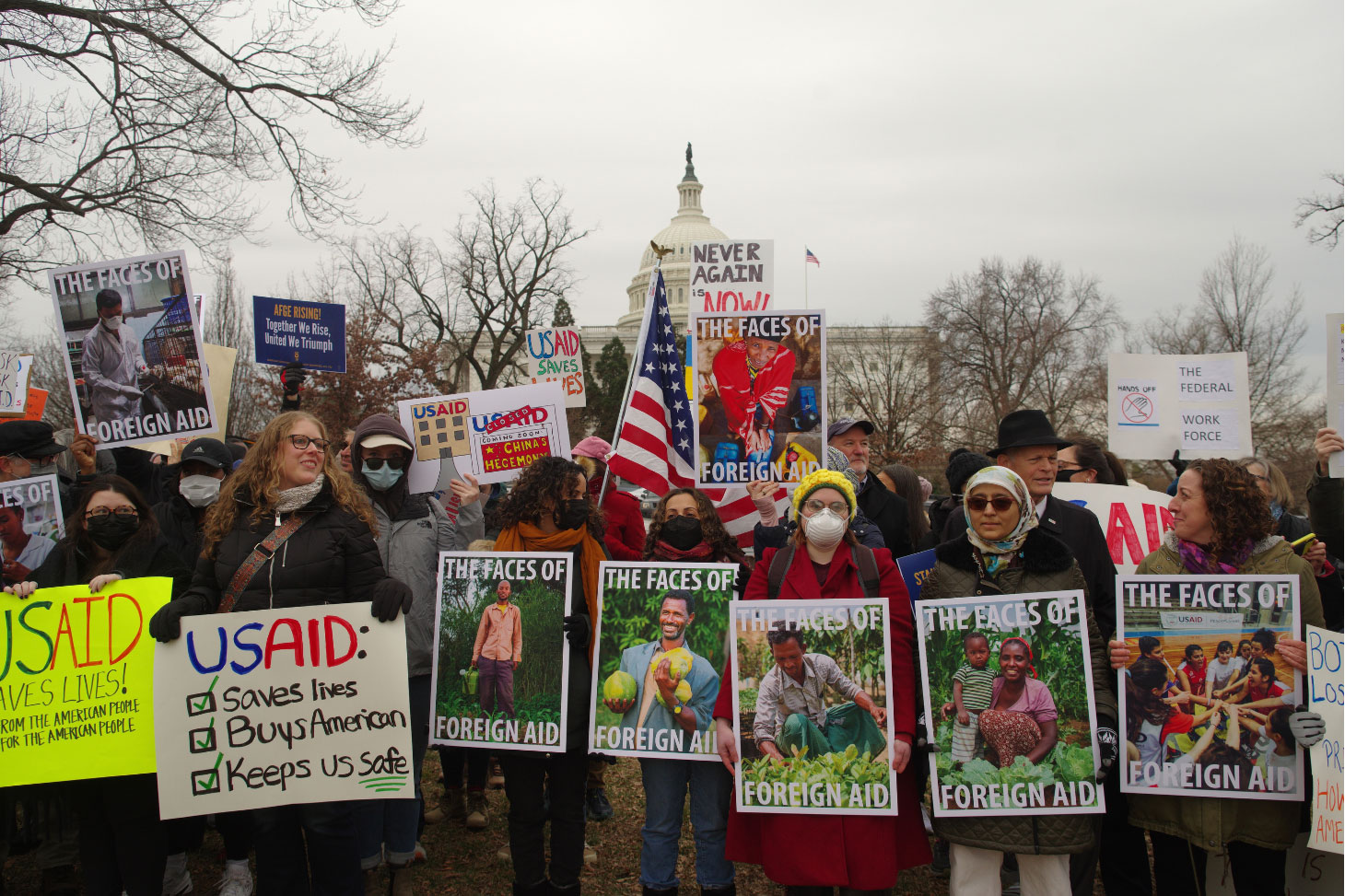
Upon his return to the White House, Donald Trump suspended “U.S. foreign development aid” for 90 days, including all operations of the U.S. Agency for International Development (USAID), in order to “assess its relevance.” The consequences of this decision are already very severe.
The collapse of U.S. funding for international aid—including both emergency humanitarian aid and official development assistance (ODA)—is a shockwave with disastrous consequences for neglected populations.
The obsolescence of the economic model of international solidarity is now glaringly apparent, revealing to everyone the structural weaknesses that had, in fact, been clearly identified for years. The abrupt nature of these cuts and the lack of negotiation regarding their terms and targets make these measures particularly drastic. However, it would be wrong to assume that everything was going smoothly in the field of international aid before the New York billionaire returned to power.
Monday through Friday and on Sundays, get free analysis and insights from our experts for a different perspective on the news. Subscribe today!
The Trump Disaster
The “four temptations” perpetuated by the financial system in place until now —and now unashamedly embraced by the new U.S. administration—are clear: the Western-centric approach of donor countries; a neoliberal approach to international aid in which each contributing state chooses which countries to aid; security concerns, with financial disbursements subject to strict oversight procedures to prevent these funds from falling into the hands of enemies of the donor countries in conflict zones; and the temptation to scale back financial transfers whenever donor countries face turmoil (such as the COVID-19 pandemic, economic crises, or the rise of nationalist and isolationist sentiments…).

The convergence of these trends has led to a shortfall in aid volume and to a growing suspicion that, for donor countries, aid is primarily aimed at expanding their soft power.
The recent decisions made by Washington are, of course, a disaster for those involved in international solidarity. Activities on the ground have already had to be abandoned, and layoff plans have already been implemented by the organizations most affected. A number of them will not survive the current events.
And even those that depend little or not at all on USAID funding will likely be affected by the ripple effects of the withdrawal of the leading donor country.
A reduction in aid that is not solely the result of U.S. actions
Even before the United States announced its drastic cuts, other countries had already announced their intention to reduce their contributions to international solidarity: France, the United Kingdom, Germany, and Belgium, to name just a few that are already well known.
Organizations for which “public generosity”—which accounts for about 20 percent of annual humanitarian funding—constitutes the vast majority of their funding will also not escape the consequences of the United States’ suspension of all ODA, as the economic shifts and political tensions resulting from certain decisions by the Trump administration are expected to have industrial and social repercussions across all countries that were once privileged partners of the United States, particularly among European Union member states.
If these fears were to be confirmed, experience shows that deteriorating conditions in various countries have a direct impact on donations from the general public, which supports the work of NGOs. Individual donors will have to decide on their priorities amid a wide range of crises that have been neglected by government funding, and compassion will then be shaped by the choices each person makes.
Furthermore, the tensions that are emerging everywhere in connection with the rise in trade barriers could have economic and social repercussions that, in turn, may lead to a shift in charitable giving toward forms of solidarity at the immediate local, national, and/or family levels.
Especially since a growing chorus within certain political groups is calling into question the very legitimacy and validity of Official Development Assistance, which recently prompted the director of the French Development Agency (AFD) to speak out explicitly in defense of the actions of the organization he leads.
The Illusion of a Compartmentalized World
Step by step, a trend is thus taking hold among the wealthiest nations that reflects a reckless indifference not only to poverty but also to environmental degradation and zoonotic diseases that may result from the damage inflicted on primary forests. No border, however, can serve as an illusory “Maginot Line”—watertight and impassable—to contain the globalized dangers that today characterize the interdependencies of a globalized world.
In Europe as well as in North America, we cannot remain indifferent to the many forms of harm being inflicted on the planet—harm that will soon be exacerbated by the resurgence of a destructive and predatory extractive industry—any more than we can remain indifferent to the survival strategies reflected in current and future mass population displacements, and to the conflicts that these various phenomena may generate.
Two figures immediately illustrate the yawning chasm that already exists in terms of global inequality. Global ODA funding from OECD countries totaled $230 billion in 2023, while “remittances ”—sums transferred by migrants to their countries of origin—amounted to $830 billion that year, of which $650 billion went to low- and middle-income countries. These funds serve as a lifeline for the most disadvantaged populations. They reflect, in fact, the inseparable balance of survival between here and there.
Yet they would have us accept the idea that, in the face of these boundless interdependencies, we in the wealthiest countries could turn a blind eye to the various mechanisms that undermine equal opportunity around the world. That an unapologetic reaffirmation of “every man for himself”—in both consumption and global solidarity—could now serve as a new, unapologetic political mantra. And that this would have no long-term consequences for lasting peace…
Thus, in a world where, by 2100, the population of the African continent could account for 40% of humanity, there can be no question—even in the absence of future upheavals—of turning a blind eye to the realities taking shape. On this continent, as elsewhere where major vulnerabilities exist, we cannot afford to neglect our concern for others—out of realism, if not out of generosity.
We must collectively resist the “every man for himself” strategy and the law of the jungle promoted by the new U.S. leaders and their cronies, and work to create a new model of solidarity free from the four founding temptations of the existing system—a Western-centric system that emerged from World War II and the subsequent decolonization processes. This implies creating the conditions for a significant expansion in the number of countries contributing to government funds, as well as diversifying the sources of private funding. A new distribution of creative and decision-making power is therefore essential within the governance of a system that must be rebuilt. In the wake of the ongoing upheaval, new struggles are emerging to fundamentally reshape the strategies and mechanisms of international solidarity.
For a longer version of this article, click here.
This article is republished from The Conversation under a Creative Commons license. Readthe original article.