

The post-World War II era would turn it into one of the violent epicenters of the Cold War, with the Red Army’s entry in 1979—whose officers were convinced they were carrying out a brief regional police operation in a vassal state, in line with previous interventions. The operation was thus given the code name“Operation Prague”…Ronald Reagan sought—and succeeded—in turning it into the “Grave of the Red Army, ” while it also became the CIA’s most costly postwar operation.
Gradually, the many intertwined mechanisms that have led to the severe food insecurity Afghanistan faces today began to take shape.
In this country of 650,000km², only 12% of the land is considered arable (compared to 60% in France) and is highly dependent on rainfall and a complex irrigation system that the failed agrarian reform of 1978—carried out by the new communist regime—would partially dismantle. Then, during the Soviet occupation, the destruction of agricultural facilities was part of strategies—sometimes deliberate—aimed at depopulating pockets of resistance.
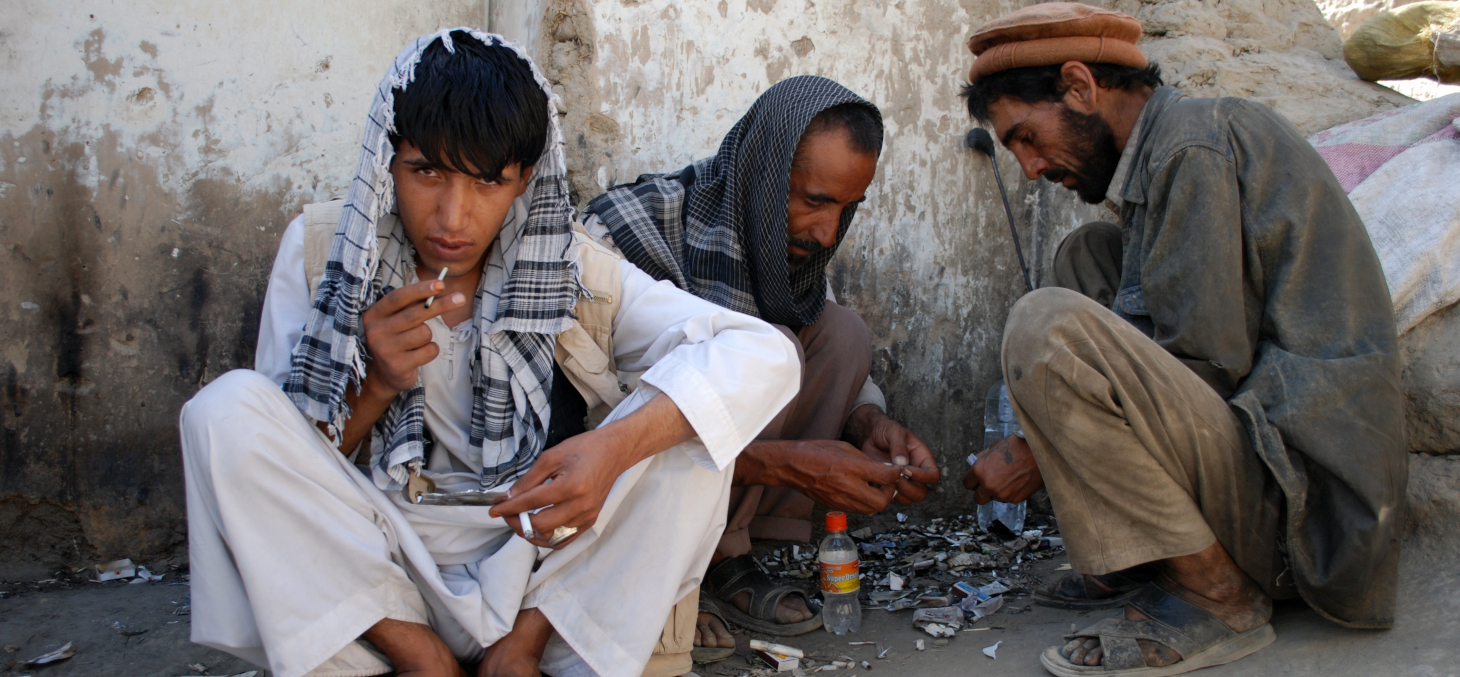
At the same time, two other phenomena are taking hold, further exacerbating the hunger crisis: massive waves of displaced people fleeing rural areas to seek shelter in squalid settlements on the outskirts of cities, and a steady increase in the amount of farmland devoted to poppy cultivation.
The rapid expansion of ephedra (“oman” in the local language), which is used to produce low-quality methamphetamine, contributes to reinforcing Afghanistan’s status as a narco-state, as part of a process of adaptive survival on the part of the producers. The financial advances granted to them by traffickers (“salaam”) to pay for the inputs that have become necessary for drug production trap them in a classic economic model of export agriculture.
Two figures illustrate these trends since the coalition’s entry in 2001 and the fall of the first Taliban regime: in twenty years, there has not been a single year in which the number of displaced people fell below 150,000, with two peaks exceeding one million in 2001 and 2014; at the same time, the area devoted to poppy cultivation has tripled, driven by greater financial returns for farmers and the Taliban’s need to purchase weapons.
The poppy’s greater resilience to global warming, compared to other food crops, has further fueled the expansion of planted acreage. The situation would not be as dire if all of the factors mentioned above had not been compounded by population growth, which has made Afghanistan the world leader in this regard, with an annual growth rate of 6 percent. Since 2001, the country’s population has thus risen from 18 million to 38 million, with an urbanization rate now estimated at 30 percent.
The Taliban are thus now in control of a country that has changed profoundly since they first seized power in 1996. All of these realities converge to create the conditions for a dire food crisis facing the new regime of the Islamic Emirate—without overlooking the responsibility of its leaders for some of the mechanisms described. To address this crisis, the state’s coffers are empty and the healthcare system is on its last legs.
In a scandalous display of collective amnesia, the members of the UN Security Council—like the other wealthiest countries in the UN General Assembly—are reluctant to make urgent contributions to the $4.4 billion appeal launched by UN Under-Secretary-General for Humanitarian Affairs Martin Griffiths and relayed by Secretary-General Antonio Guterres.
They need peace.
— United Nations (UN) (@ONU_fr) January 26, 2022
They need hope.
They need help.
And they need it now.
—@AntonioGuterres calls for support for the Afghan people. https://t.co/ruGkn3OFcX pic.twitter.com/r6rQoSELAy
All of them have forgotten history, forgotten the Doha Agreements, which had deliberately excluded both Ashraf Ghani’s Afghan government and the allies of the international coalition from the negotiations. Thus acknowledging the political transition that had been foretold, and now pretending to be outraged by the Taliban’s rise to power… All the while forgetting the “Great Game” in which both sides have continued to drag the civilian population into issues that are completely beyond their control.
In December 2021, after tough negotiations, the Security Council finally passed a resolution that, for one year, allows for the delivery of humanitarian aid—which can be deployed, subject to certain conditions— without being subject to the sanctions regime targeting the new Afghan authorities. While China and Russia exerted all their influence to bring about this political decision, the two countries did not, however, commit to addressing the funding aspects of Resolution 2615, which was ultimately adopted unanimously by the Security Council.
This procrastination once again underscores the urgent need to overhaul the humanitarian aid funding model.
Famine: "If the 100 richest countries contributed 0.03% of their GNP to aid, we could meet all the world's needs." Pierre Micheletti, president of @ACF_France, is a guest on @InterTV5 with @antoinegenton @TV5MONDEINFO and @ChBozonnet @lemondefr pic.twitter.com/anKh5AhUMq
— TV5MONDE Info (@TV5MONDEINFO) October 16, 2021
As it is currently structured, this aid is insufficient in volume and too dependent on the complex interplay of relations among major powers. But in the meantime, we must quickly secure this funding and make it available to organizations capable of deploying it. In Afghanistan, the fate of 22 million people depends on it.
In order to facilitate the collection of funds for emergency aid—and to work toward establishing some form of legitimacy for their political role—a delegation of Taliban officials recently made its first trip to Europe to meet, in Oslo, with representatives of Western countries, which are currently the primary funders of global humanitarian aid.
Brought together under a coordinating body (the Agency Coordinating Body for Afghan Relief & Development, or ACBAR), dozens of international and Afghan NGOs—approved by the Taliban authorities—will be responsible, alongside specialized UN agencies, for delivering emergency humanitarian aid.
Under the auspices of the Ministry of Economy of the “Islamic Emirate of Afghanistan,” a document has been drafted that formalizes the comprehensive plan for monitoring and overseeing NGOs involved in humanitarian responses. Certain aspects are sure to raise questions and spark debate, given that such activities are currently not being hindered by the country’s new authorities.
In addition to the humanitarian aid budget—which is already struggling to be secured—there are also additional financial needs to implement the “Transitional Engagement Framework.” This program ensures the coordination of activities by member entities of the United Nations team by helping to maintain basic services—such as health and education—and to preserve essential community systems. It brings the total financial needs for the coming year to $8 billion.
This underscores just how crucial the issue of the economic model and the contribution of a much broader base of countries providing international aid has become. It is therefore no surprise that the organizers of the upcoming European Humanitarian Summit, to be held in Brussels from March 21 to 23, have decided to make this issue one of the main topics of the meeting.
This article is republished from The Conversation under a Creative Commons license. Readthe original article.