

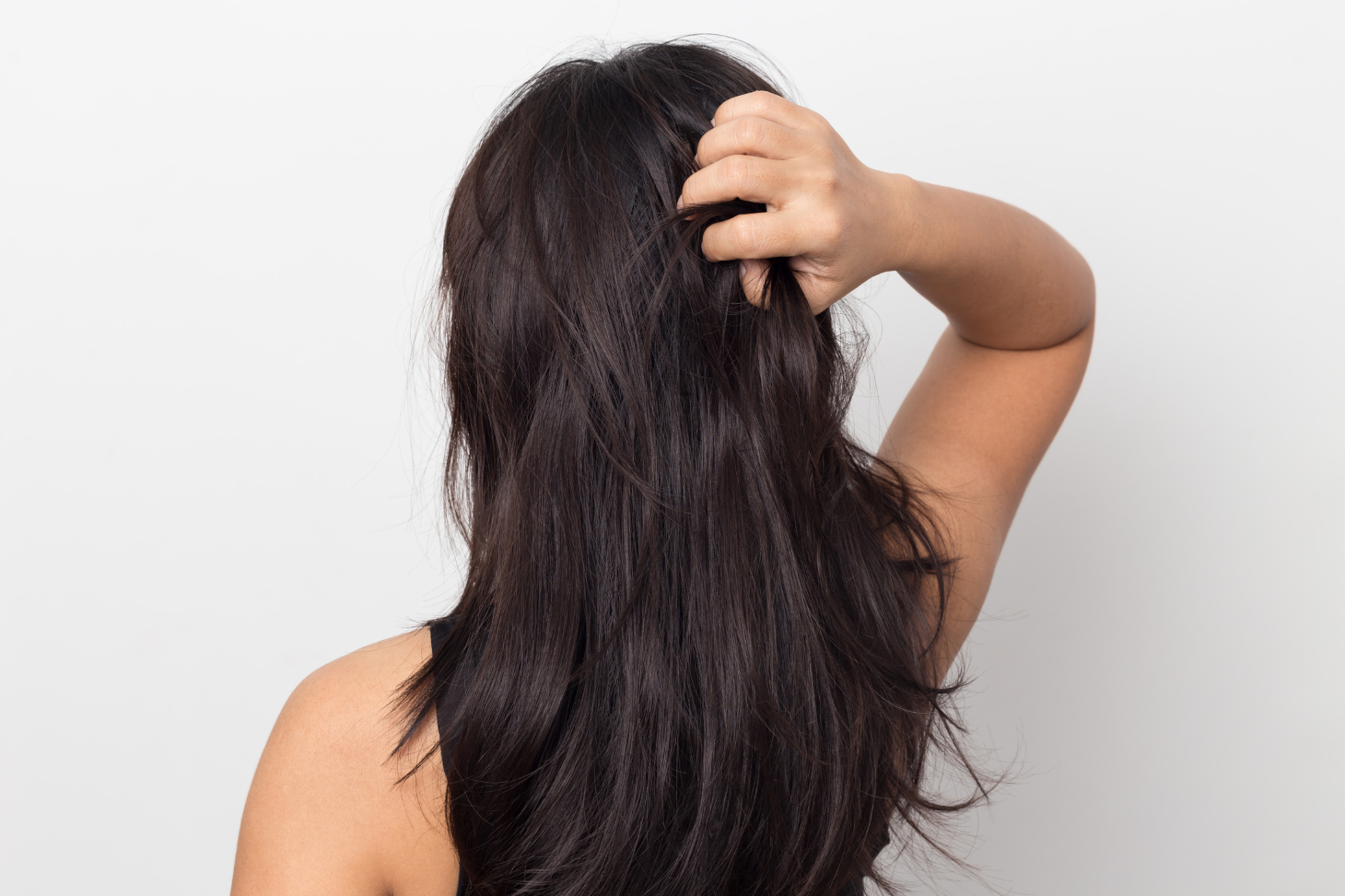
Try a little experiment that will take you just twenty seconds: hold your hands out in front of you and try to stay completely still. Then, when you close your eyes, pay attention to the subtle sensations that arise: don’t you feel a slight itch right there on your scalp? Or around your nose? On your forearms, perhaps? Don’t you feel an overwhelming urge to scratch?
Throughout the day, we tend to repeat these seemingly harmless movements over and over. We scratch our cheeks, rub the sides of our noses, run our fingernails down the back of our necks, and through our hair. Why do we have this frantic need to run our fingernails over our skin? What need do these gestures fulfill? Could they be automatic, unconscious actions? Here’s what science has to say about it.
In the early 2000s, Italian neurologist Carlo-Alberto Tassinari of the University of Bologna observed that during certain epileptic seizures, people exhibit unconscious gestural activities, many of which are directed toward the face or body. These often involve rubbing or scratching and are referred to as “epileptic automatisms.”
The cerebral origin of these actions remains a mystery, but Tassinari hypothesized the existence of “central generators of motor ‘patterns’”—in other words, neural networks that would provide basic motor programs for performing movements such as swallowing, yawning, or even walking. During the crisis, these generators would be freed from a latent inhibition present in the conscious state, allowing these basic behaviors to emerge.
In a more specific study, his team focused on automatic movements directed toward the face—movements that occur primarily at the end of an epileptic seizure involving the temporal lobe. The temporal lobe is the region of the brain primarily responsible for emotions and memory. Temporal lobe epilepsy is the most common form of epilepsy in adults. The study in question compared these movements to those we make spontaneously, such as when we are sitting in an audience attending a lecture.
The result is that there is no difference in the phenomenology of the gesture, whether it is “natural” or “epileptic.” Thus, a little less than once per minute, we perform (in this listening situation) a gesture of rubbing our face (the chin, eyes, nose, and cheeks). We rub, knead, massage, and scratch our skin: this is part of our basic behavioral repertoire.
Of course, there may be good reasons to scratch: certain skin conditions are called “pruritic” when they cause itching and lead to scratching. Psoriasis, hives, seborrheic dermatitis, scabies, or even a simple insect bite are all conditions that affect the skin and cause itching that can sometimes be debilitating.
But more often than not, when we scratch, we scratch “for no reason”! There’s nothing on our skin—just that automatic urge to scratch. To understand this activity, which is as commonplace as it is mysterious, it’s helpful to break down scratching into its two basic components: the sensation—which is an itch—and the behavior, consisting of the act of scratching. The behavior is triggered by the sensation and makes it stop. However, as we’ve already mentioned, the two elements can be independent: we can feel an itch and yet not scratch, and we can scratch without having felt an itch.
Worse yet, simply bringing up the subject—or writing about it, as I’m doing right now—can trigger a scratching frenzy, and after every sentence I type, I have to stop to scratch an eyelid, a cheek, an eyebrow, and so on. Similarly, just seeing someone scratch triggers an urge to imitate them, as powerfully as seeing someone yawn makes you yawn.
Itching is defined as an unpleasant, uncomfortable sensation that triggers the urge to scratch. It results from the interaction of numerous chemical mediators (the main one being histamine, released by certain immune cells called mast cells) with free nerve endings—that is, the tips of the sensory nerve fibers in the skin.
Our skin has various sensors that collect information about the stimuli affecting it. Most of these are “mechanoreceptors,” meaning they are sensitive to surface pressure, fine touch, or vibrations. Free nerve endings, on the other hand, are “chemosensitive” and more specifically transmit information related to pain and sensations of cold and heat.
The fact that the same fibers transmit pain signals, skin temperature, and the sensation of itching demonstrates the connection between the signal and the execution of a basic behavior: unlike other signals originating in the skin, which contribute to the exploration of the environment, this signaling pathway is designed to intervene rapidly in order to provide relief (withdrawal in the case of pain, or action—scratching—in the case of itching).
Nevertheless, it would be wrong to equate itching with a minor form of pain. While all organs (except the brain) can experience pain, the sensation of itching affects only certain parts of the body: the skin, the mucous membranes, and the conjunctiva of the eye. No one can say that their liver itches, or that they feel the need to scratch their heart or spleen!
Furthermore, it turns out that pain is the stimulus that most effectively suppresses the sensation of itching, which explains why scratching can sometimes be forceful and, in some cases, even directly cause skin lesions.
It should be noted that strong pain relievers, such as opioids, are not effective in relieving itching; in fact, they may even cause itching, likely by increasing the release of histamine from mast cells.
So you scratch with the tip of your fingernail. This stimulates the free nerve endings and alleviates—at least temporarily—the pruritus, or itching. But you can also use the pad of your little finger. So you rub, knead, and massage. It’s not really “scratching” anymore.
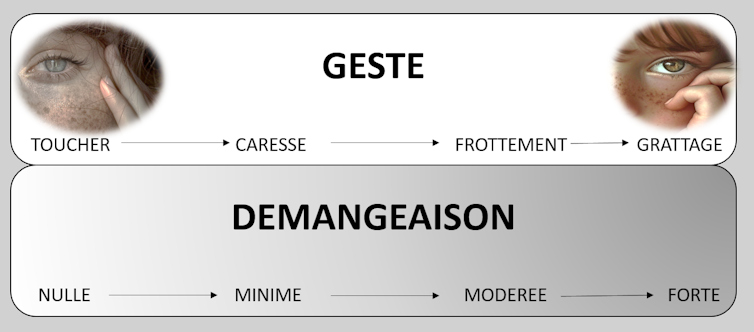
Yet there is a certain continuum in the range of our casual gestures directed at our skin, between frantic, downright painful scratching and the gentle rubbing—bordering on cleansing—applied to the side of the nose or the cheek. And when the conjunctiva of the eye itches, we rub the closed eyelid to avoid injuring this delicate tissue with our fingernail.
This spectrum therefore encompasses both sensation—ranging from intense itching to a complete lack of skin sensation—and movement—ranging from a light touch, a caress, or rubbing to frantic, violent scratching. The figure below illustrates this continuum and the relationship between sensation and movement.
Like any motor behavior, scratching can take on a compulsive nature—that is, it can get out of control, become excessive, and take over one’s life.
In certain extreme, pathological cases, the consequences are far from minor: one team reported observing a patient who, following an episode of shingles, developed an area on her forehead that was devoid of pain sensation. She then began compulsively scratching the area, which eventually broke through the skin and then the skull, exposing the meninges that protect the brain. The image above, reconstructed from the original figure in the article, illustrates the loss of the skull’s contour and the exposure of its contents, visible in the upper left.
Fortunately, these extreme cases are extremely rare! The minor compulsive scratching episodes we may occasionally experience are mainly due to a lowered trigger threshold, stemming from a sensation that we would normally tend to ignore (subliminal).
In short, these are the result of our attention being mobilized—attention that, on certain occasions, is ready to pick up on low-intensity sensory information and respond to it immediately. Obviously, the more attentive we become to these subtle cues, the more we detect them and act on them, so that we find ourselves caught in a vicious cycle. The experiment described at the beginning of this article is an example of this; indeed, simply reading this article may have made you want to scratch yourself…
The attentional filters at our disposal can allow us, when necessary, to ignore supraliminal (an itch) or subliminal (a rubbing motion) messages, but they consume valuable resources in everyday tasks (such as listening to a lecture, to return to the example cited above). When we’re engaged in an activity that demands our attention, our control over our automatic behavior diminishes… and we scratch.
**_Further Reading
- Vercueil, L. *Ticklishness (and Other Minor Neurological Issues)*, Belin.