

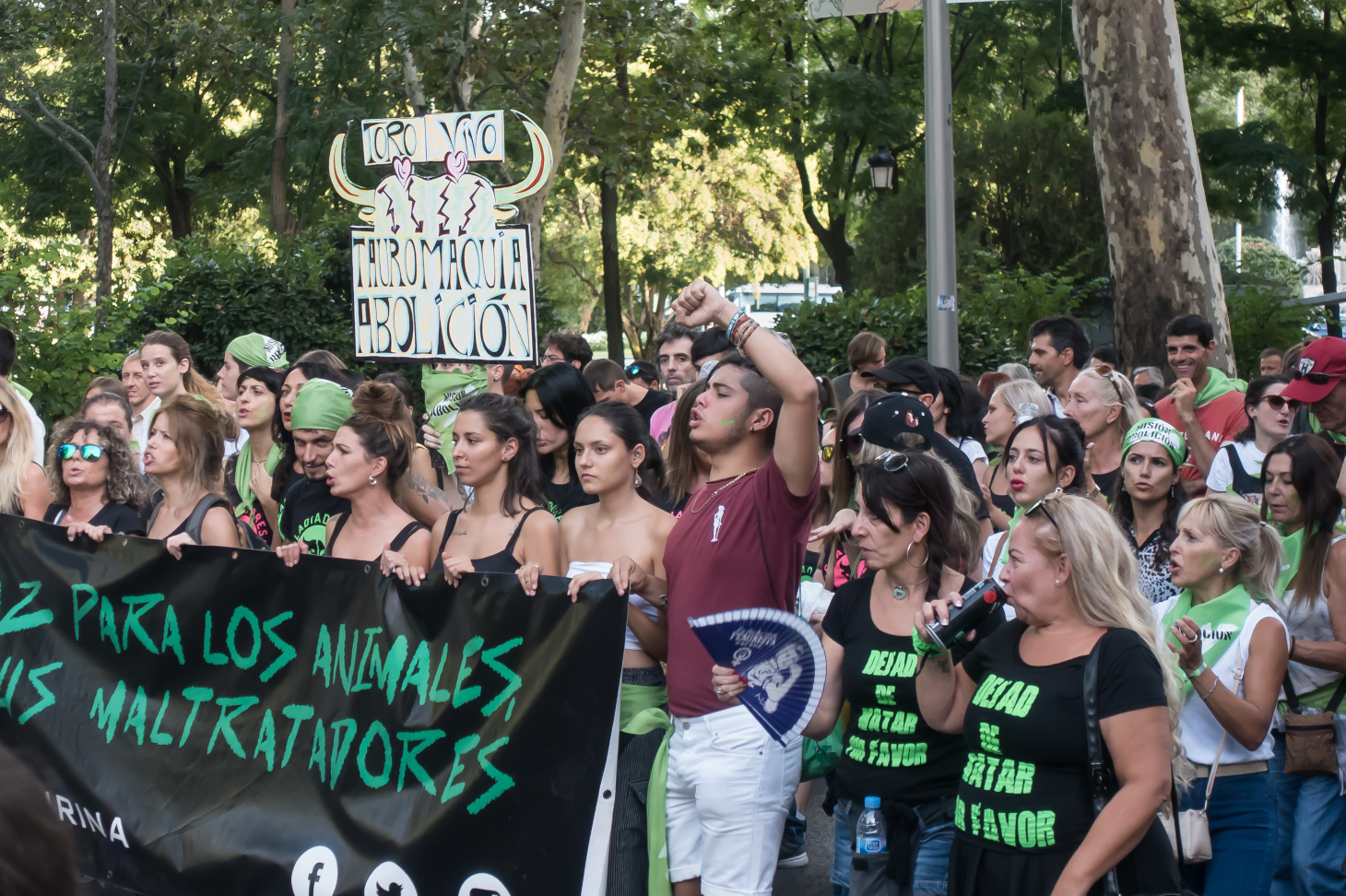
The debate on bullfighting is set to resume in the National Assembly: On November 24, lawmakers are scheduled to consider a bill aimed at banning the practice, sponsored by Nupes lawmaker Aymeric Caron.
Article 521-1 of the Penal Code already prohibits bullfighting (as well as animal cruelty and the killing of domestic animals). However, an exception exists for twelve departments in southern France, where bullfighting is permitted on the grounds of “unbroken tradition.”
In a ruling dated April 3, 2000, the Toulouse Court of Appeals had notably stated, “It cannot be disputed that in southern France—between the Arles region and the Basque Country, between the garrigue and the Mediterranean, between the Pyrenees and the Garonne, in Provence, Languedoc, Catalonia, Gascony, the Landes, and the Basque Country, there exists a strong bullfighting tradition that manifests itself in the regular organization of full-scale bullfighting spectacles (…)”.
In this context, one question has received little attention so far: What about the psychological effects of bullfighting on children who witness it, some of whom are very young?
While it is regrettable that there is a severe lack of specific data on this subject, what we do know about children’s perceptions of animals and violence may nevertheless provide some answers.
According to anthropologists, refraining from harming living beings unnecessarily is a moral principle that human cultures everywhere seek to promote. However, bullfighting practices constitute exactly the kind of “serious abuse or acts of cruelty committed against animals” condemned by Article 521 of the Penal Code, which carries a fine of 30,000 euros and two years’ imprisonment, unless they are committed in one of the French departments granted special exemption status.
[More than 80,000 readers rely on The Conversation’s newsletter to better understand the world’s major issues. Subscribe today]
When children witness such scenes, the consequences for them are likely to be more harmful than for adults, for two reasons. First, violent scenes cause greater distress in younger children. Furthermore, the long-term effects of such scenes are more pronounced in children.
Furthermore, the sight of blood is something that really upsets young children, whether based on their parents’ observations or on the children’s own accounts.
The second reason for children’s potentially greater vulnerability when it comes to bullfighting is less well known. It stems from the fact that children are more concerned than adults about the fate of animals. Studies conducted by researchers at Yale University with children aged 5–9 show that when a dog’s life and a human’s life are at stake, 35% of children prioritize the human, 28% prioritize the dog, and the rest are unable to make a decision. Adults are much less hesitant: 85% choose the human.
Since children are emotionally closer to animals than adults, involving them as spectators in the ritual of a bull’s execution (or even as future matadors) likely affects them more deeply. If adults were offered the option of having a dog impaled in the arena instead of the bull, they would find it unbearable and refuse to participate. However, in a child’s mind, cows and dogs are much closer to one another than they are in ours. Not to mention that horses—animals to which we are very attached—are also sometimes injured or killed.
The comfortable moral boundary we draw between animals that sit on our laps and those that end up in our stomachs stems from cultural perceptions that have not yet taken root in the minds of young children.
Although the available data on the effect of bullfighting spectacles on young children is too scarce and needs to be expanded, it already suggests that some children who attend bullfights are affected by them.
Spanish and British researchers conducted a survey of 240 children in Madrid aged 9 to 12. When asked, “How do you feel when you watch a bullfight?”, 10.4% said they felt happy, 36.8% said they felt indifferent, and 52.8% said they felt sad.
The researchers also showed these children videos of bullfights in which the scenes were accompanied by voice-over commentary. Some of the children heard neutral commentary from a narrator, while others heard enthusiastic and celebratory commentary.
This approach revealed that children who had watched bullfighting scenes accompanied by celebratory commentary subsequently experienced higher levels of anxiety and displayed greater hostility.
These findings are consistent with other studies showing that the impact of a violent scene is greater when it is legitimized by those around the viewer. And what better way to normalize violence than by presenting it as a “party”?
These findings also appear to refute the old catharsis theory, which held that witnessing violence would serve as a release for aggressive impulses. In reality, more often than not, when children witness violence, it causes them distress; and depending on how it is portrayed, it tends instead to trivialize violence or even inspire it.
Furthermore, attending a bullfight sends the message to young people that there is nothing wrong with enjoying oneself by harming animals. This is a cause for concern: in France, a recent survey of 12,500 teenagers revealed that nearly 7% of them had already committed acts of cruelty toward animals. These same perpetrators of animal cruelty were more likely to have committed acts of aggression toward other students.
Can we really believe that the normalization of violence in the arena ends once the bull is dead and we go home?
The Committee on the Rights of the Child, a group of independent experts that monitors the implementation of the United Nations Convention on the Rights of the Child, expressed concern about the impact that bullfighting could have on children under 18—both as spectators at events and as students in bullfighting schools.
This international convention calls for the promotion of children’s mental health and well-being, as well as a “culture of peace and nonviolence.” Reminding French officials that our country had ratified it, the United Nations called on France in 2016 to protect children from participating in bullfighting.
Similar concerns have been raised with the governments of Spain, Portugal, Colombia, Mexico, and Peru.
It is now up to the French lawmakers to respond to this request. A decision is expected on November 24.