

Is France the country where placebos are prescribed most frequently? That’s what an article published in September 2025 claimed, even though the research included only a very small French sample. The authors acknowledge this limitation but nevertheless report that France had the highest reported frequency of placebo use (2.5% of general practice visits).
In fact, the main finding of this study is that more than 80% of general practitioners have already prescribed a placebo treatment in the hope that it would produce a beneficial placebo response for their patients. Specifically, such practices may include common situations such as prescribing an antibiotic (intended to treat bacterial infections, ed.) for an infection likely caused by a virus, or recommending vitamins or supplements in the absence of a deficiency to address mild fatigue or pain. These findings are consistent with previous research on the subject: the use of placebo treatments is common in clinical practice and is most often done without patients’ knowledge, even though its use raises significant ethical questions.
In reality, this debate is not new: for more than 2,500 years, the question of whether or not to inform the patient has been a recurring theme in medicine, and in practice, it is most often the healthcare staff who have retained control over this decision.
What is a placebo?
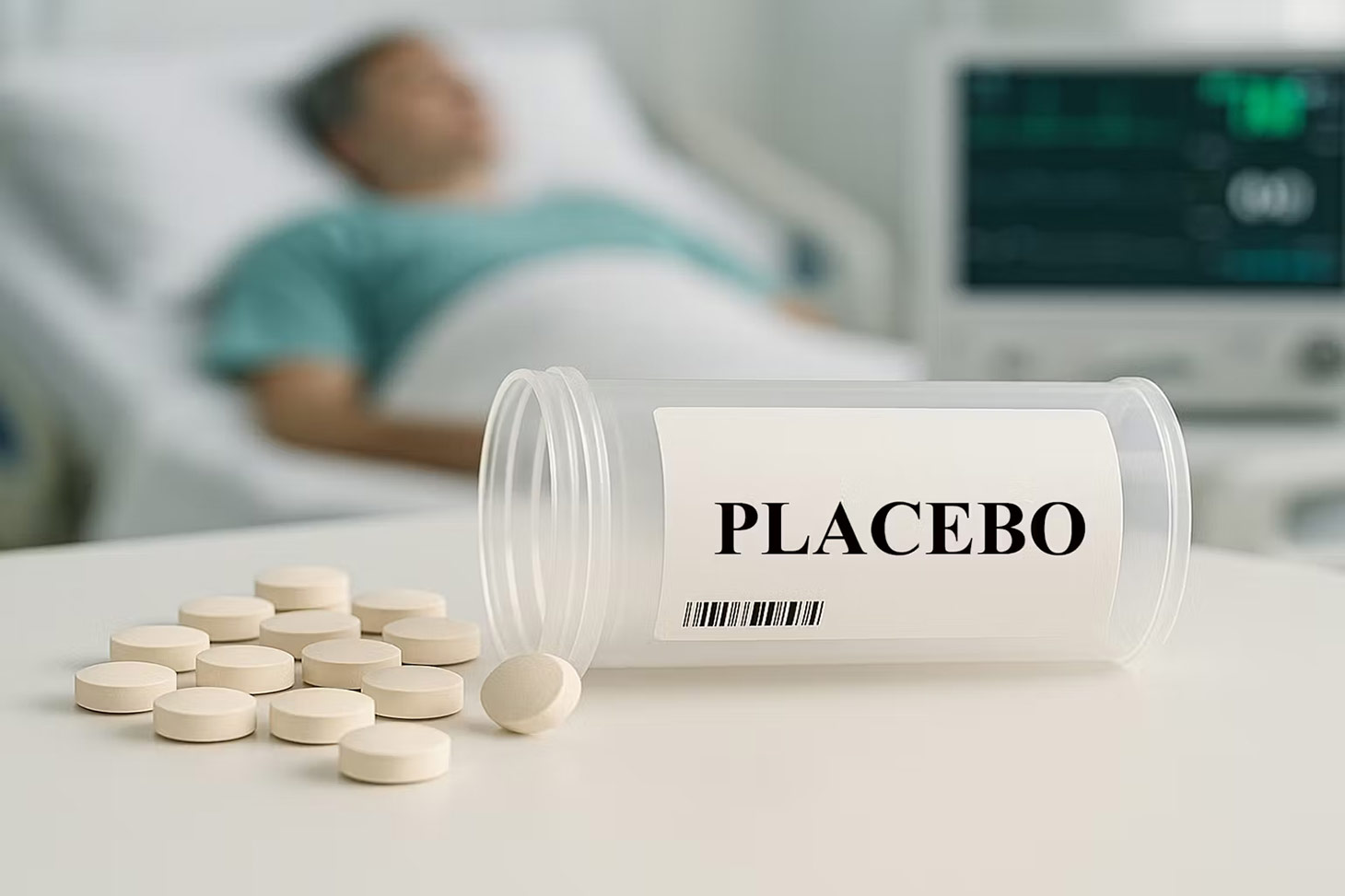
A placebo is an inert treatment with no active ingredient—for example, a cellulose pill that passes through the body undigested. They are often used in research in control groups to test the effectiveness of treatments. But that’s not all there is to placebos.
Some contain active ingredients but have no effect on the symptom being treated. These are referred to as “impure” placebos. As noted earlier, an antibiotic—which is effective against bacteria—becomes a placebo when used to treat a viral infection. In other words, a treatment may be pharmacologically active but act as a placebo when administered outside its intended indication.
Moreover, these prescriptions are not intended to deceive or cause harm. Doctors’ motivations are often much more complex: pressure from patients’ expectations (whether real or not), clinical uncertainty, a desire to “do something” in response to a complaint, or the hope that a treatment might, after all, provide relief.
However, these practices raise significant ethical questions, particularly when patients are exposed to adverse effects—as in the case of antibiotics—without benefiting from their specific efficacy. In all cases, it remains essential to inform patients about the expected benefits and risks associated with treatment. While these forms of pharmacological placebos are relatively easy to identify, non-pharmacological placebos are much harder to detect. In psychotherapy, physical therapy, or surgery, certain interventions can also be considered placebo treatments when they do not produce a specific effect on the targeted symptom.
The placebo effect activates neurophysiological mechanisms
For some time now, extensive research has been conducted to understand how the placebo effect alters our internal chemistry. These studies show that the placebo effect activates very real neurophysiological mechanisms. For example, it can trigger the release of endorphins—substances produced by our brain that alleviate pain—or stimulate dopamine, which is involved in motivation, movement, and attention, among other things. Key regions such as the prefrontal cortex are involved in this modulation. Functional imaging studies, such as fMRI and PET scans, confirm that these brain regions are specifically activated during a placebo response.
In summary, a placebo treatment is a treatment that can take many forms. However, it always works through the placebo response, which includes the placebo effect—that is , the effect of the care setting—or the effect of the passage of time.
Do you have to lie for it to work?
The problem with the placebo treatments currently in use stems from the fact that they are administered without the knowledge of the people receiving them. This prevents patients from exercising their autonomy, which is why the American Medical Association has expressed reservations about their use—especially since placebo effects can be produced without resorting to a placebo treatment, simply through the quality of the caregiving relationship, the attention given to the patient, empathetic listening, or the setting in which care is provided.
This practice raises a genuine ethical dilemma: How can we help patients benefit from the placebo effect while respecting the autonomy and trust of those we care for? For example, if someone is already receiving the maximum allowed dose of morphine but is still in pain, would it be ethical to administer a placebo in this situation? Or, how should we approach more common situations, such as insomnia, where one might want to try a placebo before resorting to something stronger?
There is a simple explanation for this misleading use of placebos: the common belief is that deception is essential. It’s a bit like a magic trick where you don’t want to reveal the secret for fear that the magic will stop working. But this commonly held belief has rarely been tested.
A game-changing innovation: open-label placebos
As good scientists, it’s only natural to test our assumptions in order to confirm or refute them. Yes, sometimes a magic trick remains amazing even when we know how it’s done. A rainbow isn’t any less beautiful when we know how it forms! So studies are being conducted on this topic.
Let’s administer placebo treatments openly, without lies or deception, and see if they produce a placebo effect. Surprise: even when identified as such, placebos continue to work! This raises many questions, including a fundamental one: at what cost does this revelation come? How much efficacy must we sacrifice in order to be honest?
Recently, at the TIMC laboratory in France (UMR 5525 CNRS, Université Grenoble Alpes), we conducted the first non-inferiority study comparing a conventional—that is, deceptive—placebo, administered blind, with an honest—that is, open-label—placebo. It turns out that when the open-label placebo is administered along with an explanation of what it is, it produces the same effect as the deceptive placebo. Since then, the results of this study appear to have been confirmed and raise many points for reflection that we, as users of the healthcare system, can take to heart.
How can open-label placebos make a difference for patients?
Lying no longer appears to be an essential component for achieving a placebo effect. This opens up many possibilities for the use of placebo treatments in collaboration between healthcare professionals and patients. Specifically, this could benefit people with common conditions, such as low back pain—the leading cause of disability worldwide—if the pain persists despite conventional treatments.
Other examples include insomnia, functional disorders, or situations where medication often poses problems in terms of effectiveness or side effects. In such situations, an open-label placebo could complement physical therapy, reduce medication use, and strengthen the relationship of trust with the healthcare provider. In a sense, it involves openly choosing to trick one’s own brain by self-administering a placebo.
Research on these approaches is still in its early stages, and there is still much to learn about open-label placebos before they can be incorporated into clinical practice. But the initial results are promising and open up exciting possibilities for leveraging this approach, offering a simple, risk-free, and transparent option for utilizing placebo effects in healthcare.
Ask patients for their opinions on the matter
Placebo treatments have been used frequently for decades, often in secret. Today, evidence is beginning to emerge showing that deception is no longer necessary for their use. Therefore, we can choose to discuss this with patients, who will undoubtedly have their own opinions on the matter.
Ongoing research will soon shed light on how to incorporate these approaches into our clinical practice, and it’s a safe bet that emerging research on the placebo effect still has a lot to teach us.
But in the meantime, would you be willing to try an honest placebo if your doctor offered it to you?
Special thanks to Dr. Richard Monvoisin, a researcher at theUniversité Grenoble Alpes, and to Prof. Nicolas Pinsault, a professor of rehabilitation sciences, for reviewing this article..