


With the coming winter on the horizon, they must therefore drastically reduce energy consumption— by up to 15% for natural gas at the EU level, and in France, by between 5% and 15% for electricity, depending on how harsh the winter is.
But this summer’s extreme drought also serves as a reminder of the climate emergency and the need to reduce our consumption of fossil fuels in a significant and, above all, sustainable way. In both these contexts—the short-term reality of the war in Ukraine and the long-term challenge of combating climate change—we must both reduce and decarbonize our energy consumption.
For now, leaders are calling for energy conservation “in solidarity” with Ukraine (and to get through the winter), and in the future, to save the climate. But are we talking about the same actions? And how can we make energy conservation a long-term practice so that it is sustainable?
To address these issues, we base our analysis on the main energy uses of a French household using data from the Odyssee/Mure database, which provides a detailed picture of energy consumption. These uses already account for more than 40 percent of final energy consumption. To be comprehensive, the analysis should be extended to the service sector (public and private), freight transportation, and industry.
Energy conservation, which is so often discussed today, is not a new concept. As early as the13th century, Saint Thomas Aquinas was already referring to it in terms of our capacity for self-restraint.
If we replace “wine” with “energy” in the philosopher and theologian’s quote, his definition stated that “the use of [energy] is a matter of moderation. Sobriety is not abstinence; it is the measure of [that use].” Later, during the oil crises, people spoke of “cracking down on waste.”
However, the concept of “sufficiency” is described as an essential pillar of climate policy only in the IPCC’s latest report, published in 2022. And it has appeared in official French discourse only very recently.
Sobriety can be understood in terms of individual behaviors and choices, but also in terms of society as a whole. In this context, we speak of collective sobriety, which is shaped by land-use policies, infrastructure, and technical systems, as well as by behavioral norms and the social imagination.
Since individual choices are partly constrained, we must view individual frugality as “embedded” in collective structures—whether material or immaterial.
In addition to this interplay between the individual and the collective, we must also consider whether or not efforts to conserve resources are reversible: buying a vehicle that consumes 5 l/100km rather than 10 l/100km is a commitment, at least for as long as you own the vehicle; on the other hand, adopting fuel-efficient driving habits when gas prices rise does not guarantee that this behavior will be sustained in the long term…
Housing and passenger road transportation (cars and light commercial vehicles) each accounted for approximately 21% of final energy consumption in 2019, as well as similar energy expenditures, amounting to €1,600 per household per year for each in 2019. Households have room to maneuver to reduce their consumption. If the 10% energy savings projected by the government for these measures were achieved in the short term, this would represent, at a minimum—that is, based on 2019 prices—an annual savings of approximately €320 for housing and transportation.
[More than 80,000 readers rely on The Conversation’s newsletter to better understand the world’s major issues. Subscribe today]
For both sectors, there are three main drivers:
At thefirst level, we find the amount of energy services required: in housing, this involves ensuring a comfortable standard of living for a number ofsquare meters corresponding to the size of the dwelling; in transportation, it refers to the number of kilometers traveled by car each year by the household. We can then speak of “dimensional” energy efficiency.
Atthe second level, we identify the specific energy consumption of the equipment—specifically, the annual energy consumption persquare meter of housing, as measured by the Energy Performance Certificate (EPC)—and, for transportation, the vehicle’s normalized fuel consumption (in liters per 100 kilometers). These indicators relate to energy efficiency.
Finally, thethird level relates strictly to consumer behavior and the intensity of equipment use; in the home, consumption will of course depend on the temperature setting—19 or 22 °C; just as in transportation, it depends on the speed—130 or 110 km/h on the highway, 90 or 80 km/h on other roads.
Isoconsumption curves highlight possible trade-offs between the first two factors: a small, poorly insulated home can consume as much energy as a large, low-energy home; conversely, when it comes to transportation, it is possible to consume little energy while driving a lot, provided the vehicle is highly efficient.
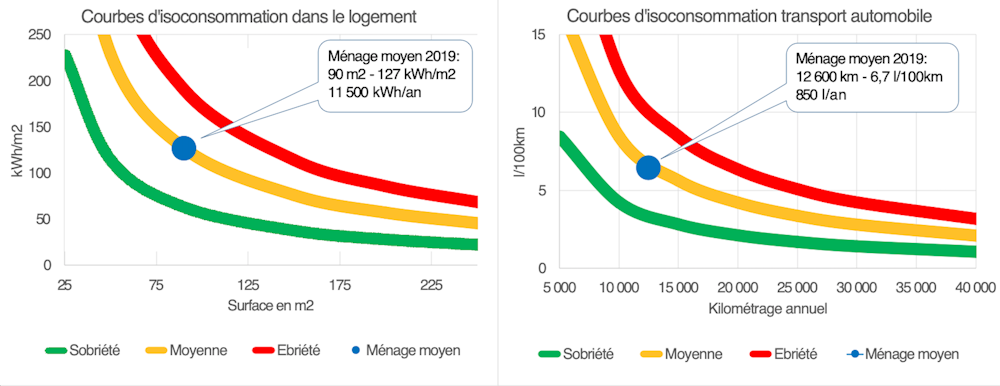
The “roadmap” for carbon neutrality in France is outlined in the National Low-Carbon Strategy (SNBC), the latest version of which, from 2020, is currently being updated.
This roadmap is part of the effort to achieve carbon neutrality and is therefore, in principle, compatible with the European Union’s “Fit for 55” package. It highlights the need to reduce final energy consumption by at least 20% by 2030 (compared to 2015), both in the building sector (residential and commercial) and in the transportation sector (road and other modes); it is important to note that this refers to energy consumption, not greenhouse gas emissions.
This goal is also consistent with the target of reducing total consumption by at least 40 percent by 2050, as set out in the SNBC.
Looking ahead to the coming months, the first steps involve “energy-efficient behavior.” These would include lowering the heating temperature by 1 to 2 °C and heating only occupied rooms. If this measure were widely adopted, it would reduce residential heating consumption by nearly 10 percent.
For motor vehicle transportation, a widespread reduction in speed by 10 to 20 km/h, combined with eco-driving practices, would result in fuel savings of approximately 15 percent.
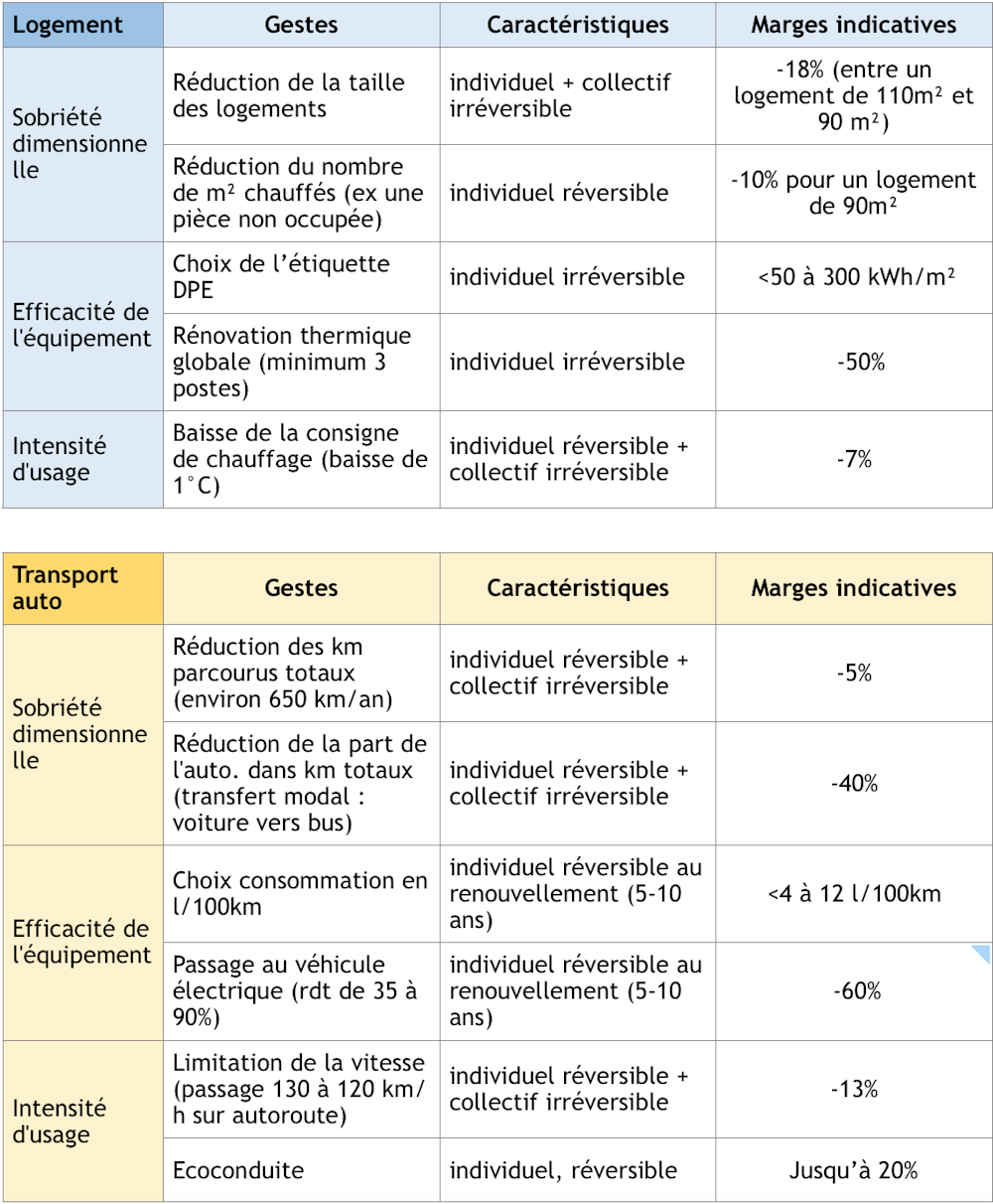
But to meet the 2030 interim goals, we will need to shift toward “energy efficiency through investment”—investing in equipment and infrastructure that reduces energy needs. For housing, efforts toward comprehensive renovation must be further accelerated: this involves renovating at least three areas (for example, roof insulation, window and door replacement, and heating) for one-quarter of the housing stock (7.3 million units); the resulting additional energy savings would be 15 percent.
In the transportation sector, in addition to making eco-friendly driving practices widespread, 10% of the vehicle fleet should be converted to electric vehicles (compared with 1% today), which would result in an additional 6% in energy savings (the efficiency of an electric vehicle is 90%, compared with less than 40% for an internal combustion engine vehicle).
To reduce final energy consumption by 40 to 50 percent by 2050, collective energy conservation will be essential. This will require both strong regulatory measures—such as limiting traffic speeds by decree or banning internal-combustion vehicles—and massive investment in new infrastructure. This is to accelerate the modal shift in transportation (replacing a car trip with a bus or train trip results in a 40% energy savings) and to ensure that all housing units meet low-energy consumption standards.
Significant and sustainable energy efficiency must therefore necessarily combine a broad-based shift toward eco-responsible behaviors with massive investment. This also requires, in both the short and long term, the implementation of coherent policies regarding energy prices and legal standards for behavior and performance.
These initiatives should primarily target public institutions and private organizations (such as Proposed emergency measures in Germany or in Spain). This is a prerequisite for ensuring that households are not the only ones shouldering the burden of energy conservation and that they are thus fully engaged in the effort over the long term.