

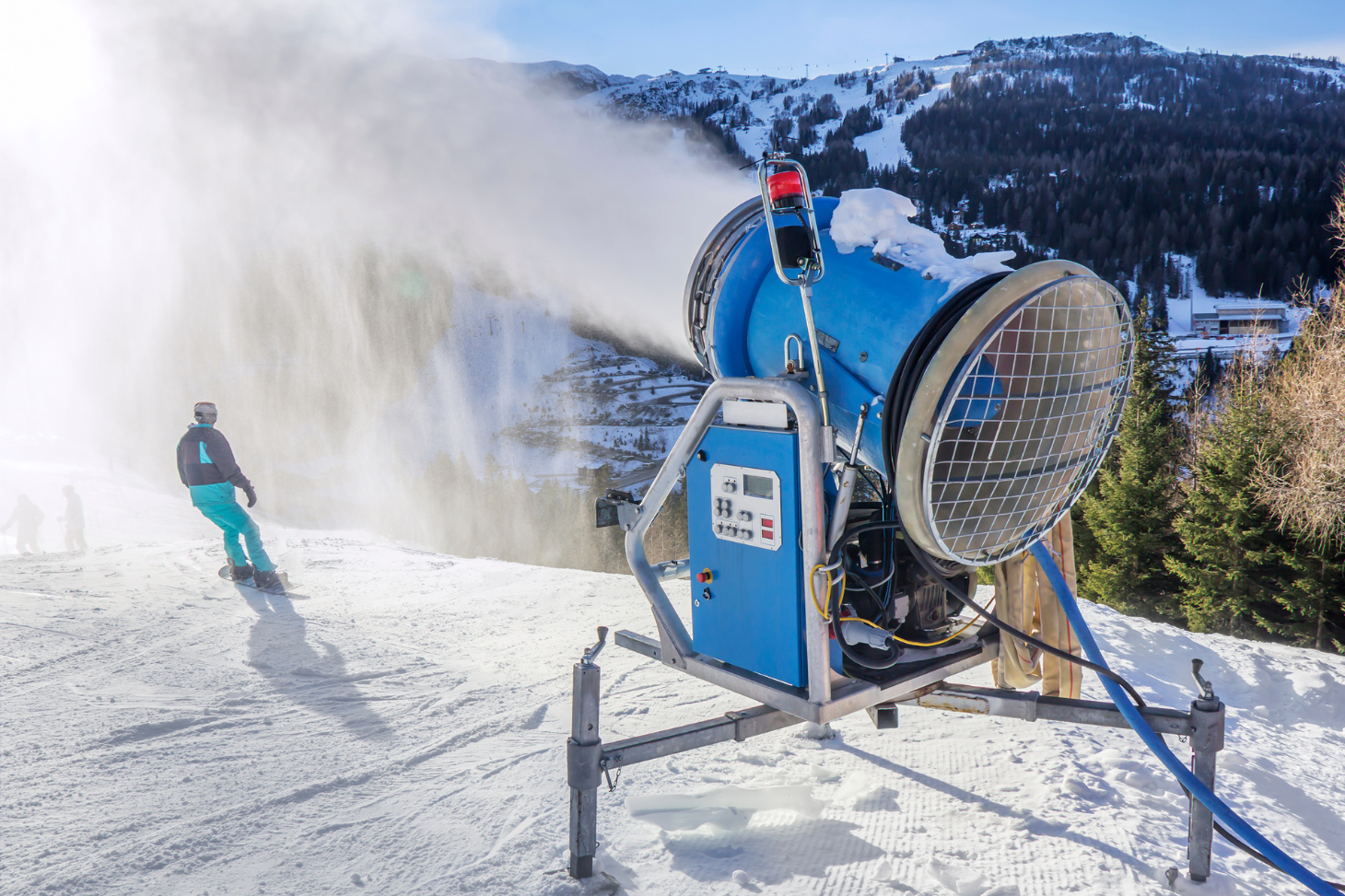
Controversy is mounting over the production of “artificial snow.” In 2022 alone, several events have brought attention to this increasingly criticized practice, also known as “manufactured snow.”
Take, for example, the Beijing Winter Olympics, which were 100% reliant on artificial snow; but also the protest organized in La Clusaz to oppose the construction of a high-altitude reservoir, or the storage and transport of snow for the Biathlon World Championships in Le Grand-Bornand. Finally, the effects of the unusually mild start to the 2022–23 winter season, which led to a severe shortage of snow.
To produce snow, ice pellets with a diameter of a few tenths of a millimeter are created by spraying microscopic water droplets that freeze before reaching the ground. The texture of this snow is similar to that of packed snow.
Criticism of this production has been evident since the mid-2000s, although the equipment used at the resorts has been evolving since the late 1980s. Against the backdrop of climate change, the appropriateness of technical adaptation is being questioned, even as the winter sports industry routinely incorporates it into its practices.
In a recently published scientific article, we analyzed the mechanisms of dependence within the winter sports industry on artificial snow production. Here are the key findings of our research.
Following trial phases that began in 1973, snowmaking expanded within the French winter sports industry.
Once touted as a marketing selling point, this technology has gradually become a standard tool for improving operating conditions at ski resorts. Its installation is now routinely considered, particularly when ski lifts are being replaced.
Between 2005 and 2016, snowmaking accounted for 20% of ski resort operators’ investment capacity, making it the second-largest investment category after the purchase of new ski lifts.
Today, snowmaking is no longer of interest solely to ski resort operators, but to all stakeholders in the winter sports industry. Real estate developers offering “ski-in/ski-out” accommodations, tour operators looking to secure ski pass sales, mountain communities hoping to bring skiing back to the village, and so on. They all want snowmaking to contribute to the success of their projects.
Despite the rapid growth of this technology and the technical advances that have been made, the ability to overcome the variability of weather conditions remains limited.
In fact, the technical adaptation involved in snowmaking does not free operators from certain constraints, such as the need for sub-zero temperatures and the necessity of having access to water resources. Today, the effects of climate change are reducing the thickness of the snowpack as well as the opportunities for snowmaking.
By reducing its dependence on the weather, the winter sports industry has, at the same time, increased its reliance on artificial snow production.
Although future climate constraints may limit the effectiveness of this production, it seems difficult for the winter sports industry to move away from it. This situation, often described as a “headlong rush,” has only recently been analyzed.
Drawing on the “development paths” theory, used in the field of evolutionary economic geography, we demonstrate in our research that snowmaking has led the winter sports industry down a genuine “path of dependence”: past decisions to invest in snowmaking and the benefits it has yielded in the past encourage continued investment, thereby depriving other activities of the resources mobilized—whether economic or natural, such as water resources.
This path of dependency can lead ski tourism down either a so-called “expansion” path or a so-called “contraction” path, each with very different implications for mountain regions.
Viewed as a means of expansion, investment in snowmaking has helped strengthen a weather-dependent seasonal business that shares the characteristics of heavy industry. Indeed, operating a ski resort requires significant capital, particularly for upgrading the ski lift infrastructure, with fixed costs that increase exposure to economic risk linked to the natural variability of snowfall.
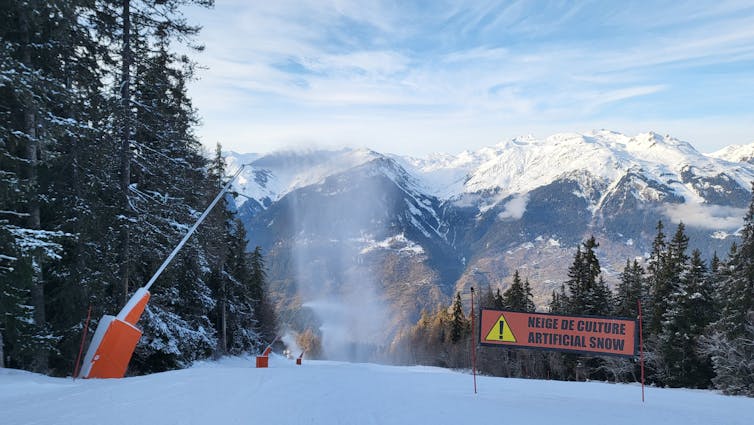
It is estimated that 10% of French people go on winter sports vacations each year, accounting for 7% of the overnight stays by French people in mainland France. France’s 250 ski resorts also provide 120,000 jobs.
But snowmaking can just as easily lead to a downward trend.
Investments in snowmaking are not only highly specialized—and, in part, solely dedicated to sustaining the ski industry—but, above all, they help perpetuate a sector-specific approach focused on the snow tourism economy.
This risk of overspecialization may also extend to mountain regions that host ski resorts. All of the specific resources (infrastructure, skilled labor, technical expertise, etc.), as well as the supporting mechanisms—such as dedicated public policies—delay potential changes and may limit the impact of measures aimed at diversifying mountain economies.
This triggers a negative feedback loop: support for investment in snowmaking facilities diverts resources that could otherwise be used to initiatepotential transitions.
This dependence has mixed effects on mountain tourism regions, and overcoming it requires both economic and institutional coordination.
Public policy therefore has a role to play. While government action has in the past helped mountain regions develop a winter sports industry, the question now is how to manage this legacy. Can public policy help reduce dependence on skiing—or even on tourism—while taking into account the causes and consequences of climate change and environmental issues?