

One year ago, on October 29, 2024, a violent Mediterranean storm struck southeastern Spain, causing catastrophic flooding in the Valencian Community. The disaster claimed 229 lives and resulted in considerable property damage and environmental destruction. Last winter, as the climatic and urban planning causes of the disaster were being established and controversies over political responsibility for crisis management continued, an artist conveyed a message that seems to sum up the lessons that should be learned from the disaster in order to transform the city and repopulate it.
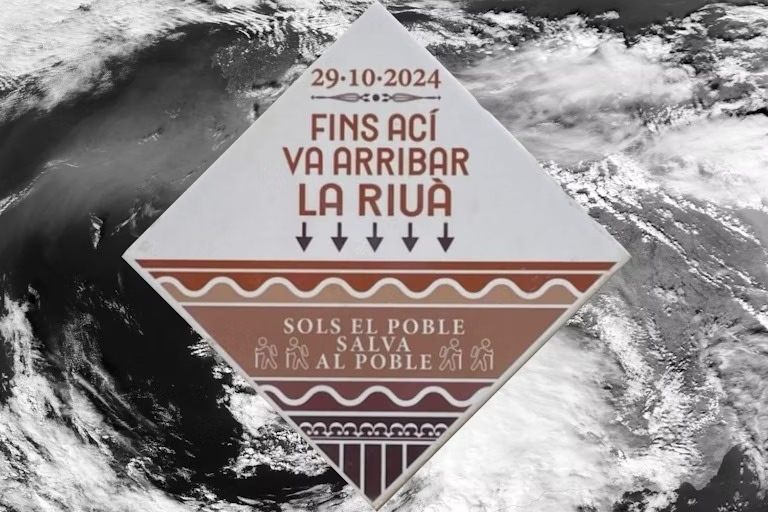
Illustrator Michael Barros, a resident of Sedaví in the flood-prone suburbs of Valencia, launched an artistic initiative in February 2025 inspired by the flood markers installed following the 1957 flood. He initially created about 100 ceramic tiles (azulejos) that he planned to offer to people in his neighborhood. These tiles proved unexpectedly popular: there are now more than 2,000 of them.

The upper part of these azulejos shows how high the floodwaters rose:“Fins ací va arribar la riuà”(in English: “The floodwaters rose this high”). The lower part depicts the great outpouring of solidarity seen during the disaster, when thousands of people came to help. Barros depicts the volunteer rescuers making their way into the flooded area via a footbridge spanning the river.
It also includes the phrase“Sols el poble salva al poble,” which translates to “Only the people can save the people.” This slogan went viral on social media at the time of the disaster and was the subject of press coverage regarding its origin and political use.
In addition to the traditional message conveyed by flood markers indicating the height reached by the water, Michael Barros’s azulejos also serve as a reminder that protecting ourselves from flooding is everyone’s responsibility. This dual message is particularly relevant: while the causes of the 2024 flood and its devastation have been well documented by various scientists, preparing for future high-risk events should not be left solely to experts, whose one-off recommendations can quickly be forgotten. In this regard, the people are truly the protectors of the people.
A worst-case scenario with known causes
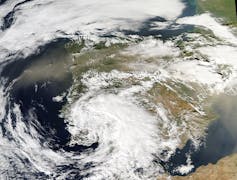
Floods have well-established climatic causes. The weather conditions responsible for the intensity of Mediterranean cyclones are well understood. In the case of the Valencia region, these are often isolated high-altitude low-pressure systems (in Spanish, “depresión aislada en niveles altos” or DANA) that draw enormous amounts of water from the Mediterranean through evaporation and transform it into torrential and destructive rainfall.
Attribution methods show that global warming is responsible, in the Valencia region, for a 50 percent increase in the area exposed to extreme rainfall and for nearly a quarter of the increase in total rainfall.
The resulting disaster was caused by a combination of several factors. To protect Valencia after the devastating flood of the Turia River in 1957, the river’s course had been diverted away from the city center. Since then, to the south of the city, levees have channeled the river toward the sea. Believing the risk of flooding had been eliminated, new residential and industrial neighborhoods—along with their transportation infrastructure—began to develop south of these levees starting in the 1970s, forming the suburb of Horta Sud (in Castilian, Huerta Sur).
In 2024, the Turia River’s floodwaters were effectively contained by the levees, but the Horta Sud area was then inundated by the rapid and massive influx of water from the Rambla de Poyo. A former tributary of the Turia, this minor coastal river (with a drainage basin of 400km²), whose upper basin received extreme cumulative rainfall (nearly 400 mm in six hours), produced a peak flow rate far exceeding that of the 1910 Seine flood in Paris: which was estimated at 3,000 cubic meters per second!

In the Mediterranean region, these small intermittent rivers, the ríos secos, heighten the sense of surprise and disorientation during flooding by concealing the source of the danger. They are invisible during dry weather, hidden by man-made structures, and lack a clear upstream-to-downstream continuity—even in their names.
In addition to these particularly critical meteorological and urban conditions, the lack of timely warnings resulted in a tragic loss of life, along with widespread property and environmental damage. The disaster exposed a significant lack of political and social preparedness.
Involving the Public in Risk Culture
In light of the recurring pattern of similar disasters, the question arises as to the resilience of metropolitan areas in the face of climate-related events—and, in particular, flash floods in the Mediterranean region. The solution must combine an understanding of local historical trends, public engagement, and ecological restoration.
The historical trajectory of economic and social development in Horta Sud was planned with the assumption that protective infrastructure would be in place. Now that this area has proven to be highly vulnerable to flooding from the Rambla, the practical and economic challenges of reducing this vulnerability are considerable.
Adapting the urban form and the activities associated with it will require long-term efforts to overcome the inertia of the institutional system and individual practices.
European, national, and local public policies on flood risk promote public engagement. Their goals of integrating and optimizing risk management lead to the development of a “top-down” risk culture—that is, one driven by expert knowledge— that treats flooding as a matter of “management.”
These policies often overlook the fact that expertise must be accompanied by actions capable of revitalizing commitment and collective action through a “bottom-up” approach. Learning to address risk together—through sustainable practices that directly involve the affected communities—would help avoid the pitfalls of short-term thinking and an overreliance on technical solutions, which have created and will continue to create new problems if nothing changes.
Ecological restoration promises nature-based solutions, the implementation of which is beginning in Valence with measures such as reducing land development and restoring the balance of riverbeds. It often faces resistance due to the inflexibility of development plans and a lack of public commitment— or even hostility.
Revitalizing Collective Action Through a Shared Vision: How Can We Live in Harmony with the River in the Future?
In the immediate aftermath of the crisis, numerous initiatives emerged. These are designed to engage the public, such as educational experiments in elementary schools or valuable amateur weather observations. They deserve to be considered within a broader framework of reflection.
We believe that analyzing relational values—understood as the inseparable bonds between people and the environment—can help identify the main factors motivating the public to participate in flood management. Beyond expert recommendations, this analysis shows that the imagination is a powerful driver of change.
Having a shared vision of how to live with the river in the future appears to be the strongest source of motivation. This is particularly important in light of the chronic loss of memory that sets in over the time that elapses between disasters—what historian Christian Pfister calls the “disaster gap”.

The spontaneous initiative of an artist like illustrator Michael Barros thus takes on its full meaning. As tangible traces of the scale of the past flood, his ceramic flood markers convey a message of reason and hope, insofar as the people who affix them to their homes or building facades take the initiative to do so. In an interview, the artist reflected on their role in collective memory:
“I hope that, over the years, this will become an opportunity to talk and reflect, to share both the good and the bad. This helps create a historical memory, so that the past remains present in our minds and so that it never happens again. Because no one here would want to move away or live with the fear that it might happen again. So we hope that the necessary measures will be taken, that [the authorities] will set aside their conflicts and work with the people—which is important, after all; if you get involved in politics, it’s to work for the people, not for the interests of a few.”
The azulejos Michael Barros’s work can therefore be seen as the sociomaterial path toward a vision he wishes to share so that he can settle back peacefully in his region. This path can—and must—reach a broader community, fostering new values and a new culture around water and flood risk in everyday life.