

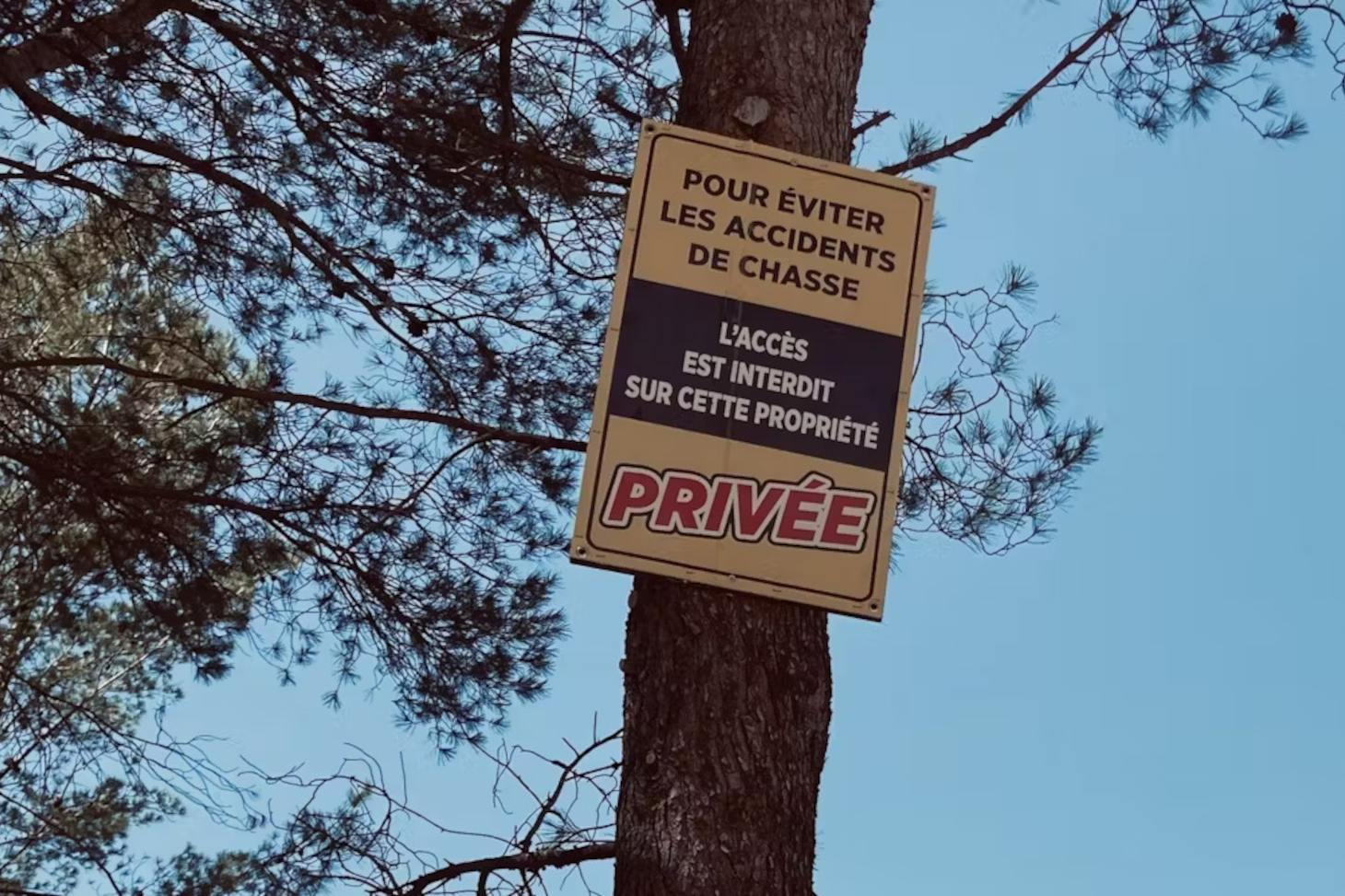
Since the law of February 2, 2023, aimed at limiting the fencing off of natural areas and protecting private property, the mere act of entering another person’s rural or forested private property without authorization—where the private nature of the property is physically marked—can indeed be punishable by a 4th-class citation (a fixed fine of 135 euros). Some landowners in the Chartreuse Mountains in Isère, in the Alpes-Maritimes, and even a forestry association in the Vosges have decided to use this measure to prevent all access to their properties. In response, many individuals and organizations have mobilized to defend the right of access to nature.
While 75% of France’s forests are privately owned by more than 3.3 million citizens—with up to 90% of forests in western France being privately owned, a figure that breaks all records in the Pays de la Loire, Nouvelle-Aquitaine, and Brittany regions—this law reshapes the relationship citizens can have with their environment.
Until then, being on private natural property—regardless of the user (walkers, hikers, mountaineers, trail runners, etc.)—was not punishable in and of itself, as civil law provided mechanisms to compensate for any damages, and criminal law allowed for penalties for trespassing or property damage. The only exception: mountain bikers could already be fined for freeriding in forests (Articles R. 163-6 of the Forest Code and R. 362-2 of the Environmental Code).
Why did it come to the point where this had to be changed?
The desire to reconcile environmental protection with the protection of private property
Originally, the law of February 2, 2023, was the result of a compromise between, on the one hand, the need to make the fences that are proliferating across the French countryside less harmful to biodiversity and, on the other hand, the desire to reassure property owners.
The primary objective of this law was therefore to address the recent surge in the practice of erecting fences to enclose private land, which has direct consequences for the environment and biodiversity, including impacts on ecological corridors and the fragmentation of natural habitats…
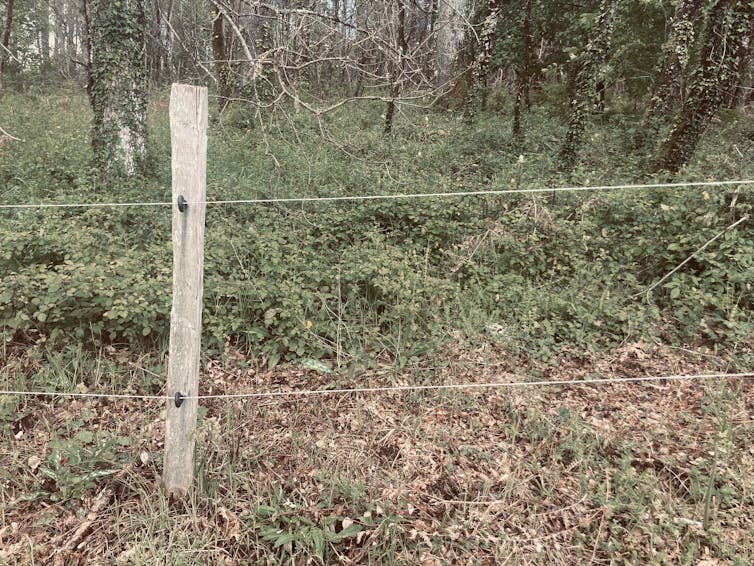
This law thus amended certain provisions of the Environmental Code to incorporate the new requirements for fences: they must be installed 30 centimeters above ground level, have a maximum height of 1.20 meters, pose no threat to wildlife, and be made of natural materials as defined by the SRADDET (Regional Plan for Sustainable Development and Territorial Equality).
The Environmental Code now specifies that existing fences (with certain exceptions, such as those on horse farms or agricultural properties, for example) located in natural or forested areas defined by local land-use plan regulations—or, in the absence of such regulations, in natural areas, must be brought into compliance by January1, 2027, without adversely affecting public health, ecological balance, or agricultural or forestry activities in the area.
Criminalizing Access to Nature as a Radical Countermeasure to Environmental Protection Measures
In response to these measures aimed at “combating the imprisonment of nature” and with a view to reassuring property owners, the legislature has therefore created a new Article 226-4-3 in the Penal Code, which provides for a fourth-class misdemeanor (a fixed fine of 135 euros) to penalize the mere act of entering another person’s rural or forested private property without authorization, provided that the private nature of the property is physically marked.
But since it went into effect, how has this law been enforced?
While, on the one hand, inspectors from the French Office for Biodiversity—who are often called upon by organizations and local residents— are increasingly conducting on-site inspections to identify fences that may not comply with the requirements of the law of February 2, 2023, on the other hand, since the entry into force of Article 226-4-3 of the Penal Code, officers authorized to do so have also been able to issue citations to hikers who have trespassed on clearly marked private rural or forested property belonging to others.
Several specific questions have arisen following the passage of this law: What is meant by the “physical manifestation” of private property? Should a red paint mark on a rock, for example, be considered such a physical manifestation?
Challenges Related to Implementation in the Field
It should be noted that in order for an offense to be enforceable—that is, to result in a penalty—it must be provided for by law in accordance with the principle of legality of crimes and punishments; in other words, the subject matter and nature of the offense must be clearly stated and specified in the law. But if no one is supposed to be ignorant of the law, and if we truly wish to apply legal reasoning to its fullest extent, how can one know whether they are committing an offense when private property is marked only by a sign reading “Private Property—No Trespassing” without any other clear demarcation of the boundaries of the property in question?
Can we honestly expect hikers to find out, before setting out on their hike, the exact boundaries of private properties that they will no longer be able to enter—as they could before the law was passed, when these properties were not fenced off any further? And as for enforcement officers, will every property owner hire sworn guards to monitor and issue citations to potential violators?
While the intention may seem commendable in some ways—given the disruption to ecosystems, safety risks, pollution, and other forms of illegal dumping, and thus the liability issues for landowners—which are difficult to deny and partly linked to overcrowding at certain sites—its implementation is not without complications on the ground. And the recent criminalization has not resolved—but rather, in some cases, exacerbated—conflicts of use with hunters, particularly when nature reserves are, paradoxically, made available to them by landowners, to the detriment of hikers.
A bill to decriminalize access to nature has been rejected
Other European countries, particularly the Scandinavian countries, enshrine everyone’s right to access nature: theallemansrätten has even been enshrined in the Swedish Constitution since 1994: “Notwithstanding previous provisions [regarding property rights], everyone’s access to the natural environment is guaranteed, in accordance with the right of public access.”
This right is an integral part of Swedish culture and allows everyone, everywhere, to camp, access beaches, swim, pick certain wild plants, and even fish for free. In return—because there is a catch—visitors must act responsibly and respect the property owners, and are required to leave the area just as they found it.
Drawing inspiration from this model—and given that the preamble to the Environmental Charter states that the environment is the “common heritage of humankind”—Green Party lawmakers Jérémie Iordanoff and Lisa Belluco introduced a bill aimed at decriminalizing access to nature. The purpose of this bill was to reverse previous legislation by outright repealing Article L. 226-4-3 of the Penal Code. To support their proposal, they highlight the beneficial effects of nature on physical and mental health and the importance of understanding nature in order to raise awareness about its protection.
These lawmakers thus denounce the futility of penalizing the simple act of walking in the forest—since no offense is committed—provided that hikers respect nature and landowners, of course. Any punitive criminal justice system is indeed intended to protect society, and the lawmakers sought to emphasize the absence of danger, invasion of privacy, or damage to property in the case of outdoor activities.
[There are already more than 120,000 subscribers to The Conversation's newsletters. What about you? Subscribe today to gain a better understanding of the world's major issues.]
Their bill was thus presented to the National Assembly’s Legal Affairs Committee on March 27, 2024, but was rejected despite several amendments. Members of Parliament had proposed to mitigate the severity of Article L. 226-4-3 of the Penal Code by establishing exceptions to the penalty in cases where the law permits it and in the case of hiking trails maintained and marked by a recognized public-interest organization, even if they cross private property.
Other members of Parliament had also proposed—to no avail—adding Article L. 361-4 to the Environmental Code, which would have provided that trails and paths marked by a public institution, a local government, or an accredited hiking federation and crossing private property are subject to a three-meter-wide right-of-way intended exclusively for the passage of non-motorized vehicles, pedestrians, and horseback riders.
Toward other solutions that strike a better balance among hikers, landowners, and local governments?
In Quebec, where more than 90% of the territory is state-owned, the physician and professor at the Faculty of Medicine and Health Sciences
Isabelle Bradette now prescribes 20-minute outings in nature to her patients to help them reduce stress: reduced anxiety, improved mood, lower cortisol levels, better mood regulation, increased creativity and concentration, and a stronger immune system. Hippocrates is even said to have remarked, “Nature is the best medicine for humans.”
In France, the goal is actually to strike a balance between the protection of private property and freedom of movement—both of which are enshrined in the Constitution—a balance whose subtlety, however, is not guaranteed by relying solely on repressive measures, while neglecting other, more “democratic” management tools, which, admittedly, require close monitoring during their implementation.
There are, in fact, agreements or departmental plans for walking and hiking trails (PDIPR) mentioned by members of Congress in the report on their proposed bill to decriminalize access to nature. These plans can be signed between willing landowners and local governments to guarantee the right of access to nature while ensuring that it is properly regulated.