


The oil will remain underground. Following the referendum on Sunday, August 20, Ecuador’s approximately 13 million citizens have decided that the country will forgo the financial windfall from the exploitation of Block 43, located largely within the Yasuni National Park and responsible for 12 percent of the country’s national oil production.
While lost revenue was the outgoing government’s main argument, environmental advocates put the figures cited by politicians into perspective. While the state-owned company Petroecuador estimated that halting the project would result in losses of 14.5 billion euros over twenty years, those in favor of halting operations pointed out that these figures did not take into account the highly volatile nature of oil prices, production costs, and, above all, the damage caused to ecosystems.
Through the ballot box, it seems that the protection of these ecosystems and the fight against climate change have triumphed. In terms of the environment, Yasuni National Park is truly impressive. Designated a biosphere reserve by UNESCO, this part of the Amazon rainforest—located 250 km east of Quito, the capital—is also home to two of the last indigenous communities living in voluntary isolation: the Tagaeri and the Taromenane. Finally, Yasuni National Park is home, on average, to more plant species per hectare than all of North America.
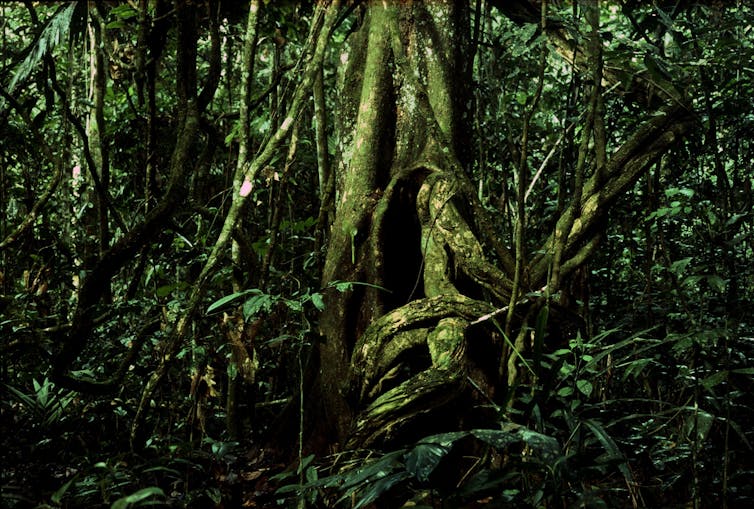
Since 2007, these lush lands in Ecuador have also been protected by the Constitution, which recognizes indigenous peoples’ “collective ownership of the land as an ancestral form of territorial organization.” This applies to the land itself, but not to its oil-rich subsoil, which is owned by the state—a provision that was called into question by this historic referendum.
The “yes” vote’s victory brings an old and complex question back to the forefront: How can we move away from fossil fuels, and oilin particular? The problem is that there is still a lot of oil: estimated reserves are equivalent to the total amount consumed since the beginning of the “black gold” era—that is, the late 19th century. In June 2023, global daily demand for oil reached 103 million barrels, the highest figure in history.
Attempts to leave oil in the ground have nevertheless emerged in recent decades, driven by long-standing resistance movements against oil extraction, particularly in tropical countries, indigenous territories, and protected areas. Before this summer’s vote, there was an unprecedented project in the Ecuadorian Amazon—known as the Yasuni-ITT Initiative—that began in the mid-2000s to halt the exploitation of an oil field, thereby preserving the environment and defending Indigenous peoples. It was this project that we analyzed at the time, highlighting the constant hypocrisy of wealthy nations.
[More than 85,000 readers rely on The Conversation’s newsletters to better understand the world’s major issues. Subscribe today]
The Ecuadorian environmental group Acción Ecológica launched the Yasuni-ITT initiative in 2006. Its unique approach was to leave approximately 20 percent of the country’s oil reserves underground. In exchange for keeping part of its carbon reserves underground and to ensure more environmentally friendly development, Ecuador asked the international community—in the name of the principle of shared responsibility for global environmental issues—for compensation amounting to 50% of the revenue it could have generated from exploiting this oil.
All the major international players backed out. A trust fund had indeed been established under the auspices of the UNDP (United Nations Development Program), but it remained an empty shell. The proposal, presented to OPEC in December 2012—when Ecuador was still a member—was not adopted. Countries and regions—primarily from Europe—as well as multinational corporations, had made vague commitments to contribute to the funding of this fund. But by the spring of 2013, the funds had not materialized. Far short of what Ecuador had anticipated over more than a decade, only a mere 1% of the necessary funds had been raised by that point. Facing widespread opposition—both external and internal—the Yasuni-ITT project was abandoned on August 15, 2013.
Neither the legal battles nor the rights granted to nature in the country’s constitutional amendments succeeded in preventing the exploitation of the ITT fields, for which a permit was finally granted in May 2014. But years of activism by indigenous and environmental organizations ultimately led, in May 2023, to a referendum mandated by Ecuador’s Constitutional Court.
The project has thus become a symbol of the protection of indigenous peoples and the preservation of biodiversity. Leonardo DiCaprio hailed the referendum held on August 20, 2023, and the “yes” vote’s victory as “an example of the democratization of climate policy.” But many other oil fields are still in operation in Yasuni National Park. And projects are proliferating, particularly on the African continent.
The Democratic Republic of the Congo (DRC), for example, has plans to auction off oil drilling permits. Tosi Mpanu Mpanu, the DRC’s climate ambassador, made no attempt to hide the financial ambition behind this idea: “Our priority is not to save the planet,” but to generate revenue.
In a notorious example of “do as I say, not as I do,” U.S. Secretary of State Anthony Blinken and John Kerry, the president’s special envoy for climate, publicly urged the Congolese government to put its plans on hold. At the same time, however, the U.S. administration has shown no willingness to compromise on its dependence on oil revenues, having put hundreds of new exploration permits up for sale since Joe Biden took office.
Kenneth Rogoff, a professor of economics at Harvard, does not mince words when it comes to the North’s hypocrisy on this issue: “For too long, rich countries have lectured developing economies on climate change without applying those lessons to themselves.”
Within the “Global South” —a diverse group of countries, many of which are nonaligned—this reality of double standards is becoming an increasing source of frustration. All of them, led by China, India, Brazil, Russia, and South Africa, are lambasting the rich countries, which continue to practice a policy of double standards: on the one hand, they are increasing their oil production and consumption, and on the other, they are pressuring emerging and developing countries to cut back.
The 59 percent vote by Ecuadorians to halt the exploitation of an oil field in the iconic Yasuni Reserve is, in this regard, hailed by Amazon advocates as “a historic victory” against the extractivist strategies of oil companies and the oil dependency of Northern countries. But it is also proof that the Global South can, without the help or endorsement of Northern countries, chart ambitious policies to protect the environment.
This Sunday, August 20, 68 percent of Quito’s residents also voted against the development of the Chocó Andino gold mine, a biosphere reserve located 20 kilometers north of the Ecuadorian capital.
As for oil operations in Yasuni, the countdown has already begun: Petroecuador, the national oil company, has one year to shut down its wells, dismantle the infrastructure, and restore the forest.
And to offset the shortfall resulting from this loss of revenue from oil, a group of economists who support ending oil production has proposed various measures, such as cracking down on tax evasion or imposing higher taxes on the wealthy.