

If there is one field in which statistical methods and monitoring tools have long been developed and appear to be very robust, it is certainly the energy sector.
The energy crises of the 1970s spurred significant efforts to define units and develop energy accounting systems—such as the national energy balance sheet. This balance sheet presents, in columns, the various forms of energy used and, in rows, the conversion and consumption of these energy forms within a given territory over the course of a year. It is an essential tool for the rigorous and reliable quantification of the components of an energy system.
And yet! Some will remember that moment during the 2007 presidential debate between Ségolène Royal and Nicolas Sarkozy, when the Socialist Party candidate challenged her opponent by asking him about the share of nuclear power in France’s electricity consumption.
The UMP candidate replied, “Half.” “That’s wrong!” retorted Ségolène Royal. “It’s only 17 percent.” Who was right, and who was wrong? “Both are wrong,” most commentators then asserted. In fact, give or take a few percentage points, both could have been right if they had been talking about energy rather than electricity (nuclear power accounted for 78% of electricity generation in 2006).
We must try to understand why, because the interpretation of these figures is not neutral when it comes to developing, discussing, and implementing energy strategies. In particular, the question of the current and future composition ofthe “energy mix” is at the heart of debates on the paths to energy transition.
These differences in accounting stem from the structure of the energy system and the conventions used to convert different forms of energy into a common unit. In particular, it is important to understand how to account for physical flows when conversions—especially those involved in electricity generation—result in significant losses within the energy industries themselves.
For combustion-based energy sources (such as wood for heating, gas for cooking, or gasoline for powering an engine), there’s no problem—or almost none: all you have to do is account for the heat theoretically produced by their combustion. And everything is converted to a common unit: for a long time, this was the metric ton of oil equivalent (toe); more recently, kWh have been used, but internationally, joules (or exajoules for large quantities) are increasingly being used.
Things are getting complicated when it comes to electricity. This is because electricity can be generated directly by converting mechanical energy in hydroelectric and wind power plants, or light energy in the case of solar power. But it can also be generated in thermal power plants, indirectly from heat initially produced by nuclear fission or combustion (coal, oil, natural gas, biomass).
For combustion-based thermal power plants, there are once again few issues: the thermal energy of the fuels at the plant’s inlet must be taken into account. But for nuclear power, how should this be done when, at present, nuclear heat is not used for any other purposes?
There are two possible approaches here: either we measure the energy that will be available as electricity at the output—this is called “consumption equivalence”—or we measure the energy that would have had to be input into a thermal power plant to produce the same amount of electricity—this is called “production equivalence.”
Depending on the reference power plant, that's two and a half to three times as much energy.
Whether electricity is considered on the production side or the consumption side—it sounds a lot like a debate among experts! In fact, it is of the utmost importance for assessing the relative weight of different energy sources in the so-called energy mix and, therefore, their relative contribution to the national energy supply.
But let’s return to the 2007 Royal-Sarkozy debate: the former was referring to the share of nuclear-generated electricity in consumption across various sectors—known as final consumption—where calculations are based on consumption equivalence (1 MWh = 0.086 toe), and the share of nuclear power is fairly limited. Sarkozy, on the other hand, was thinking more in terms of nuclear power’s share of the total energy entering the system, including nuclear heat: when measured in terms of production (1 MWh = 0.21 to 0.26 toe), this share is considerable, even though, to date, this heat has been irretrievably lost. It all makes sense now!
The accounting policies for renewable electricity and nuclear electricity can ultimately result in three types of accounting systems.
Convention 1: Equivalence to production for nuclear power, in order to account for heat loss, but equivalence to consumption for renewable electricity, since there are no production losses in this case; This is specifically the rule adopted in the International Energy Agency’s international statistics, which, for nuclear power, assumes a 33% efficiency ratio between input heat and output electricity (1 MWh = 0.26 toe).
Convention 2: an identical rule for nuclear power and primary renewable electricity, based on equivalence to generation with a hypothetical reference efficiency of 40% (1 MWh = 0.21 toe); this is the option adopted in the BP Statistical Review of World Energy, which is one of the key reference sources for international energy statistics, published annually.
Convention 3: An identical rule for nuclear power and primary renewable electricity, but based on consumption equivalence (1 MWh = 0.086 toe); this rule is not adopted by any institution, but it would at least make it possible, based on the IEA system, to avoid a glaring imbalance in the treatment of nuclear electricity and electricity from renewables: this would prevent nuclear energy from being overweighted by the factor of 3 mentioned above.
Applying these accounting conventions to the analysis of energy systems in France, Germany, Europe, and the world yields very contrasting results, with significant differences depending on the accounting system used.
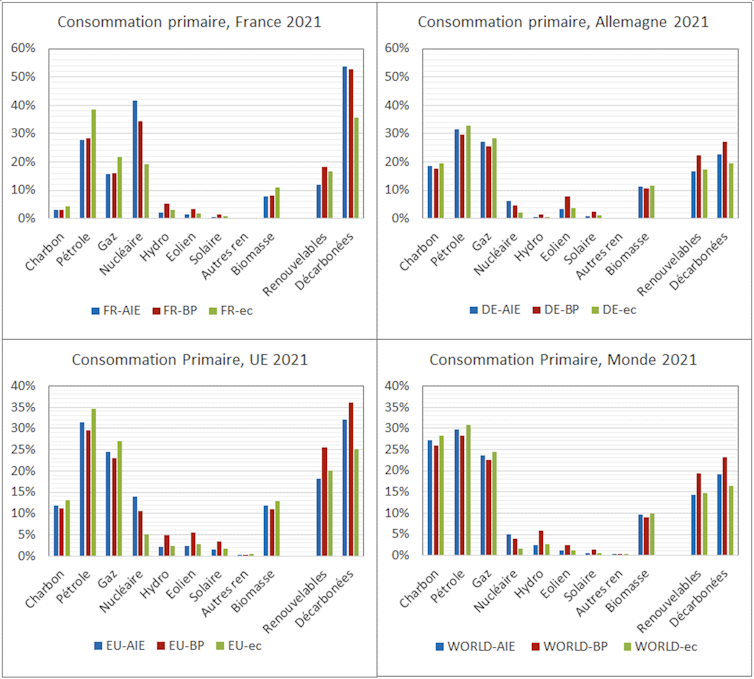
This is obviously the case for France, which is in a unique situation due to the scale of its nuclear power generation. And we see this reflected in the estimates provided by the 2007 presidential candidates: 42% nuclear power under Scenario 1 and only 19% under Scenario 3!
Ségolène Royal and Nicolas Sarkozy would therefore have been almost correct if they had talked about energy rather than electricity; all they needed to do (aside from the confusion between energy and electricity) was to clearly define the terms.
But an examination of primary energy supply yields other insights. For example:
the very small share of nuclear energy, regardless of the accounting method used, both globally (between 1.7 and 5 percent) and in Europe (between 5 and 14 percent);
but also the very low share of “electric” renewable energy, even in Germany (depending on the definition used, between 5 and 12 percent, compared with 4–10 percent in France—thanks to hydropower—6–14 percent in Europe, and 4–10 percent worldwide);
In contrast, biomass makes a fairly significant and stable contribution, at around 10% in all the cases studied.
The categorization of the various sources—first identifying renewable energy sources, then carbon-free energy sources, a category that is essential from the perspective of reducing greenhouse gas emissions—is also very informative.
If we use Convention 2 (BP system), Europe appears to be using more renewables than the global average (25% versus 20%), and if we add nuclear power to calculate the total share of carbon-free energy, the gap widens (36% versus 23%). Similarly, when comparing France and Germany in terms of renewables, France lags behind (18% versus 22%), but is far ahead in terms of total carbon-free energy (53% versus 27%).
After this examination of energy accounting, it is difficult to determine which system would be best: clearly, none stands out as the undisputed choice.
One solution would be to ignore the problem by focusing on final energy consumption. This approach is relevant when examining the structure of energy consumption in the building, transportation, and industrial sectors. But if we are concerned—as has been particularly the case since Russia’s invasion of Ukraine—with issues of energy dependence and energy strategy, then we must carefully examine primary energy, that is, the energy entering the energy system.
And, in this case, it is important to be aware of the pitfalls inherent in accounting system conventions and the fact that they can sometimes lead to very significant discrepancies in the assessment of the contribution of different energy sources.
[Nearly 80,000 readers rely on The Conversation’s newsletter to better understand the world’s major issues. Subscribe today]
From this perspective, the convention used by BP—however imperfect it may be—avoids the unbalanced treatment that overweights nuclear energy in the IEA system by applying an identical convention to both nuclear and renewable electricity. Furthermore, the common equivalence used is simple.
This agreement also highlights the superior characteristics of electricity compared to other energy sources in terms of efficiency: for example, the efficiency of an electric car motor is 90 percent, compared to 40 percent for an internal combustion engine.
If one were to choose from the perspective of an energy strategy analyst—rather than that of a physicist or a pure energy accountant—Convention 2, or the “BP Convention,” would likely appear to be the least bad option.