

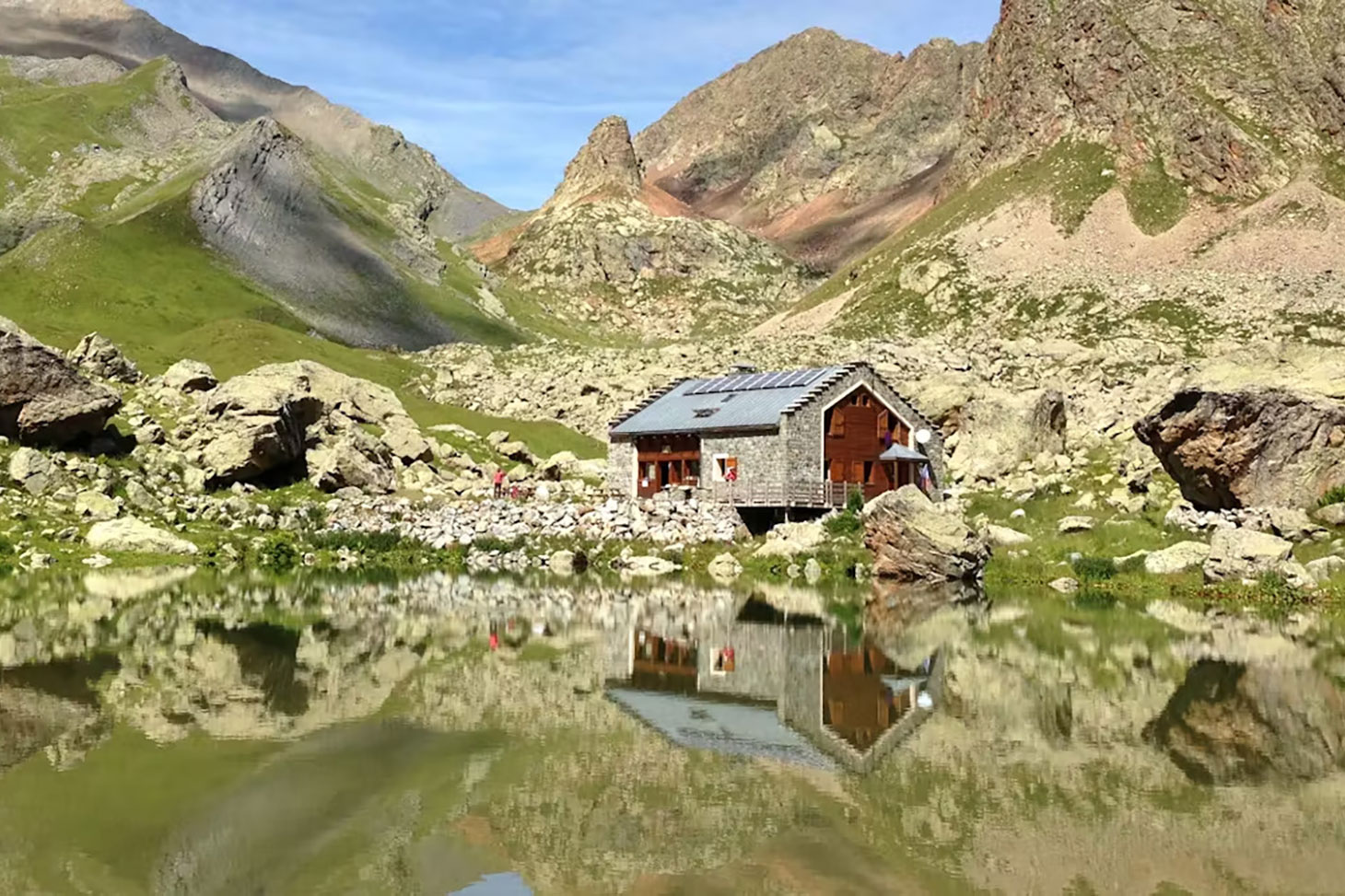
At the interface between valleys and mid- and high-altitude areas, mountain huts are playing an increasingly pivotal role in tourism in the largely undeveloped mountains, as their clientele expands and their status and original functions—providing lodging and meals—evolve and expand. In the French Alps, there are 234 such refuges, representing a total capacity of 9,466 beds, of which 138 strictly meet the three defining criteria set forth in the Tourism Code, namely: the absence of access by road or ski lift, inaccessibility to emergency vehicles for at least part of the year, and the permanent availability of a space open to the public.
Due to their geographic, technical, cultural, and functional characteristics, these accommodations are highly atypical by conventional tourism standards: access on foot to isolated sites of high environmental value, often designated as protected areas; frequent disconnection from communication networks; very limited water and energy resources; significant constraints on the treatment or transport of wastewater and waste; cramped living quarters; the possibility of extreme weather conditions, hazardous situations (avalanches, rockfalls), or accidents; and the need for self-sufficiency outside of staffed periods or in unstaffed huts.
The same is true of the living conditions: communal meals, a single menu for dinner, shared dormitories… These characteristics place them at the heart of major societal issues: our relationship with nature, our attitudes toward comfort and frugality, adaptation to climate change, not to mention social accessibility and community life.
A Revival in Visitor Numbers
Over the past five years, throughout the Alpine region, the number of visitors to mountain huts—measured in overnight stays—has reached record levels. This has been the case in Switzerland since 2019 and in France since 2023.
However, an examination of trends in the number of annual overnight stays over a long period reveals a very mixed picture for France. Nationwide, the number of overnight stays recorded each year at shelters operated by the French Federation of Alpine and Mountain Clubs (FFCAM) has declined sharply after peaking at around 300,000 in the first half of the 1990s.
After a recovery in the early 2000s, followed by a period of stagnation, the total number of annual overnight stays began to rise again in 2017, reaching approximately 370,000 in 2023 and 2024, according to FFCAM data.
For the year 2023, if we also take into account visitor numbers at the 12 mountain huts in the Vanoise National Park, this mountain range has the highest annual visitor count in France (110,000 overnight stays), followed by the Écrins mountain range (76,000 overnight stays), then by the Pyrenees (73,000 overnight stays), the Mont Blanc massif (66,000 overnight stays), and the Southern Alps (34,000 overnight stays).
Differences in visitor numbers between mid-mountain and high-mountain areas
Trends in visitor numbers vary significantly depending on the valley and area, as well as on the altitude and accessibility of the sites. High-altitude mountain huts located above 2,700 meters—which are primarily geared toward mountaineering—are, with a few exceptions, experiencing a downward trend in visitor numbers, while mid-altitude mountain huts or those most accessible to hikers are seeing an increase in visitor numbers.
A stark contrast is becoming increasingly apparent between the limited practice of mountaineering—which involves approximately 200,000 people out of the total French population—and the widespread practice of hiking, which involves 10.4 million participants in non-mountain areas and 6.4 million in mountainous areas, according tothe 2020 National Survey on Physical and Sports Activities.
Furthermore, changing climate conditions have drastically reduced summer mountaineering, which has now shifted by one month to late spring, creating a sense of continuity with ski touring—a sport that has been growing rapidly over the past decade (accounting for more than 30 percent of annual overnight stays in some mountain huts).
Threats, Challenges, and Dilemmas: Welcome to the Refuges of the Anthropocene
At the same time, the impact of climate change on mountain huts is growing, with buildings located in high-altitude mountain regions being the most vulnerable. A recent study of a sample of 45 mountain huts located in three mountain ranges in Switzerland (Valais) and France (Écrins and Mont Blanc) highlights that three-quarters of them are affected by at least two of the five types of impacts identified: deterioration of road access, deterioration of hiking trails, damage to buildings, dwindling water resources, and changes in the conditions for engaging in activities around the mountain huts.
In the 2010s, it was primarily access to the mountain huts in the Mer de Glace basin, in the Mont Blanc massif, that was disrupted by glacial retreat.
Starting in 2020, mountain huts in the Écrins Massif have experienced numerous instances of permanent closures (such as La Pilatte, at 2,577 meters ) or temporary closures, attributable to geomorphological instability caused by glacial retreat, torrential flooding, rockfalls on access trails, or water shortages.
Beyond the mountain huts, the road and hiking infrastructure that provides access to them is also regularly damaged, with the chronic destruction of footbridges and trails being a major issue. In the Écrins, weather events in 2023 and 2024 damaged 30 kilometers of trails out of the 600-kilometer network managed by the national park and destroyed 53 of the 120 footbridges installed to cross mountain streams. The annual budget allocated to the maintenance and restoration of trails and footbridges increased by 65% between 2019 and 2024, rising from 260,000 euros to 435,000 euros (source: Écrins National Park), and represents a financial burden that is becoming increasingly unsustainable.
Increasingly complex operating and security conditions
Climate-related pressures are accompanied by multiple factors that increase complexity, heightening the vulnerability of mountain huts by undermining the balances on which their operation depends. Thus, the trend toward greater comfort and services that has prevailed since the mid-2010s conflicts with the need for conservation in terms of energy and water resources.
Similarly, rising costs associated with renovating and ensuring the environmental sustainability of an aging building stock are compounded by declining public funding.
Faced with such changes, the park rangers—who are classified as self-employed workers— are seeing their responsibilities significantly expand, whether it involves welcoming diverse groups of visitors, sharing information about culture and heritage, explaining changes in the landscape and biodiversity issues, effectively managing the campsite around the mountain hut, providing all kinds of advice to first-time mountain visitors, or even addressing certain clumsy or inappropriate behaviors.
Shelters: Laboratories of Transition
Despite the renewed interest they are generating and their role as a tool for land-use planning and a means of access to the mountains, mountain huts face significant structural and functional uncertainties, and the outlook may seem very bleak. In fact, it is precisely the preservation of the current network that is being called into question by the combined effects of climate-related destruction and the impending collapse of public funding.
The principles governing visitor flow—based on widespread automobile use and in place for decades—need to be reexamined, particularly with regard to access to the upper valleys, the location of parking lots, the network of access trails and footbridges, and the level of maintenance of hiking and climbing trails.
The goal is to redefine tourism and sports practices by envisioning longer stays, itinerant trips, and extended periods of staffed operation. A key challenge involves re-spacing mountain huts at different altitudes and adjusting accommodation capacities (upward or downward, depending on local conditions). All factors that determine the status and operation of mountain huts must now be taken into account, including their social accessibility, environmental sustainability, staffing arrangements, and economic model.
This forward-looking discussion was the focus of creative and collaborative workshops RefugeRemix held in 2019, 2023, and 2024 as part of the research programs Sentinel Shelters* and HutObsTour. As a follow-up to the Rencontres on Sanctuaries at the Heart of Transitions, organized in 2023, this initiative brings together stakeholders in the sector around a platform aimed at developing a roadmap for the future, under the auspices of the Alps Mountain Range Commission and with the support of the Écrins National Park.
The Sentinel Refuges and HutObsTour program teams contributed to this article: Victor Andrade, Richard Bonet, Laine Chanteloup, Mélanie Clivaz, Marc Langenbach, Jean Miczka, Justin Reymond, and Sophie de Rosemont. Thanks also to Brice Lefèvre and Pierrick Navizet.
*The Sentinel Refuges program was launched as part of the ITTEM Labex.