


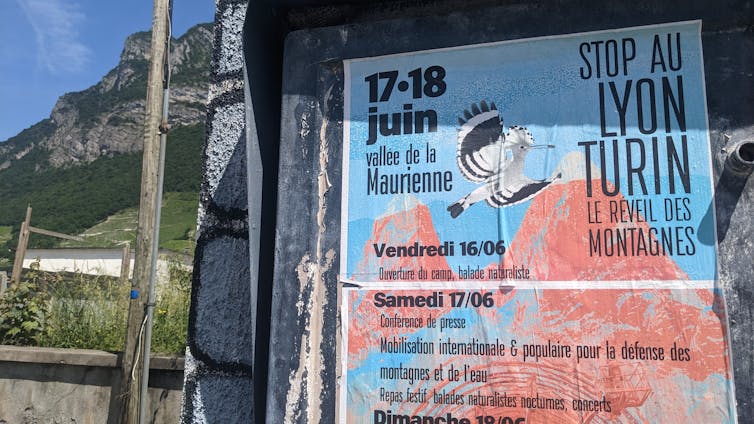
In Savoie, environmental activists from Soulèvements de la Terre broke into one of the construction sites for the new Lyon-Turin rail line on May 29, 2023. A banner reading “The Mountains Are Rising” was unfurled to call for a Franco-Italian weekend of protests against the project, scheduled for June 17 and 18, 2023, in the Maurienne region.
Conceived in the 1980s, the project for a new Lyon-Turin rail line has since faced numerous delays, particularly regarding the route between the Lyon metropolitan area and Saint-Jean-de-Maurienne. Ten years after the 2013 declaration of public utility (DUP), decisions regarding the 140 km of new French access tracks to the 57.5 km cross-border tunnel have still not been made: no schedule, no funding, and no land acquisition.
However, preliminary work on the tunnel began as early as 2002, and it is scheduled to open in 2032. The project is being managed by a consortium of French and Italian companies called Tunnel Euralpin Lyon Turin (TELT), a public developer owned 50% by the French government and 50% by the Italian railways. With a total length of 271 km, the cost of this new Lyon-Turin rail line is now estimated at 26 billion euros, up from the 8.6 billion initially projected.
Its proponents present it as a transportation infrastructure project that supports the ecological transition. According to them, it would eventually relieve the Alpine valleys of heavy truck traffic by promoting a shift from road to rail. Conversely, opponents of the project describe it as a massive, unnecessary undertaking that is destructive to the environment. They argue that the existing, currently underutilized rail line between Lyon and Turin, once renovated, would reduce freight transport by truck.
They argue that priority should be given to the existing infrastructure and that we should not wait years for the modal shift of freight to rail. Supporters of the new project, on the other hand, consider the existing line to be obsolete and inadequate. Underlying this debate are the traffic forecasts for freight flows passing through Savoie: underestimated by some, overestimated by others.
On February 24, the report from the Infrastructure Steering Committee (COI) changed the game. It proposes postponing the construction of new access roads to the cross-border tunnel until 2045 and prioritizing the modernization of the existing line.
The scenario chosen by the Prime Minister calls for the following timeline: studies for new tunnel access roads during the 2028–2032 term, construction to begin in 2038, and completion no sooner than around 2045… which, if the timeline announced by TELT is followed, would be 13 years after the tunnel opens. The prospect of a new tunnel without new access roads is thus taking shape: a scenario that satisfies neither the project’s supporters nor its opponents.
[More than 85,000 readers rely on The Conversation’s newsletters to better understand the world’s major issues. Subscribe today]
On June 12, there was a new twist. The Minister of Transportation announced 3 billion euros in funding for the access roads to the cross-border tunnel, to be included in the 2023 and 2024 budget bills. The government also approved funding for the detailed preliminary design, which will determine the route, amounting to approximately 150 million euros.
It is against this backdrop that the “Soulèvements de la Terre” protest will take place on June 17 and 18, 2023. Its goal is to give national visibility to the demands put forward by opponents: an immediate halt to construction of the cross-border tunnel and the cancellation of the proposed new Lyon-Turin rail line.
In addition to residents’ groups, this opposition now brings together agricultural unions (Confédération paysanne) and railroad unions (Sud Rail), local associations (Vivre et agir en Maurienne, Grésivaudan nord environnement), and environmental organizations (Attac, Extinction Rebellion, Friends of the Earth, Alternatiba, Cipra), political organizations (La France Insoumise – LFI, Europe Ecology – The Greens – EELV, New Anti-Capitalist Party – NPA), and the No TAV Savoie collective.
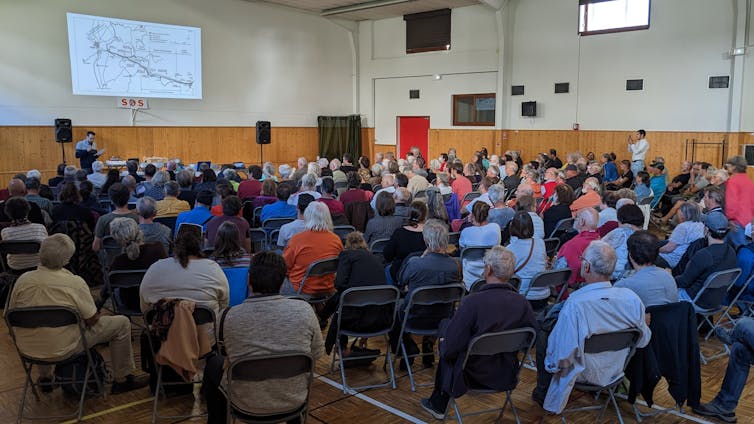
That hasn't always been the case: for a long time, the project seemed to enjoy broad support in France, despite strong opposition in Italy since the early 1990s from the No TAV movement.
2012 marked a significant turning point for the French opposition, which at the time was fragmented and received little media attention. A public inquiry held that year as part of the DUP procedure spurred a resurgence of opposition groups, their advocacy, and their coalition within a new organizational framework. This new structure quickly gained momentum, dominated media coverage, and forged connections with other protest movements in France by joining the network of “Grands projets inutiles et imposés” (GP2I), following in the footsteps of the Notre-Dame-des-Landes movement.
This new publicity campaign is contributing to a re-examination and politicization of the new Lyon-Turin rail line. Some supporters of the project are now switching sides to join the opponents, leading to a broadening of the movement.
EELV, which had supported the project for 20 years, is a striking example of this shift. While it had previously deemed the project indispensable and without alternative—even as opposition intensified in Italy—the “Environmentalists’ Convention on Alpine Crossings” in 2012 marked a change in its position.
This new approach can be summarized as follows: reducing road freight does not depend on the creation of new rail infrastructure, but rather on the transition to a development model that generates less freight traffic, with the renovation and improvement of existing rail infrastructure taking priority in order to manage the remaining traffic.
This position is currently supported by the mayors of Grenoble and Lyon, as well as by EEV and LFI members of the European Parliament and the French National Assembly. However, the French movement has so far remained far removed from the tactics used in the Susa Valley.
This proposed new Lyon-Turin rail line also, and above all, reflects an outdated view of the European landscape as seen through the lens of mobility issues. Just as the construction of rail, road, and later highway tunnels through the Alps since the late19th century has done, it contributes to a kind of leveling of the mountains to make passage easier and thus enable massive and rapid flows of traffic.
This standard for the movement of people and goods reflects a particular worldview. Historian Anne-Marie Granet-Abisset summarizes it as follows: “It corresponds to the models established by urban planners (both political and technical) working in European capitals, who seek to impose their vision on the territories they manage, despite the considerable sums of money mobilized to do so. Any opposition is ignored and portrayed as disinformation or bad faith.”
These issues related to information and communication remain ever-present in the public debate between the project’s proponents and opponents. They give rise to numerous heated exchanges, with each side accusing the other of spreading misinformation—not to mention the journalists and their investigative work.
Since the summer of 2022, tensions have centered on the issue of water resources and the impacts of the cross-border tunnel project on them. This issue will also be at the heart of the protests on June 17 and 18, 2023, in Maurienne, thereby linking them to the other protests spearheaded in recent months by Soulèvements de la Terre. A controversy over the drying up of springs has been ongoing for twenty years in the Maurienne region.
More broadly, the debate over the usefulness and relevance of the new Lyon-Turin rail line highlights the paradox facing the high Alpine valleys. Against the backdrop of the call for ecological transition, this paradox presents a dual and conflicting constraint as historian Anne-Marie Granet-Abisset summarizes : “Regions that must be traversed easily and quickly in accordance with the criteria of transportation economics—a powerful lobby at the European level—and regions that may appear to be unspoiled, rooted in a different conception of time—that of the slow pace of mountain passes and mountain huts—while at the same time being easily accessible from major cities.”