

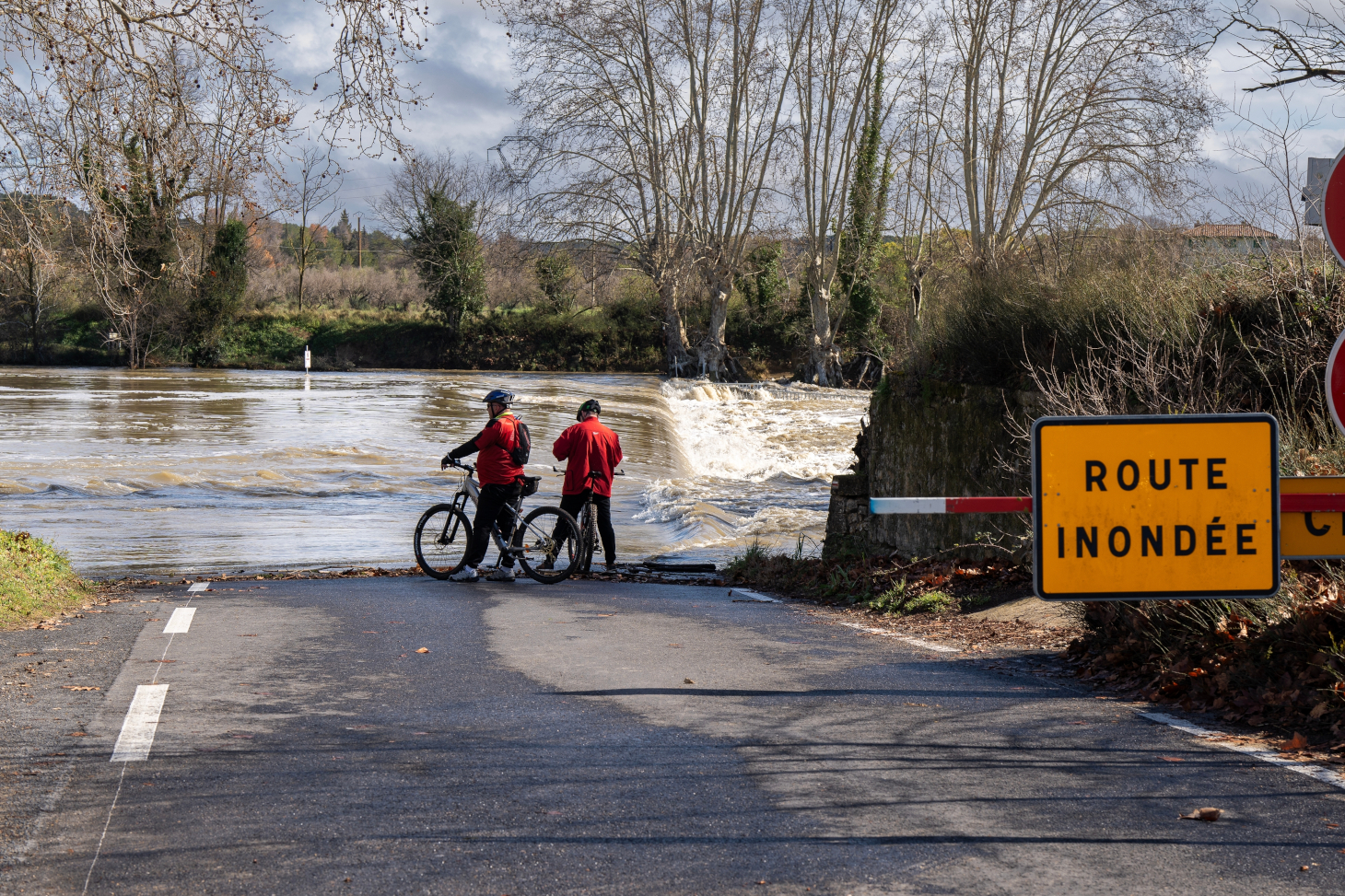
The death toll from the most recent flash floods of this kind, linked to Tropical Storm Monica, has thus risen to seven in the Gard and Ardèche departments.
This is an opportunity to take a closer look at the often underestimated danger posed by these extreme weather events—which are bound to become increasingly frequent—with Isabelle Ruin, a socio-hydrologist at the CNRS, a specialist in the perception of danger, and the author of a dissertation on driver behavior during flash floods.
Flash floods occur as a result of intense, often localized, and short-duration rainfall that causes massive runoff, which particularly affects the road network. The many departments in southern France affected by these episodes of intense rainfall also feature hilly terrain crisscrossed by numerous small, barely visible streams scattered throughout the landscape, which is further intersected by many road routes. Thus, in departments such as Gard, Alpes-Maritimes, and Hérault, the terrain and the increase in impervious urban surfaces contribute to faster runoff speeds, further increasing the destructive power of the water.
These intersections and areas where road networks and waterways overlap are all high-risk locations where drivers on their usual routes may be caught off guard by a rapid rise in water levels. Consequently, people’s exposure to this type of event is not limited to their homes or workplaces; it is even greater on the roads because cars and their passengers are highly vulnerable to these localized flash floods. Nearly 40% of deaths during flash floods occur under these circumstances. In the United States, the figure is even more striking, particularly in Texas (up to 70%), where traveling by car is the norm and fording streams is commonplace.
During rainy spells, the primary challenge is therefore realizing just how dangerous it is to drive in these conditions. But very often, as drivers, we’re on “autopilot,” and our attention is focused on the destination. This can make it difficult to assess whether the rain and the amount of water on the road are serious enough to disrupt our tight schedules.
On top of that, a car provides a false sense of security. Few people realize the power of water and the danger it poses, especially when inside a car. The vehicle is seen as a second home, providing a sense of control and safety. But aside from the risk of hydroplaning, once there’s 30 cm of water and the car is moving, it’s quickly lifted by Archimedes’ principle and rapidly becomes uncontrollable. Then, once the water reaches the doors, it becomes difficult to open them, and very often the power windows stop working because the motor is flooded. The car then turns into a veritable trap.
We generally find it easier to recognize risks in our homes or workplaces because we have a clearer picture of our immediate surroundings, which we experience every day. If you’re a homeowner, you also learn at the time of purchase whether your property is in a flood zone or not. Moreover, in these areas, the building’s design makes us less vulnerable to localized runoff. On the other hand, the risks we face while traveling are often overlooked, even though that is where we are most vulnerable.
The danger posed by our daily commutes during periods of rain and flooding is, in fact, often underestimated. Counterintuitively, it is often small streams—which are usually dry throughout the year—that pose the greatest danger to drivers during flash floods. This is because the danger is linked to the size of the watershed, or the area over which water is collected: the smaller the watershed, the shorter the time between rainfall and flooding. Thus, sometimes just a few dozen minutes are enough to turn a trickle of water into a raging torrent. But when residents are asked about the watercourse closest to their homes, they typically mention the large river where they regularly see water and overlook the tiny stream. During a flood, they’ll therefore think to avoid the areas near large waterways, but they won’t necessarily consider changing their route to avoid that small stream right near their home, which, just a few hours earlier, was dry.
Yes, on the road, at the onset of a rain-and-flooding event, it’s difficult to gauge the water level. The water is often murky, making it hard to estimate its depth. In addition, the force of the runoff often causes damage to the road’s foundation or surface, which can lead to collapses that are hard to spot due to poor visibility caused by the weather conditions. It’s also raining, so intuitively, people prefer to stay dry inside their vehicles rather than get out and seek shelter on foot in a higher location.
[More than 85,000 readers rely on The Conversation’s newsletters to better understand the world’s major issues. Subscribe today]
Yes, that is indeed striking. A survey conducted about fifteen years ago among tourists showed that, in the event of an alert, tourists were more likely to cancel their trips and activities than local residents.
To understand this behavior among residents of the Mediterranean region, who are frequently exposed to these events, it is important to realize that flash floods are very difficult to predict and pinpoint with certainty. As a result, residents are alerted several times a year by orange-level (level 3 out of 4) rain-flood advisories—which are issued at the departmental level to warn of flash floods. However, these events ultimately occur on a much smaller scale than that of the department. Consequently, the orange alert may lose its sense of urgency and tend to be underestimated. When deciding whether to go about their daily activities or avoid putting themselves at risk, residents will be easily tempted to stick to their original plans, since the worst-case scenario is not certain.
Unfortunately, most deaths occur during an “orange” alert rather than a “red” one. During a “red” alert, people clearly sense the imminent danger, and their behavior generally adapts accordingly. Under an orange alert, we’re in a middle ground; we tell ourselves, “We’re not going to change our plans,” especially since, with our inflexible and busy schedules, it’s often difficult to disrupt our routines when the perception of danger and its likelihood are far from clear.
Despite all the progress that has been made thanks to weather radars, some degree of uncertainty will always remain. Everyone must therefore be aware that the information cannot be completely reliable and accurate.
What is certain, however, is that we will have to adapt, because these events will become more frequent and widespread due to global warming, increased urbanization, and greater exposure, and will affect regions of France that are not used to them. We will have to learn to live with this risk rather than try to ignore it by thinking we are safe behind levees and protective structures.
Flash floods are, in fact, among the deadliest weather phenomena because, due to their intensity and the speed at which they occur (ranging from a few tens of minutes to a few hours), they leave very little time for those exposed to seek shelter. They generally affect small areas, but the mortality rate relative to the number of people exposed is thus much higher than for floods on large rivers, which spread very slowly (over several days).
As we can see, flash floods continue to catch people off guard in their daily lives. Most of the time, activities such as commuting to work or picking up children from school are the hardest to cancel. Thus, floods are deadlier when they occur on weekdays during peak travel times. It is therefore essential that all stakeholders in a region agree to incorporate more flexibility into their daily operations. Employers, for example, should be willing to accept potential delays or occasional telework in the event of a flood warning.
We also need to learn to change our instincts. When an alert is issued, our first instinct is to rush home to be with our families—which means picking up our children from school and hitting the road at the very moment when it’s most dangerous. Often, these reactions are driven by emotion, as worry—and sometimes a lack of contact with loved ones—can lead us to make the wrong decisions. However, the best course of action would be for each family member to seek safety in an elevated location wherever they are for the few hours that the incident lasts. At school, children are taken care of because every school is required to have a specific safety plan (PPMS). Whether at work or at home, everyone should prepare a safety plan for themselves and their family or employees by in case of an emergency by developing their own family safety plan.