

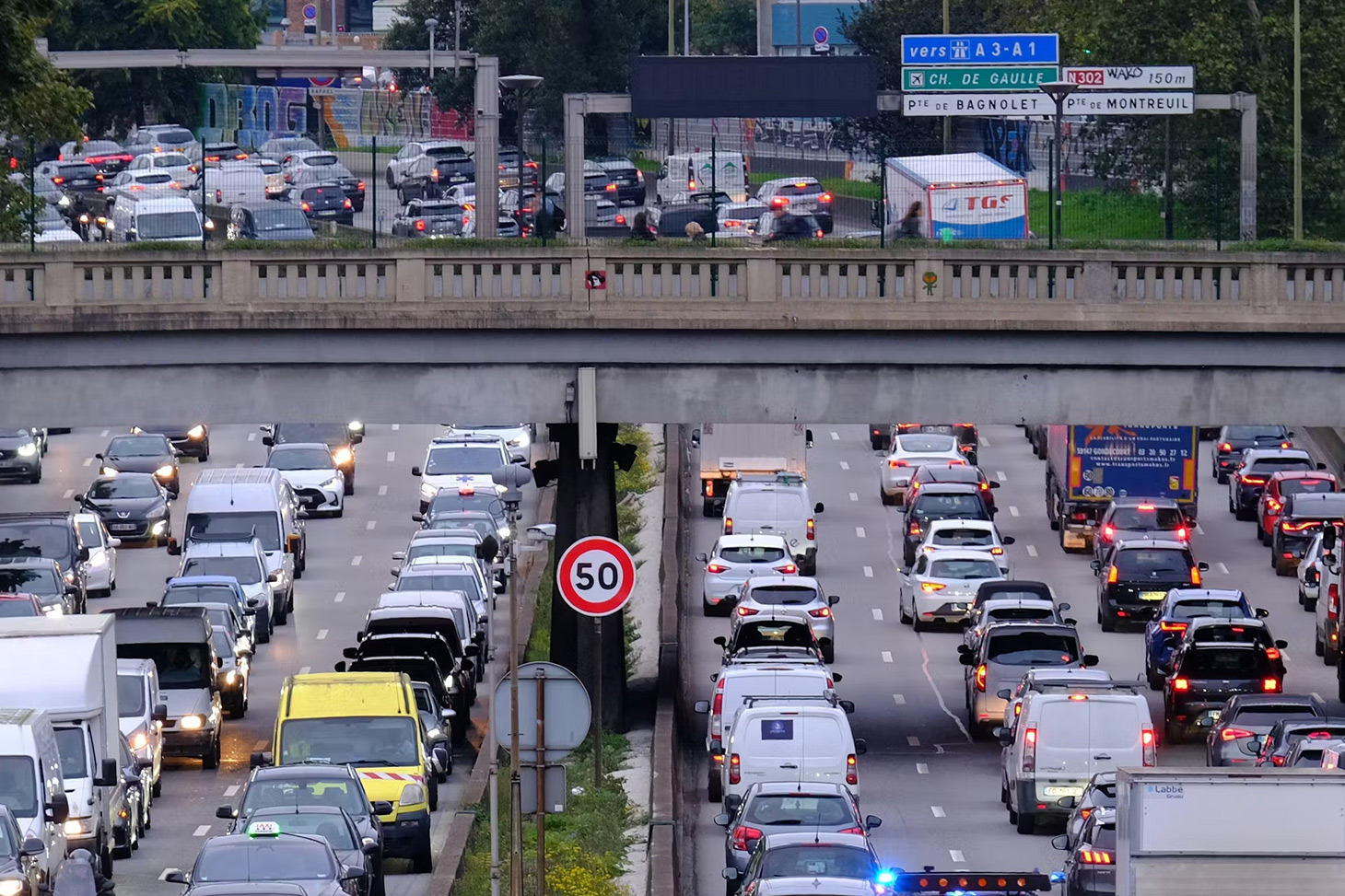
It is responsible for 7% of deaths in France. Air pollution is an invisible but very real scourge. And to tackle this problem, we must first measure it.
This is the work of Cécile Tassel, a doctoral student at the University of Grenoble-Alpes, and Gaëlle Uzu, a research director at the French National Research Institute for Sustainable Development (IRD). These atmospheric geochemists are the authors of a groundbreaking study that has just been published in the journal *Nature*. In it, they present an indicator for measuring the damage caused by fine particulate matter that has rarely been used until now: oxidizing potential. By compiling data from 43 sites across Europe, the researchers have created the most comprehensive database ever assembled on the subject.
The Conversation: Until now, fine particulate matter and air pollution have primarily been measured based on their diameter and mass concentration, usingPM10 (the cumulative mass of all particles smaller than 10 micrometers [µm]) andPM2.5 (particles smaller than 2.5 µm). What are the limitations of these measurements?
Gaëlle Uzu and Cécile Tassel: That’s right. In 1996, in France, the Law on Air Quality and the Rational Use of Energy (known as the “Laure Law”) made the measurement of fine particulate matter mandatory, and the regulatory reference indicator has since been the mass concentration of particles based on their diameter. France was a pioneer at the time, and the EU drew heavily on this law when drafting the European directive. These data are, of course, crucial, since our lungs are supposed to allow only gas flows to enter and exit during respiration. But these fine particles, due to their size, can enter the lungs and disrupt their functioning. Size is therefore, of course, very important, as is the frequency of repeated exposure to these particles.
But these indicators don't tell the whole story. This is because some particles are of natural origin (such as those from sea spray, volcanoes, and forests, where plants emit polyols), while others are man-made, emitted primarily by road traffic.
So if we look only at mass concentration, we might find that a seaside location has the same concentration of fine particles as Grenoble (Isère), a city notoriously polluted in winter due to its geographical location at the bottom of a valley. However, at the seaside, these particles are mainly salt and magnesium, which actually have a beneficial moisturizing effect on our lungs, whereas in the city, they are primarily micrograms (μg) of pollutants emitted by road traffic, which have a completely different effect.
To obtain more information about the physical and chemical properties of the particles and their health hazards, we used another indicator: oxidizing potential.
This indicator measures oxidative stress in the lungs. Oxidative stress is a biological mechanism that signals an imbalance between the amount of antioxidants—which protect us—and reactive oxygen species, which can be released or generated in the lungs following the inhalation of airborne particles. If levels become excessive, increasing oxidative stress can occur, leading to inflammation of lung cells and their death. This is a key biological mechanism in the development of cardiovascular and respiratory diseases, which are among the leading causes of death in France today.
To better understand and combat this problem, we have therefore compiled 11,500 measurements of oxidative potential from 43 sites across Europe.
On the institutional front, this new indicator was recommended in the new European directive on air quality, adopted in late 2024.
From what you're saying, it all seems crystal clear. So why is this indicator used so rarely?
G. U. and C. T.: First of all, it’s a relatively recent indicator. It was first used in research by Japanese and American chemists in the early 2000s, but their studies remained confidential for years. It wasn’t until 2015, in fact, that links were established between human health, on the one hand, and sources of pollution, on the other. From that point on, we were able to incorporate this indicator into somewhat broader epidemiological studies. We were also able to model the sources at the European level.
Since these measurements are relatively new, there is not yet a standardized protocol for measuring oxidative stress, so the results are not always comparable across studies. However, to enable a large-scale comparison, we conducted our 11,500 measurements from across Europe using the same protocol.
With regard to the antioxidants we measure—on which there is not always consensus—we decided to conduct two types of tests that are representative of two major families of pulmonary antioxidants and are also the most commonly used in research to date.
Finally, there is currently no automated device for measuring oxidizing potential in real time. Furthermore, modeling this indicator is computationally very expensive.
If we now turn our attention to the sources of oxidative stress, what do we find?
G. U. and C. T.: The two main sources of oxidative stress are road traffic and wood heating. Wood heating is easy to detect because when wood is burned, cellulose is burned. When cellulose burns, it creates levoglucosan molecules, and we know of no other sources besides the combustion of wood or charcoal that emit them. So when we detect its presence, we know it’s linked to wood heating. This generally occurs between October and March. It’s very rare to measure it in the summer, and when it does occur, it’s likely due to barbecues, but the levels remain negligible. Oxidative stress linked to road traffic, on the other hand, is present continuously, with peaks, of course, during school vacations, for example, or depending on the day of the week.
With all these measures—unprecedented in scope on a continental scale—what findings were you able to make that would have been impossible based solely on measurements of the size and concentration of fine particulate matter?
G. U. and C. T.: For example, we observed that the samples taken in Athens, Greece—where the sampler is located across from the Acropolis in a fairly wooded area—had a mass concentration roughly equivalent to that of a school in a suburban area of an Alpine valley. However, the oxidizing potential is much higher in this suburban area, largely due to its topography, specifically its location in a valley.
We also observed that certain concentration spikes were not so much due to local emissions as to meteorological phenomena, such as episodes of Saharan dust. As such, the oxidizing potential of a single microgram of Saharan dust is not very high; rather, it is the accumulation that is harmful. Our lungs aren’t designed to handle large amounts of sand dust per cubic meter of inhaled air over several days; it irritates them.
Finally, more generally speaking, we observe much higher levels of oxidizing potential at traffic-exposed sites near major roadways than at rural or even urban sites. These differences are not as pronounced when only the mass concentration is measured.
But the good news is that we can take action on the two main sources of emissions: inefficient wood-burning heating and road traffic. Our simulations show that reducing emissions from each of these two sources by at least 15% can lower average urban levels of oxidizing potential to those observed in the least polluted urban areas.
Following this groundbreaking publication, what are the next steps toward better understanding oxidative stress and combating air pollution?
G. U. and C. T.: When we published our study, we proposed target values for oxidizing potential to be achieved across Europe and made our database—along with the code we used to conduct our emissions reduction simulations—available to everyone. These simulations can now be replicated at more local levels to set specific goals and develop strategies for implementation.
Several studies are also attempting to spatially model the oxidizing potential, but this area of research is still ongoing. Prototypes for online measurements of the oxidizing potential are also being developed in several laboratories, including theInstitute of Environmental Geosciences (Isère), but their sensitivity has not yet exceeded that of laboratory measurements.