


Several recent studies show that, while raising awareness can inspire and motivate, it does not necessarily bring about lasting changes in collective behavior. When it comes to climate issues, the emphasis on individual “small actions” can even prove counterproductive by placing the burden of responsibility on individuals and obscuring the role of social, economic, and institutional organizations.
The result: Given the scale of the climate crisis, a sense of helplessness often prevails. This is a legitimate feeling, since even in a “heroic” scenario—where a family takes every possible step to reduce its carbon emissions (diet, transportation, home energy)—the overall reduction in its carbon footprint would still be limited to 30–40 percent. But an alternative path exists: widely disseminating the principles of active education to guide institutional decision-making.
Active Learning: Moving from the Individual to the Collective
How can education go beyond raising individual awareness to become a catalyst for collective and institutional transformation? It is no longer simply a matter of informing people about the severity of the problem or the solutions to it, but of building collective awareness and fostering “acting together” by empowering the public to make collective choices. Furthermore, active education relies on deliberative mechanisms that rethink the frameworks within which choices are debated and made possible, taking into account the public, its experience, and the time available (for example, citizens’ assemblies). These deliberative mechanisms are based on three key principles:
First, to enable the contextualization of data: the orders of magnitude and the information used are directly linked to the group in question and thus become a concrete entity, rooted in real-world practices and institutional constraints.
Next, provide a structured deliberative framework. This often draws on engaging educational methods, such as role-playing exercises or scenario-based exploration. Choices are then approached as collective hypotheses, rather than as individual positions to be defended. When repeated over time and integrated into institutional processes, these approaches make it possible to track the evolution of collective decisions, priorities, and compromises—going far beyond a one-time awareness-raising event with no lasting impact.
Finally, embed the approach within a real decision-making framework. The results of these experiments must be viewed as concrete commitments, intended to guide and shape the future choices of the institutions involved. These mechanisms are thus effective because they bring learning, deliberation, and governance together, forming one of the stages in a decision-making cycle. Active education then becomes an integral part of collective decision-making processes, rather than merely a tool for top-down instruction or communication.
When the institution gets involved
To explore this approach, Sciences Po Grenoble-UGA conducted a large-scale pilot of the participatory tool “Ma Terre,” which uses an ergonomic, immersive, and modular graphical interface to facilitate collective decision-making on concrete choices for the socio-ecological transition and to visualize the effects of different scenarios in real time and in a dynamic way. On October 20, 2025, the MaTerrathon brought together nearly 300 participants—students, staff, and facilitators—at Sciences Po Grenoble-UGA.
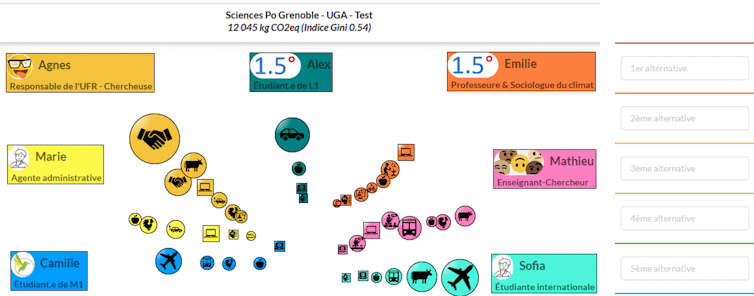
The MaTerrathon took the form of a participatory role-playing game, based on orders of magnitude and data from the institution’s own carbon footprint assessment. Participants were divided into 36 groups of 6 to 8 fictional yet realistic characters, representative of the diversity of genders, ages, and roles within the Institute—a student, a faculty member, an administrative staffer, or even a research director. This allowed for deliberation on an equal footing, with each decision discussed as a collective hypothesis: the goal was to identify concrete priorities for action and understand the compromises necessary to reduce the carbon footprint. The objective was clear: to accelerate Sciences Po Grenoble-UGA’s concrete contribution to theUniversité Grenoble Alpes ’s low-carbon initiative, with a stated target of reducing greenhouse gas emissions by 40% by 2030.
The facilitation of the pair-based activities was entrusted to students, school staff, and members of the Ma Terre collective. Participation by the entire third-year class was made mandatory so that everyone could take part in the institution’s strategic decisions, with a clear goal: to ensure that those who make decisions are not separated from those who experience the environments in question on a daily basis.
MaTerrathon: Some Results
The workshops took place over the course of one morning, followed by a presentation of the initial results in the afternoon. This prompt presentation facilitated a group discussion, allowing participants to analyze the numerical results together—immediately and objectively.
Given the key goal of reducing the facility’s carbon footprint by 40%, the results from the workshops are very encouraging. Specifically, 16 out of 36 tables—or about 45% of the total—met or exceeded this goal. Interestingly, many results cluster around this target value: nearly half of the tables fall within a range of 35% to 45% reduction (with a median reduction across all tables of approximately 39%). This shows that the 40% goal is not an isolated target, but rather one that is achievable for a significant proportion of the participants.
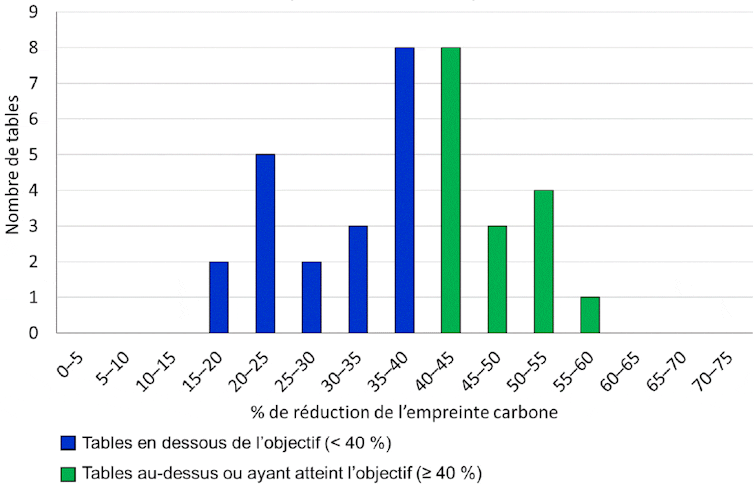
This distribution also reveals natural variability among the different work groups. It shows that achieving the objective is not a one-time stroke of luck, but rather the result of multiple discussions—whose nature, course, and outcomes vary—that together build a coherent collective dynamic. Finally, the reductions observed in various sectors are not random: the restaurant, transportation, energy, and procurement sectors recorded the largest percentage decreases, ranging from 38 to 52 percent.
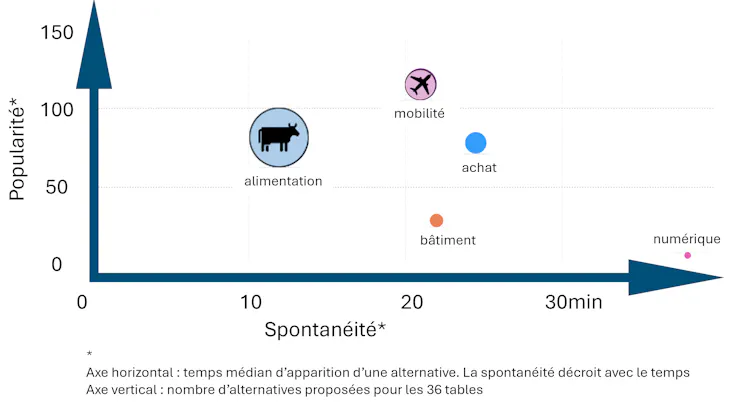
Beyond the reductions, a striking feature of the Ma Terre initiative is that it produces an indirect indicator of the acceptability of the measures by assessing their spontaneity and popularity. By creating a framework that is both structured and engaging, the MaTerrathon encouraged the expression of disagreements while limiting polarization. It highlighted the constraints and areas of flexibility for the various categories of users and staff, as well as those of the institution as a whole, and ultimately made it possible to assess the acceptability of the collective action plan that was developed.
This transformative experience illustrates how an active learning program can become a veritable mini-citizens’ convention, combining training, participation, and collective decision-making, while integrating scientific foundations, educational principles, and institutional mechanisms. This approach strengthens cohesion and a sense of belonging.
However, it is crucial to keep in mind that these figures reflect intentions to change, which may or may not translate into concrete actions. A gap may persist between intention and actual implementation, making it essential to track commitments and evaluate the program in order to turn these ambitions into tangible results.
Changing the scale without losing the meaning
The project isn’t limited to the Alpine University. ENS-Lyon and other institutions have also tested this deliberative approach in higher education. A version titled “Ma Terre en classe” has been adapted for middle and high school students, and its implementation is beginning on a European scale through cross-border Erasmus+ projects (CitEuropass, EU Voices, and EFEU).
For schoolchildren, the goal is to give a voice to future generations so that they understand, from a very young age, the impact of their choices and adopt a sustainable lifestyle. Young people gain firsthand experience that their voices matter and that they can shape the future. These initiatives are in line with the recommendations of the Jouzel-Abbadie report, which emphasizes the importance of early education in collective action, cooperation, and the challenges of the ecological transition. For Europe, the goal is to engage with linguistic and cultural diversity.
Not a turnkey solution
Active education initiatives—whether in the form of school-based workshops (“Ma Terre en classe”), mini-citizens’ conventions in higher education (“Ma Terre en 180 minutes, ” “MaTerrathon”), or European cooperation projects—do not offer ready-made solutions for the socio-ecological transition. However, they invite us to rethink the role of education as a space where shared assessments are developed, trade-offs are discussed, and decisions are made in a clear context based on relevant data. In this sense, active education emerges as an integral component of the democratic transformations required by and for the socio-ecological transition, and offers the possibility of evolving social norms.
This article is republished from The Conversation under a Creative Commons license. Readthe original article.