

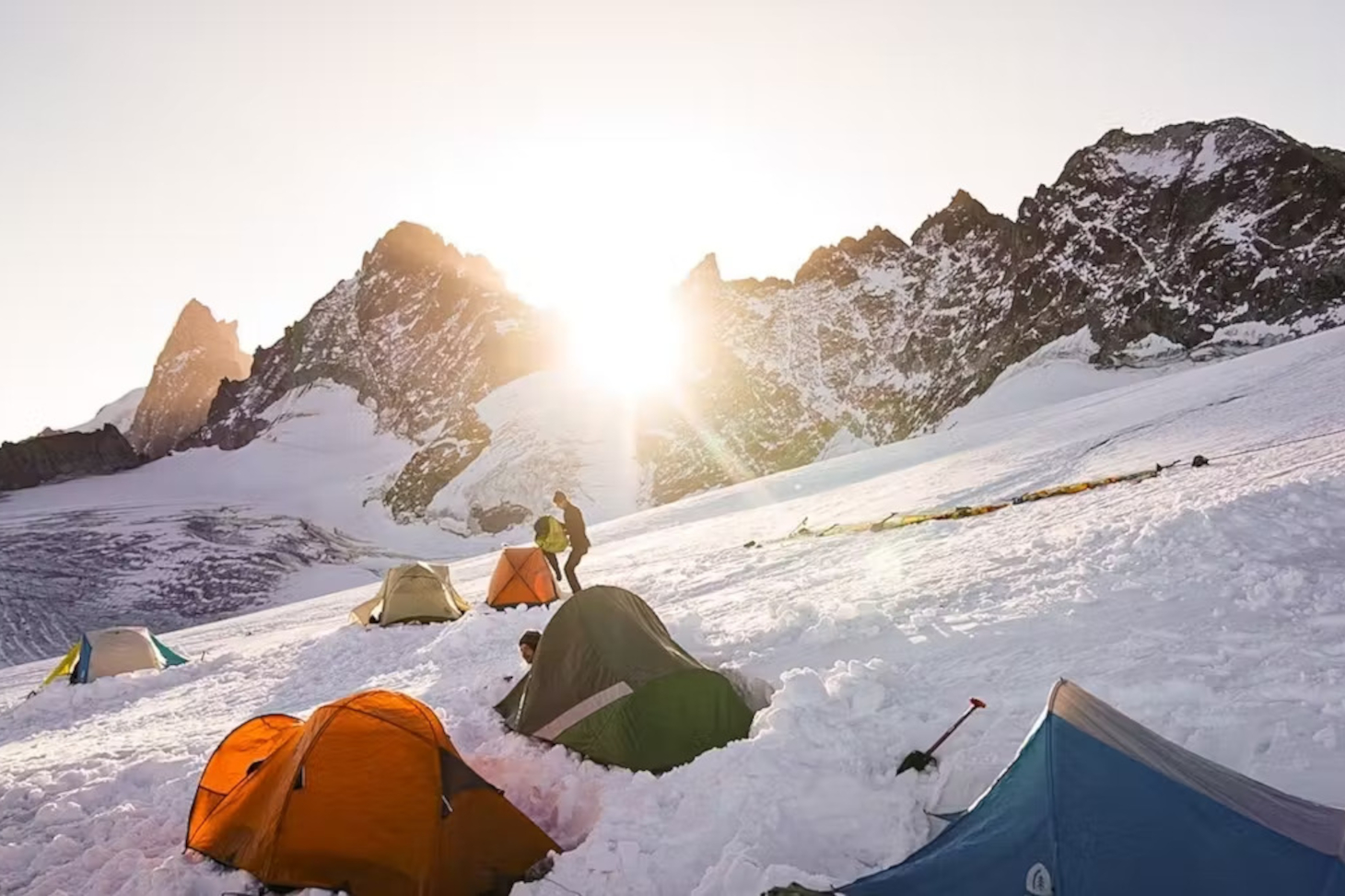
From October 7 to 13, Soulèvements de la Terre (SLT) occupied the construction site to block the preparatory work. The goal of this new development is to extend the two existing sections, which since 1978 have provided access to the Col des Ruillans at 3,221 meters and will eventually connect to the Dôme de La Lauze at 3,559 meters. Led by the Société d’aménagement touristique de la Grave (SATG) and the municipality, this project is estimated to cost 12 million euros—an investment whose merits have divided the residents of La Grave for the past five years.
At the heart of these disagreements lies the question of the direction the tourism transition should take in the face of climate change: should the existing socioeconomic model in mountain regions be strengthened or take a different path?
Setting out from the village of La Grave at 1,400 meters on the night of October 6–7, about fifteen SLT activists climbed 2,000 meters in elevation with backpacks weighing 15 to 20 kg. After a 12-hour climb, they reached the top of a rocky outcrop jutting from the Girose Glacier, where a tower for the new cable car is slated to be built. They set up their base camp there that afternoon, before announcing on social media the creation of “Europe’s highest Zone to Defend (ZAD).”
[More than 85,000 readers rely on The Conversation’s newsletters to better understand the world’s major issues. Subscribe today]
Through this surprise mobilization, the SLT demonstrated that they could be present in areas where they are not necessarily expected, and that for this reason:
They have the logistical resources to carry out an occupation-style deployment lasting several days at an altitude of 3,400 meters.
They have mastered mountaineering techniques and the physical demands of high-altitude climbing.
On the Girose Glacier, the living conditions dictated by the environment are, in fact, nothing like those in other ZADs in France, including those in La Clusaz (in November 2021 and October 2022)—the first of their kind in the mountains, located in the Colombière Woods at an elevation of 1,400 meters. During the week of the occupation, however, temperatures were mild, ranging from -7° to 10 °C, due to an unusually warm fall.
Very quickly, this occupation of the glacier brought national attention to this controversial local development project. As soon as it was publicly announced, a flurry of articles appeared in the national media based on promotional materials (photographs, videos, press releases, and live social media posts) provided by the SLT from the Girose Glacier. The activists on site had the necessary skills and equipment to produce professional-quality content at an altitude of 3,400 meters. They paid particular attention to the media presentation and its aesthetic appeal.
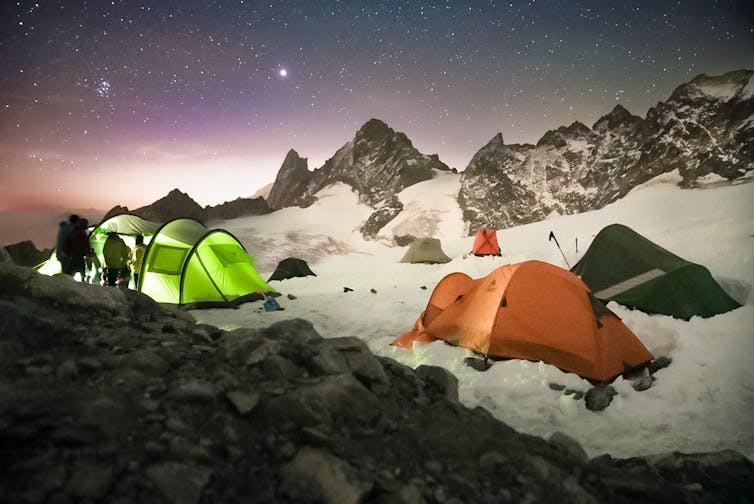
Although unprecedented in its form, as well as in the locations and resources mobilized, this mobilization is part of a shared political framework that references the common good as well as the familiar imagery and narratives of the SLT, which it updates based on this experience in the high mountains. This is evident in the communication strategies employed: references to the ZAD, the strategy of nonviolence, the masked appearance of activists, and slogans such as “the battle for the ice,” “we are the glaciers defending ourselves,” and “it’s urgent, but the SATArde.” Once deployed, this language of mobilization is easily recognizable by the public, whether they support it or not.
This occupation of the glacier was hastily organized in just a few days by the SLT in response to the preliminary work undertaken by the SATG a few days earlier. Its goal was to halt that work following the Marseille Administrative Court’s decision on October 5 to reject an emergency injunction seeking its immediate suspension. Filed on September 20 by local and environmental organizations, the petition aimed, in particular, to protect the Dauphiné androsace found on the rocky outcrop.
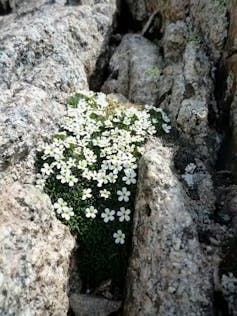
This protected plant, which was not formally discovered until 2021, was identified on July 11 at the site by two scientists from the Alpine Ecology Laboratory (CNRS, Université Grenoble Alpes, and Université Savoie Mont Blanc) and certified by the French Office for Biodiversity (OFB). Their ecological assessment report was made public and submitted to the administrative authorities on July 18: it shows that there are several specimens of the Dauphiné androsace within a radius of less than 50 meters around the proposed pylon site. However, this species is not mentioned in the environmental impact study, and the consulting firm that conducted the study claims to have searched for it without finding any.
Two days after the occupation began, the SATG asked the Hautes-Alpes Prefecture to evacuate the SLT camp so that work could resume as soon as possible. On October 10, the gendarmerie went to the glacier to notify the activists that a municipal ordinance prohibiting camping until spring had been issued. They also informed them that the camp was illegal and therefore subject to civil and criminal prosecution.
In response, a new “motion for a preliminary injunction” was filed the following day by local and environmental organizations to halt the construction work… which was once again rejected on October 30 by the Marseille Administrative Court. This decision is based on the opinion of the Regional Directorate for the Environment, Planning, and Housing (DREAL) and the Prefect of the Hautes-Alpes, who determined that the risk of harm to the Dauphiné androsace had not been sufficiently established. MW and LGA are now considering filing an appeal to the Council of State.
In the meantime, the SLT has decided to return to the valley as early as October 13, since their presence is no longer necessary to prevent the work from proceeding, given that weather conditions now make it impossible to resume the work before spring 2024.
⛏️This Friday, October 13, after a week of occupying the site and blocking construction work on the third section of the cable car on the Girose Glacier, the occupiers are breaking camp and letting the weather continue to halt the work. pic.twitter.com/dKsDvLik3h
— Les Soulèvements de la Terre (@lessoulevements) October 13, 2023
Although illegal, this “temporary” occupation of the glacier could allow the courts to reach a substantive ruling on all the issues contested by local and environmental groups. In this sense, the occupation has helped Mountain Wilderness (MW) and La Grave Autrement (LGA)—which have been fighting the project for five years—to “buy time.” Their actions, which have been ongoing since April 3—the date the town of La Grave granted the building permit to SATG— haveso far failed to prevent construction from beginning…even though their legal challenges on the merits will not be considered by the courts until next year and construction could have taken place before then.
This mobilization by the SLT also forced the project’s promoters to break their silence and take a public stance. They denounced “fourteen crackpots who do nothing with their lives and get in the way of those who work, ” to which the mountain press responded , “The glaciers say thank you to the crackpots.”
In Europe, this mobilization of the SLT in the high mountains is unprecedented in the history of socio-environmental protests against tourism—and, more broadly, in the history of social movements. This lends it a strong symbolic dimension, especially since the future of glaciers has itself become a symbol of climate change and their artificial modification for tourism or sports purposes is drawing increasing criticism in the Alps. The most recent example is the carving of a ski run into a Swiss glacier using excavators to make way for a World Cup ski race.
A similar situation, in which a construction vehicle breaks up ice to level it and make downhill skiing possible, was already observed in La Grave in September 2020. The goal at the time was to get the old ski lift on the Girose Glacier up and running—a lift that the third section of the cable car is ultimately intended to replace… except that the cable car’s objective is to increase the number of downhill skiers on a glacier that is bearing the brunt of global warming, which will subsequently require the use of excavators to secure crevasses. In this context, the question raised by the SLT’s mobilization can therefore be rephrased as follows: Shouldn’t we now leave the Girose Glacier free of all transportation infrastructure to turn it into an outpost for the tourism transition and experiment with a new approach to the mountains?
This issue echoes the French government’s position at the One Planet Summit regarding the need to protect the ecosystems represented by glaciers…with the Girose Glacier development project presenting “a few inconsistencies,” as Christophe Béchu, Minister of Ecological Transition, acknowledges, due to the complexity of the case.
The day after the SLT ended its occupation of the glacier on October 14, a demonstration was organized by the Enseignes de La Meije (an association of merchants in La Grave) to support the construction of the third section of the cable car. For them, as well as for the SATG and the municipality, the resort’s very existence is at risk without this section, a claim disputed by LGA in its analysis of the economic impact on the region. The La Grave mountain guides’ association is also divided on the issue. The debate, therefore, is not simply a clash between glacier lovers up above and businesspeople down below; between those who live in the area year-round and others who are there only a few days a year; between “oddballs who do nothing with their lives” and those who work, and so on.
As is the case everywhere in the mountains, the debate in La Grave is more complex than it seems and calls for a renewal of dialogue if we are to take seriously the inevitable shift in the mountain development model in the face of the effects of climate change. Recognizing that there are not, today, two irreconcilable visions of the mountains does not mean agreeing with everyone upstream on every issue. Disagreements can be fruitful in envisioning the future of the region without the artificial modification of the glacier being the only solution for living and residing in La Grave.
If work on the third section of the cable car is set to resume next spring, the SLT has already announced that it will return to the Girose Glacier.