

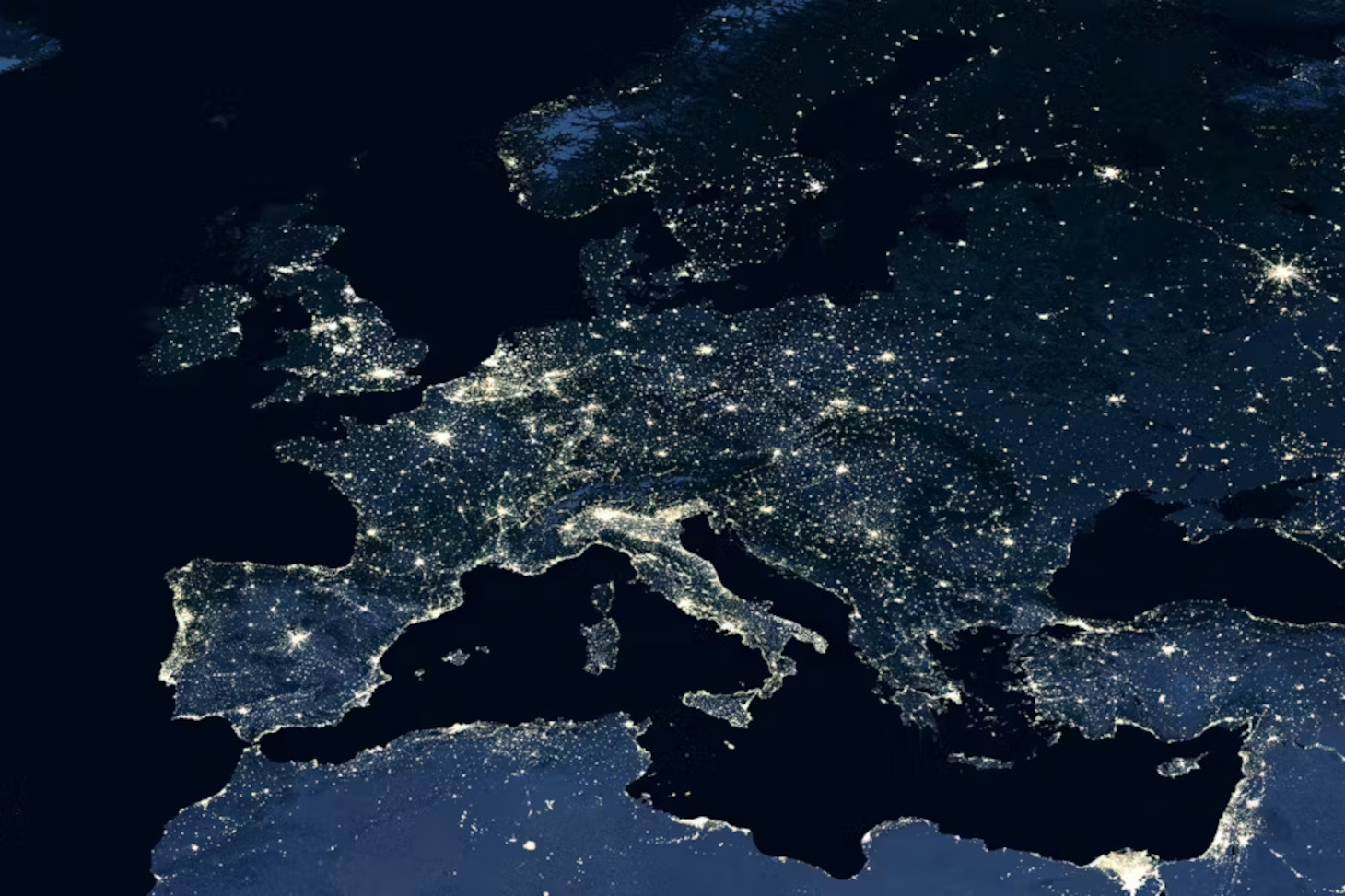
This Saturday, October 12, many municipalities in France will turn off their streetlights to raise awareness about the impact of nighttime light on biodiversity. More generally, local governments’ efforts in this area can be measured using astronomical instruments, either on the ground or via satellite.
This Saturday, October 12, 2024, your city or town may turn off its streetlights. Every year in October, during “Jour de la nuit, ” many municipalities (a map of the lights-out events and activities can be found on the event’s website) participate in awareness campaigns to protect nocturnal biodiversity and the starry sky, coordinated by the association Agir pour l’environnement. In 2023, approximately 300 municipalities carried out a total or partial lights-out. The goal of the initiative is to draw the general public’s attention to the consequences of light pollution, while reconnecting with the night.
Did you know that at the end ofthe 19thcentury, it was possibleto see the Milky Way within the city limits of Paris? Today, nearly one-third of the world’s population can no longer see it, including 60% of Europeans and 80% of North Americans.
A recent study conducted in the United States has shown that there is a strong link between access to a starry sky—which allows people to marvel at the universe—and interest in and engagement with science. Light pollution therefore appears to have an impact not only on biological and ecological processes, but also on human behavior, science education, and society.
In Grenoble, our team measured the effects of light pollution during the 2022 “Jour de la Nuit” event. We used a wide-angle camera from the FRIPON network ( Fireball Recovery and InterPlanetary Observation Network, normally used to detect celestial bodies entering the atmosphere), installed on the roof of our laboratory, and a Ninox photometer loaned by DarkSkyLab.
During the 2022 edition of “Jour de la nuit,” we observed that the light emitted by the sky due to artificial lighting in the municipalities of the Grenoble metropolitan area had decreased by 10% to 15% compared to measurements taken the following day under identical weather conditions.

This modest decrease can be attributed to the fact that few municipalities participated in the lights-out initiative, that only 60% of Grenoble’s streetlights were turned off, and that sources other than streetlights contribute to the light pollution halo, as was observed in the city of Tucson, Arizona. Nevertheless, this demonstrated that it was possible to quantify the impact of street lighting on the measured level of light pollution.
The FRIPON network camera located on the roof of the Grenoble Observatory of Universe Sciences (OSUG) has been in operation since 2016. This has allowed us to assess changes in luminance—that is, the light intensity per unit area of the sky—during cloudless, moonless nights, using a unit familiar to astronomers: apparent magnitude per square arcsecond (which we will discuss further below). This measurement shows a 28% decline over 7 years—approximately 4% per year—with a more significant decline between 2022 and 2023.

Apparent magnitude is a logarithmic scale established by Hipparchus (an ancient astronomer) that measures the relative brightness of celestial objects.
By definition, the star Vega has a magnitude of zero.
The magnitude of a star 100 times fainter than Vega is 5; that of a star 10,000 times fainter is 10; and so on—each factor of 10 corresponds to an increase of 2.5 magnitudes.
A dark sky thus corresponds to a magnitude greater than 21.5, whereas a light-polluted sky in large cities can have a magnitude per square arcsecond of less than 19.
In the case of the Grenoble-Alpes metropolitan area, the maximum magnitude recorded is 19.45 per square arcsecond.
This trend in sky quality is corroborated by measurements fromthe VIIRS instrument, aboard a polar-orbiting satellite that continuously measures the Earth’s surface radiance in the visible and infrared spectra. The figure below shows that the light emission, as measured by satellite over the Grenoble region, has decreased since 2012 at a rate of just over 4% per year.

It is therefore possible to quantify changes in light pollution levels over several years and thereby support local governments in their efforts to reduce public lighting. This also helps raise public awareness of the impact of light pollution and promote the widespread adoption of partial or even total lighting shutdowns in municipalities and regions.
As a result, the Grenoble-Alpes metropolitan area, in collaboration with the Vercors and Chartreuse Regional Nature Parks and the Belledonne area, has expanded the “Day of the Night” initiative into “Month of the Night” throughout October, allowing awareness-raising activities focused on the nighttime environment to be spread out over an entire month.
Light pollution is recognized as a source of environmental disruption. Indeed, living organisms have a fundamental need for darkness. This is obviously true for nocturnal species (28% of vertebrates and 64% of invertebrates), crepuscular species, or those active at night during specific periods such as migration. Light can therefore disrupt their movements, behaviors, or orientation— even in the case of plants and fungi.
A 2024 study, for example, shows why flying insects are drawn to artificial lights. Regardless of species, the day-night cycle is a fundamental element in the evolution of life in general, as it allows for the synchronization of circadian clocks that govern a multitude of metabolic, physiological, and behavioral processes.
In fact, the 2017 Nobel Prize in Medicine was awarded for discoveries related to the circadian rhythm, which is linked to the day-night cycle. For several years now, it has been understood that light pollution affects ecosystems by disrupting the relationships between species.
For example, predator-prey relationships and pollination are affected, causing a cascade of effects on species that were not initially thought to be affected by artificial light. For these reasons, ecologists now consider artificial light to be a major anthropogenic pressure contributing to the decline in biodiversity.
Awareness of light pollution, driven by initiatives such as “Jour de la nuit,” highlights the importance of reducing artificial lighting to preserve nocturnal biodiversity and restore the starry sky to its former splendor.
Recent scientific studies show that every effort counts in reducing this pollution, which has tangible impacts on ecosystems and the quality of astronomical observations. By encouraging the partial or total shutdown of street lighting, local governments are helping to create a future that is more respectful of nature and the fundamental cycles of life.
Once this research is complete, it will be interesting to apply the methodology to the several hundred FRIPON cameras located throughout France and around the world. This network of cameras was not originally set up to measure light pollution levels, but it has proven to be a valuable tool that provides access to years of historical data.