

Although snow conditions have since improved significantly, the start of the 2022–2023 winter season was marked by a significant lack of snow at French ski resorts.
Some resorts could only offer man-made snow runs bordered by grassy slopes. Others were unable to open their ski areas because temperatures were unusually mild. However, according to climate change experts, these abnormal conditions are on their way to becoming the new norm.
In the Parpaillon Massif, between the Alpes-de-Haute-Provence and the Hautes-Alpes, the elevation of the 0 °C isotherm is expected to rise, and some scientists estimate that it will even increase by 300 meters in the spring by 2050.
In this context, there is a growing consensus that diversifying the tourism offerings of resorts is a strategy for adapting to climate change. However, this leads to mixed reactions on the ground: debate, controversy, conflict, and so on. Tensions are particularly focused on the economic and environmental issues surrounding artificial snowmaking, which is used to compensate for the growing shortage of natural snow.
Since 2018, we have been conducting research to better identify and understand these situations.
The Hautes-Alpes is a department with a wide variety of ski resorts that has long faced snow shortages, as was the case in the early 1990s in the Queyras Mountains.
There are as many ways to approach diversification as there are specific regions. In the debate, a spectrum of positions can be observed, with the two extremes being:
On the one hand, diversification can only serve as a complement to the ski resort model, which must remain the main tourist attraction.
On the other hand, diversification is seen as a way to move away from the “all-ski” model.
This highlights the transitional dilemmas facing ski resorts as a whole today —“between creative action, inertia, and maladaptation”—as pointed out by geographer Philippe Boudeau, who questions “the status and role of recreation in these regions.”
In the Dévoluy mountain range, on the border of the Northern Alps, diversification takes the form of costly investments centered on the resorts and designed to complement skiing, which remains the cornerstone of the region’s tourism industry.
In 2013, a 3,200-square-meter multisport center opened in the resort town of Superdévoluy. It features two indoor basketball courts, a climbing wall, four squash courts, a weight room, and a spa. In 2019, a balneotherapy center opened, this time in La Joue du Loup, as part of a real estate development project.
[Nearly 80,000 readers rely on The Conversation’s newsletter to better understand the world’s major issues. Subscribe today]
These two major investments— notably the 6.8 million euros for the balneotherapy center—took precedence over another diversification project launched in 2013. That project proposed creating a museum space dedicated to science in order to develop science tourism outside the resort: “Le Dévoluy: From the Subsoil to the Stars.” It drew in particular on the presence of the astronomical observatory run by the Institute for Millimeter Radio Astronomy (IRAM).
Following the 2020 municipal elections, the new administration radically altered this science tourism project. The plans for the museum were scaled back and shifted to the ski area.
It is now set to be located at the arrival station of a planned ski lift, the purpose of which is to raise the starting point of the slopes to a higher elevation. The project also includes the creation of a high-altitude lake formed from the two existing hillside reservoirs currently used to produce artificial snow. The cost of these new developments is estimated at 28 million euros. This decision reflects a ski-centered approach to adapting to climate change in the Dévoluy region.
Further east, the Queyras Regional Nature Park is characterized by a diverse landscape full of contrasts—one that is potentially controversial, as illustrated by the recent episode involving the scientific astro-tourism project in Saint-Véran. Spearheaded by the municipality in 2019, opponents suspect it of being a pretext to reinforce the ski resort model. It sparked controversy in the village, which led to the project’s abandonment in 2020 following the election of a new municipal administration.
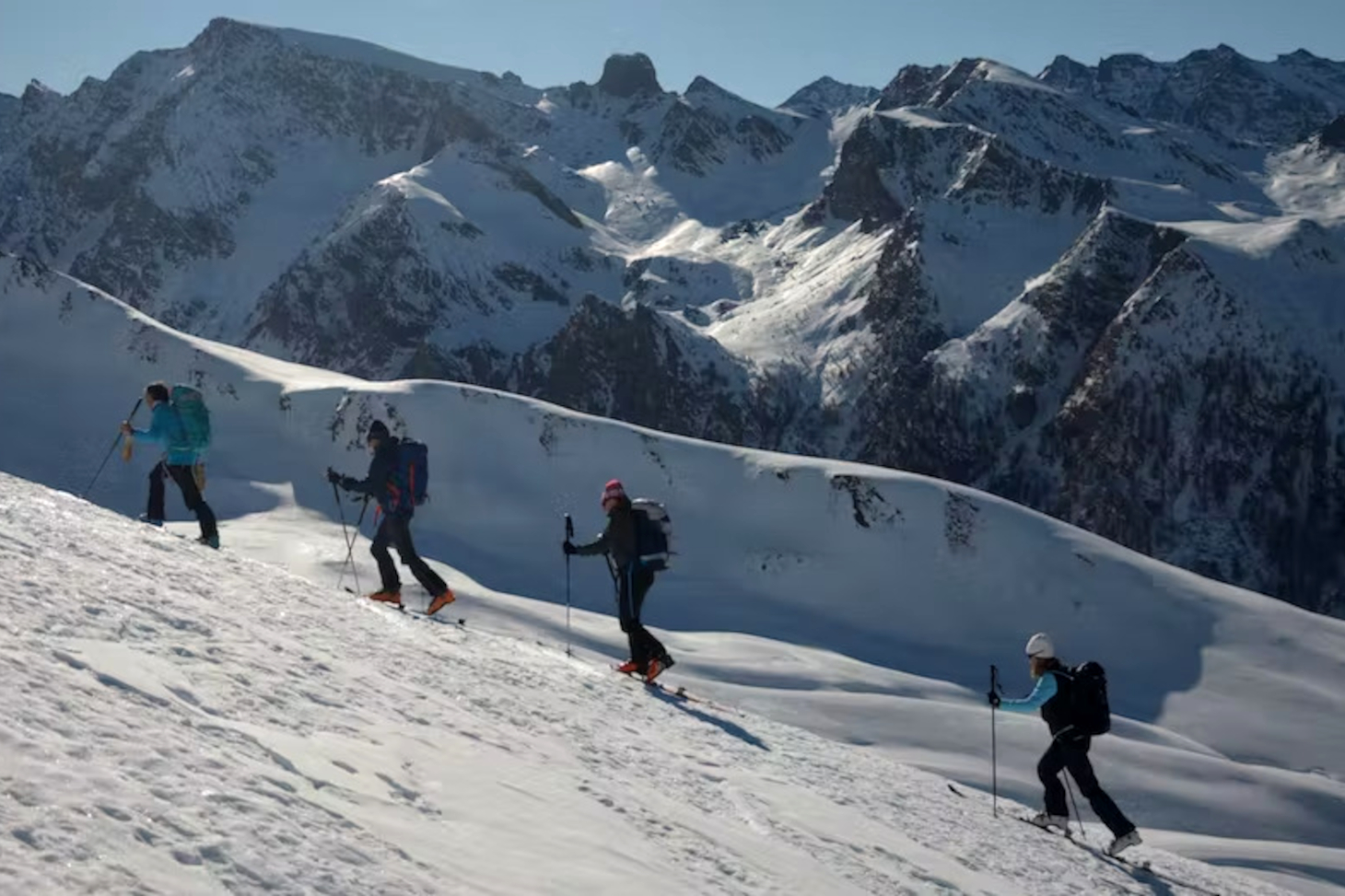
In Aiguilles, a high-mountain guide created France’s first marked ski-touring trail in 2009 on the site of the former alpine ski resort, which had closed in 2007 following the reorganization of the resorts in the massif. In 2014, the pilot program was abandoned due to a lack of institutional support, before being relaunched in 2022 as part of the permanent conversion of the alpine ski area, spearheaded by the new municipal government. It thus took fifteen years for this innovative initiative to begin finding its place in the future tourism offerings of the Queyras region.
In Abriès, the mayor, newly elected in 2020, has stated his ambition to reduce tourism pressure on the area as part of a post-“all-tourism” approach. However, this does not mean a planned halt to investments in alpine skiing for the coming years (renovation of ski lifts, modernization of the artificial snowmaking system, and creation of new tourist accommodations).
In the Queyras, diversification thus oscillates between reinforcing the modernist model of the alpine ski resort and the proliferation of social innovations aimed at boosting the economic appeal of villages outside that model. Currently, the latter has not managed to gain the upper hand over the former. The Queyras is therefore in the midst of a transformative period of uncertainty regarding its ongoing adaptation strategies in the face of climate change.
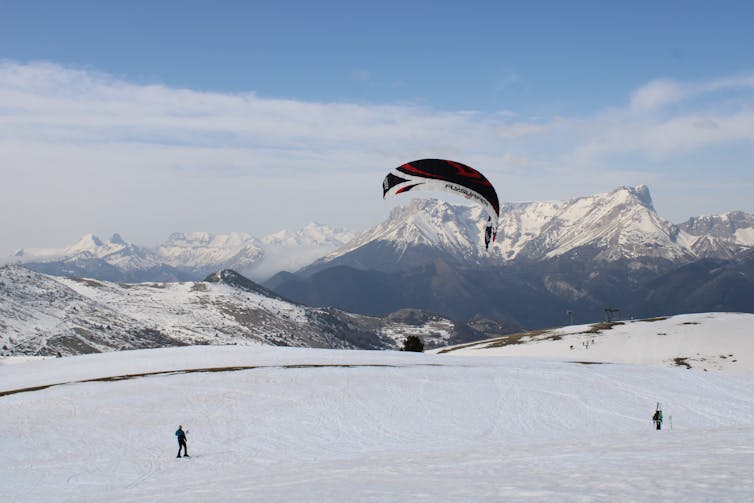
In Céüse, in the southwestern part of the Queyras region, diversification has been driven by the skiers themselves since the resort’s ski lifts ceased operations in 2018 due to management difficulties and a long-standing lack of snow. Contrary to media reports describing it as a “ghost resort,” the site sees heavy recreational use by local residents.
These reinvented ways of enjoying the Céüse ski area are already year-round and multi-activity, adapting to variations in snow conditions. Activities range from ski touring, snowshoeing, and hiking; snowkiting (a sport involving gliding on a snowboard or skis while being pulled by a traction kite) and sledding are also popular there.
These spontaneous uses do not rely on artificial snowmaking. They are in line with the recommendations of several studies commissioned by political authorities since 1993, which have consistently advocated for diversification in Céüse.
However, the intermunicipal association in charge of the resort has not yet been able to leverage these practices to revitalize the region.
In the Hautes-Alpes, Ski Resorts Face the Challenge of Climate Change
In the face of climate change, ski resorts in the Hautes-Alpes are adapting—though not without debate and conflict: Should skiing remain the main tourist attraction?
With the permanent closure of the ski lifts in 2020, the challenge is to transform a small ski resort—one that has never found a viable business model—into an opportunity for diversification as an alternative to a “ski-only” approach. In 2021, the emergence of a new community movement is helping to reignite the debate over Ceüse’s future. Tensions between those for and against the ski resort are flaring up again, though they have not stalled the discussions.
A new project led by the community of municipalities is being launched. It aims to change the image of Céüse as a “ghost station” and to develop a year-round recreational program there (marking trails for hiking, biking, snowshoeing, and skiing; developing an orienteering course, etc.). In Ceüse, the question now is how to formalize this spontaneous diversification and leverage it for the local economy.