

As you are no doubt aware, the27th Conference of the Parties to the United Nations Framework Convention on Climate Change opens this Monday , November 7, 2022, in Sharm el-Sheikh, Egypt. The discussions, which are expected to be contentious, will continue through November 18. This will be the first COP where the issue of financial compensation for damages suffered by developing countries will be at the top of the agenda.
This summit, bringing together nearly 200 countries, promises to be disrupted by the South’s growing distrust of the North and by the recurring demands of the “developing countries plus China” group—which represents no less than 6.5 billion of the planet’s 8 billion people!
To understand the tensions and debates surrounding this central question (who is responsible for global warming, and who should pay?), we need to take a step back.
December 2009: As negotiations at COP15 in Copenhagen entered their final stages, U.S. President Barack Obama proposed a package of $100 billion per year, to be mobilized starting in 2020, to fund mitigation and adaptation policies in developing countries.
This was less a matter of “North-South solidarity” than an attempt to secure a deal: financial transfers from industrialized countries in exchange for commitments to reduce emissions from major emerging economies. All of them— led by China—refused to make any promises.
Thirteen years later, according to the OECD, the 100 billion is reportedly on track to be raised. But the announcement has been met with skepticism and mistrust by developing countries. This funding package consists overwhelmingly of loans —which will therefore have to be repaid—rather than grants.
With little transparency regarding whether this funding is “new and additional” compared to traditional development aid, the countries of the Global South have almost no control over how these funds are allocated.
The breath of fresh air that the promise of 100 billion had provided has now turned into deep frustration.
As early as 1991, during the initial negotiations for the United Nations Framework Convention on Climate Change, the Alliance of Small Island States (AOSIS)—all of which are vulnerable to rising sea levels—was already proposing an “international mechanism for financial compensation for losses and damages associated with the adverse effects of climate change.”
In fact, an international mechanism for loss and damage will be established in 2013 at COP19 in Warsaw. However, two years later, the Paris Agreement clarified that this was a tool for cooperation, not for compensation, and that it “cannot give rise to or serve as a basis for any liability or compensation.”
A “dialogue on loss and damage for the most vulnerable countries” was finally launched at COP26 in Glasgow (2021) (known as the “Glasgow Climate Pact”).
[Nearly 80,000 readers rely on The Conversation’s newsletter to better understand the world’s major issues. Subscribe today]
In recent years, countries in the Global South have been pushing for a financial mechanism to compensate for damages to be officially launched at COP27. But the United States and Europe have never wanted this, and they will not support the creation of a new fund.
At COP27 in Sharm el-Sheikh, they will therefore limit themselves to proposing—as the EU’s official position—to strengthen existing institutions.
These intense tensions stem from the notion of “historical responsibilities,” a concept that has shaped the negotiations since the early 1990s.
The principle of “common but differentiated responsibilities,” enshrined in the 1992 Climate Convention, cemented the division of the world into two blocs and the concept that only industrialized countries bear historical responsibility.
So far, it has exempted countries in the Global South—including China—from any obligation to reduce emissions; it has then introduced the issue of financing for adaptation; and finally, that of financial compensation for damages suffered by countries in the Global South.
For the past 30 years, it has been a central element of climate negotiations, reflecting the call for international solidarity in the face of the threats posed by global warming. At least in theory, since the challenges have been constant. Over time, this principle of historical responsibility has indeed evolved into increasingly urgent demands, all framed in terms of “climate justice.”
The United States has always been a staunch opponent of this principle. It has never endorsed it, and this will be set forth in writing as early as the Rio Conference (1992). This principle therefore cannot be interpreted as an acknowledgment of international obligations on the part of the United States; much less as “a reduction in the responsibilities of developing countries.”
This position remains the red line of Washington's climate diplomacy.
Economist Olivier Godard has clearly pointed out that the historical responsibility of industrialized countries—which underlies claims for compensation for loss and damage—is not as easy to establish as it seems, whether in terms of legal and moral grounds or even statistics.
But for its defenders—representatives of emerging or less developed countries—the situation is clear. As early as 1991, the South Centre, a think tank representing countries of the Global South, pointed out that industrialized countries had historically monopolized environmental space. And the simple observation of relative cumulative emissions would suffice to demonstrate this responsibility. It would therefore be justified to hold states and their current populations accountable for the actions of past generations. It would then fall to them to assume the obligation to repair the damage caused by the actions of their ancestors.
What do the numbers tell us? To get a clearer picture, we need to examine the relative trends in annual and cumulative greenhouse gas emissions from industrialized countries (known as the Annex 1 group under the Climate Convention) and those from developing countries, major emerging economies, and China (the Non-Annex 1 group).
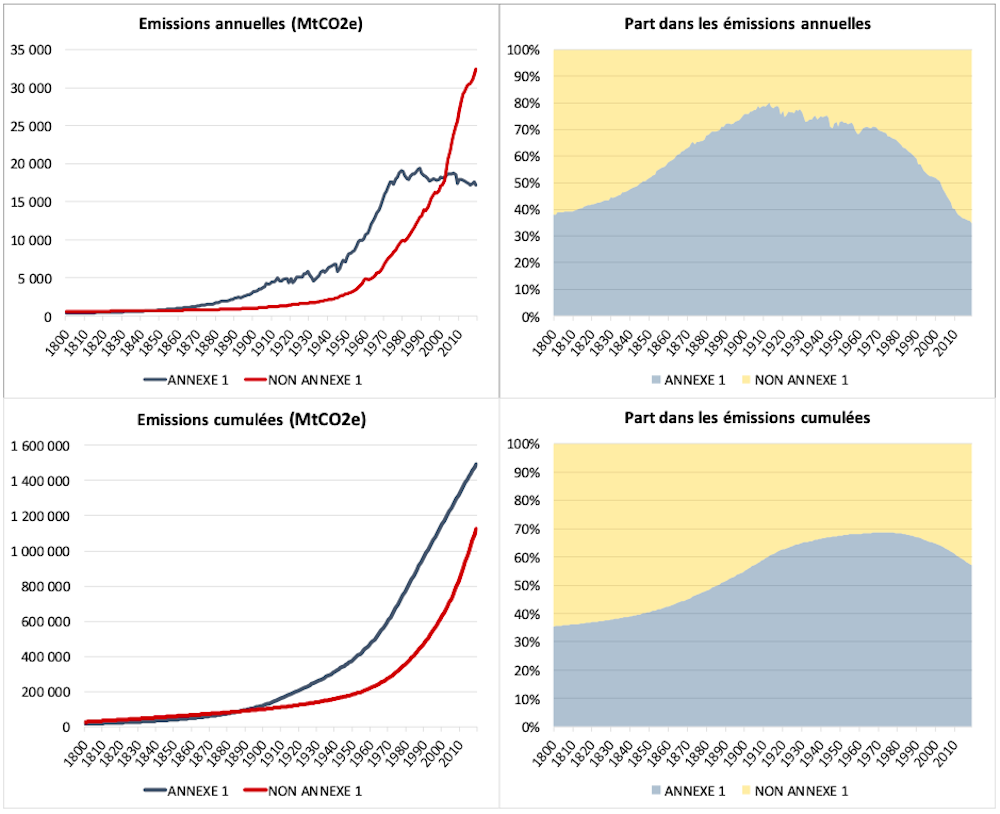
An analysis of annual emissions reveals a turning point in Annex 1 countries beginning in 1980 (the second oil crisis), followed by a slow decline. In contrast, emissions from non-Annex 1 countries have continued to rise, and at an exponential rate. As a result, while in 1980 emissions from industrialized countries were twice those of the “developing countries + China” group, that ratio is now reversed.
In terms of cumulative emissions (those that could reflect historical responsibility) up to the end ofthe 19th century, before the Industrial Revolution was in full swing in the North, emissions from countries in the South accounted for the majority.
The landscape then changed completely, and remained that way until 1980, when the share of Northern countries peaked at 70 percent. Since then, it has steadily declined due to strong economic growth in emerging economies. Today, it is still above 50 percent, but it will take less than ten years for the cumulative emissions of developing and emerging economies to exceed those of industrialized nations. Historical responsibility will then be shared equally.
On the other hand, before 1990, the basic conditions for establishing a case for liability were not met. Previous generations did not have the prior knowledge that greenhouse gas emissions would alter the climate; it was therefore impossible to blame them for this—and, a fortiori, to hold subsequent generations responsible. And, of course, current generations have no capacity to actor means to influence the energy and development choices made by past generations.
Furthermore, beginning in the 1990s, the acceleration of economic growth in emerging economies—driven by a massive increase in their consumption of fossil fuels—has resulted in an equally massive increase in their emissions. As a result, every year for the past twenty years, their emissions have consistently exceeded those of Annex 1 countries.
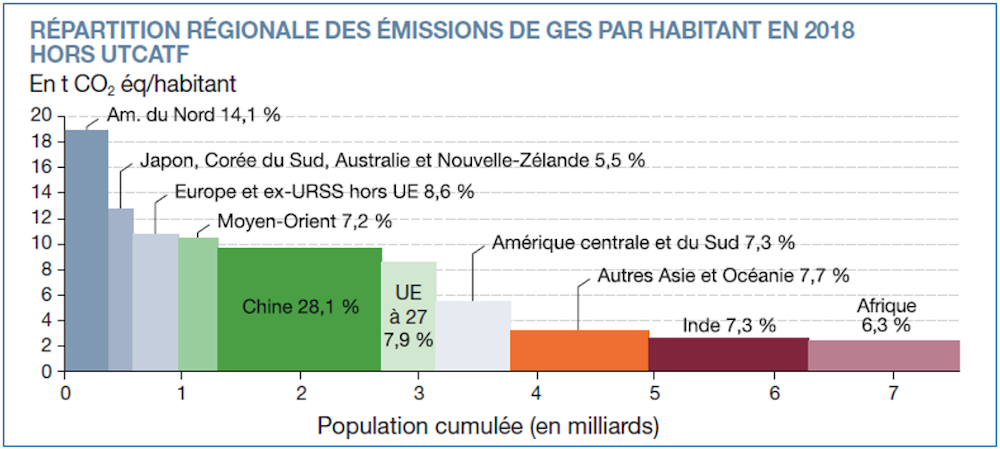
Nevertheless, in terms of immediate individual responsibility, per capita emissions are still much higher in the North than in the South, due in particular to the intensity of their energy consumption. There is one significant exception, however: China’s per capita emissions now exceed those of the European Union.
As we can see, it will be impossible to resolve the issue of historical responsibility. It will remain undecidable, emotionally charged, and highly political. No statistics or theory of justice will ever be able to establish a consensus, and this issue will remain a lasting “skandalon”—a stumbling block—capable of derailing negotiations.
The demands of the countries of the Global South cannot be fully met in Sharm el-Sheikh.
Regarding “losses and damages,” a major study published in 2018 estimated them at no less than $290–580 billion per year by 2030. As global warming intensifies, the cost of these impacts could exceed $1,000 billion annually by 2050.
No matter how reliable these estimates may be, it is unrealistic to imagine that the United States and the European Union would take on a financial obligation that would require them to pay out hundreds of billions of dollars each year.
However, it is in no one’s interest for COP27 to end in failure. A compromise—albeit an unsatisfactory one, particularly for developing countries—will have to be reached. Diplomacy is also the art of masking conflicts that will never be resolved.
Nathalie Rousset—who holds a Ph.D. in economics, is a former program manager at Plan Bleu, and now works as a consultant—contributed to the data analysis and the writing of this text.