

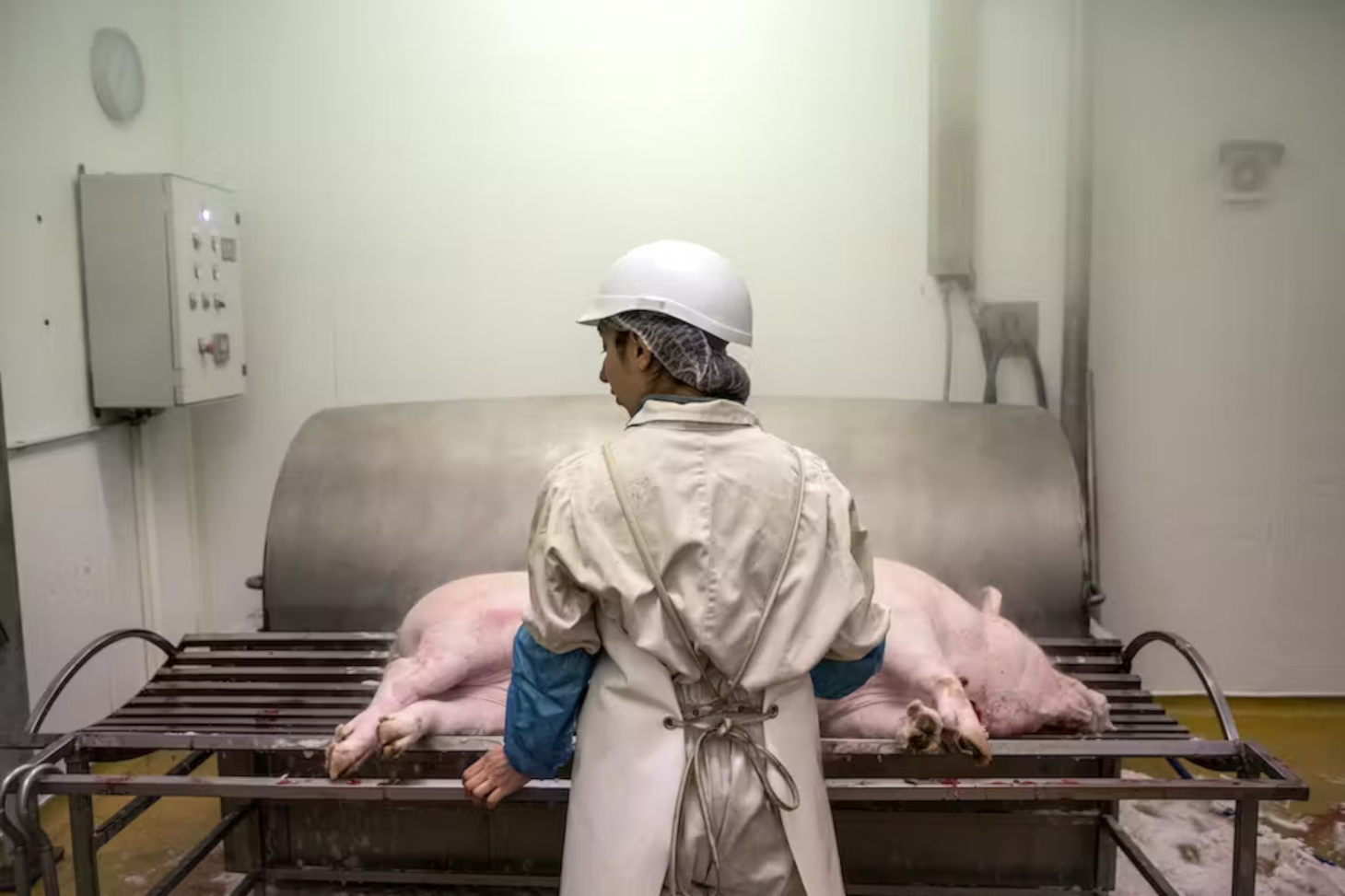
Émilie Jeanin’s mobile slaughterhouse—the first of its kind in France—closed its doors in Burgundy on February 28, 2023, following the judicial liquidation of its parent company, Le Bœuf éthique.
Although highly anticipated, this 100% mobile slaughterhouse—designed to slaughter animals right where they live—met the expectations of local farms and consumers, and the government had confirmed its compliance with regulations.
Although this pioneering project faced numerous challenges, the farmer nevertheless paved the way: she demonstrated that it is feasible to establish mobile slaughterhouses in our country—as has long been the case among our European neighbors—since European legislation permits it.
This initiative is not an isolated one: across France, projects for alternative slaughterhouses are springing up, led by groups of farmers—both men and women—who are determined to break free from conventional slaughterhouses.
These projects involve cooperative slaughterhouses—whether stationary or mobile, located on farms or at shared facilities serving multiple farms—reflecting the diversity of needs and the regions in which they are established.
The farmers who run them all use the same term: “farmer-run slaughterhouses,” defined by the agricultural union of the Confédération paysanne as local slaughterhouses managed by and for farmers, rooted in livestock-raising regions, and serving short supply chains.
But in what way do these small-scale slaughterhouses represent a break from the industrial system? Do they truly embody a path toward agricultural and food transition?
Historically, the slaughter of farm animals was the domain of butchers, who worked in their slaughter and cutting shops in the heart of cities. Changing attitudes toward blood and death, the emergence of the first animal rights organizations, and growing concerns about hygiene and public health led to the creation of municipal slaughterhouses in major French cities: the one at La Villette, for example, opened its doors in 1867.
Local authorities were therefore involved in the governance and management of slaughterhouses, which were strategic links in the food supply chain for residents. It is hard to imagine today, but municipal slaughterhouses were long places of social interaction, open to the local community, where slaughterhouse workers mingled with professionals from the livestock, animal transport, and butchery industries.
Over the past fifty years, the industrialization of agriculture and the development of long, specialized supply chains for milk and meat have led to the privatization of slaughterhouses. They have been gradually bought out by large agricultural cooperatives and moved farther and farther away from cities, out of public view.
This privatization was accompanied by the specialization of slaughterhouses by animal species, their geographic concentration (primarily in the western part of the country), and an increase in the volume of animals slaughtered.
Between 1970 and 2000, half of France’s slaughterhouses closed in successive waves, and by 2010, public slaughterhouses accounted for only 36% of facilities in France—a total of 102 establishments. Their decline led to a corresponding decline in small-scale facilities, and local slaughterhouses—despite being described as “support slaughterhouses” for traditional butcher shops and short supply chains— accounted for only 2% of total meat volume in 2009.
Since the 1990s, the increasing privatization and industrialization of the slaughter system have signaled a disconnect between livestock farming and food production: in between, the killing of animals has become a black box. “From now on, slaughter must be industrial—that is, massive and anonymous: it must be nonviolent, ideally painless; it must be invisible, ideally nonexistent. It must be as if it were not there,” summarizes ethnologist Noëlie Vialles in her 1987 book, *Le Sang et la chair*.
Sociologist Jocelyne Porcher has echoed the underlying unease felt by livestock farmers in the face of this trend. Her research highlights their feeling that their work is being “ruined” due to the stress their animals experience during transport and while waiting in the holding pen (the area where animals are kept after unloading), the resulting decline in meat quality, and their sense of abandoning their animals at this difficult stage.
The all-too-rare accounts from employees, researchers, and journalists also reveal the dramatic physical and psychological impacts of working in a slaughterhouse, where employees are subjected to extremely fast-paced assembly-line work.
At the same time, increasingly stringent animal welfare standards have not alleviated society’s growing unease about the conditions animals face in slaughterhouses, as painless slaughter has become a prerequisite for mass meat production.
According to Agreste data from 2016, 4.7 million cattle, 23.8 million pigs, 4.3 million sheep, 0.73 million goats, and 13,000 equines are slaughtered in France at 260 slaughterhouses.
However, it wasn’t until 2016 that the issue of slaughterhouses made its way onto the French political agenda, when a parliamentary commission of inquiry was appointed following the release of the first videos by the anti-speciesist organization L214 denouncing acts of violence in slaughterhouses.
The commission’s findings are in line with the call made by agricultural and environmental stakeholders who, in an op-ed published in late 2017, urged that mobile slaughterhouses be allowed.
The 2018 Agriculture and Food Act (known as the Egalim Act) enshrines this societal demand in Article 73, which is said to reflect the wishes of 81% of the French population.
This decree marks the political recognition of the need to establish a network of new local slaughterhouses across France to spare animals from grueling transport and to support short supply chains and the localization of food production.
Groups of livestock farmers now have the legitimacy to engage in dialogue with their elected officials and local governments, which had previously been rather skeptical. Currently, about 30 alternative slaughterhouse projects are taking shape and forming networks across France.
These fall into three categories: small, stationary slaughterhouses operated by groups of farmers themselves, alongside or in place of hired workers; mobile slaughterhouse projects (slaughterhouses on wheels), capable of traveling between different farm groups; slaughter box projects that allow animals to be slaughtered on the farms where they were born and then transported to permanent facilities for carcass processing. To date, six permanent farmer-run slaughterhouses are in operation, located in the southeastern quarter of France.
The business model of small-scale slaughterhouses is radically different from that of a conventional slaughterhouse: its goal is not to be profitable, but to break even, while serving the needs of small and medium-sized farms. To this end, the slaughtering work is not performed by employees, but is carried out in part or in full by farmers who provide this service as an extension of their farm operations and their status as agricultural entrepreneurs.
As a result, the slaughterhouse operates with a variable payroll that depends on demand. Since most of the business involves short supply chains, producers bring in small batches of animals each week: keeping the slaughterhouse open one or two days a week is sufficient to meet this demand.
This economic model gives rise to a unique social model: there is no hierarchy or imposed pace, as the farmers—both men and women—volunteer and organize themselves to run the slaughterhouse. These slaughterhouses also accept non-standard animals—such as kids, free-range pigs, or horned breeds—which are often rejected by conventional slaughterhouses or accepted only at prohibitively high rates.
Small-scale slaughterhouses are developing services that reduce dependence on middlemen, such as providing a cutting room and vacuum-sealing equipment. They also allow those bringing in animals to deliver them that very morning and, of course, to enter the slaughterhouse if they wish.
However, in direct sales and short supply chains (with no more than one intermediary between the producer and the consumer), farmers have a few animals slaughtered each week, selecting them based on their customers’ requests. At markets, farmers’ markets, or community-supported agriculture (CSA) programs, farmers rely on the quality of their products and the trust of their customers.
Meat is no longer just about the price per kilo: it tells the story of a farm, a region, and the relationship between a farmer—whether male or female—and their herd.
Animal welfare standards in slaughterhouses have steadily improved over the past fifty years, largely due to European regulations. However, the debates surrounding these standards are too often limited to the question of whether animals are conscious—and thus whether they experience pain—when they are bled.
Yet these ethical considerations lose their meaning when the tasks of verifying loss of consciousness and then death—carried out by employees—are caught in the vise of production pace, repetitive tasks, and exhaustion from the work schedule—to the point of slaughtering one cow per minute, 7,500 pigs per day and 2 million animals per year in the slaughterhouse where journalist Geoffroy Le Guilcher, author of the book *Steack machine*, went undercover.
In a small-scale slaughterhouse, time is flexible: it’s important to take as much time as needed. If a cow refuses to move forward, a pig gets scared, or a lamb jumps off the conveyor belt, the slaughtering process is interrupted and the farmers’ actions take precedence. Moreover, the animals are never anonymous: upon arrival at the holding pen, just as when the carcasses are returned, each animal belongs to someone and is intended for someone—and it passes through the hands and under the watchful eyes of the farmers working in the slaughterhouse.
In small-scale slaughterhouses, animals are viewed neither as the “animal-as-raw material” of industrial production nor as the “animal-as-child” of animal rights movements, as described by anthropologist Charles Stepanoff. They are regarded as “animal-subjects, ” which it is acceptable to kill under certain conditions.
The distinction made by philosopher Donna Haraway between beings that are made killable and beings that are killed responsibly takes on its full meaning here: animals mass-produced for profitable meat must be killed efficiently, quickly, and quietly, which requires the development of standardized animal welfare standards. Killing animals responsibly, on the other hand, means never ceasing to ask why, and doing so with a clear conscience.
While small-scale slaughterhouses offer a path toward an agricultural and food system that is both ethical and sustainable, their journey remains fraught with challenges.
In the Luberon and Lozère, farmers are still seeking public funding and municipal land for their future mobile slaughterhouse. In the Drôme and Hérault, the construction of on-farm slaughter units is imminent, even though France’s interpretation of European regulations regarding mobile slaughterhouses is less favorable than in Sweden, Germany, or Austria.
Faced with these political and institutional deadlocks, and as preparations are underway for the new five-year agricultural policy bill, stakeholders are now taking action to secure recognition for small-scale slaughterhouses as a genuine alternative model.