

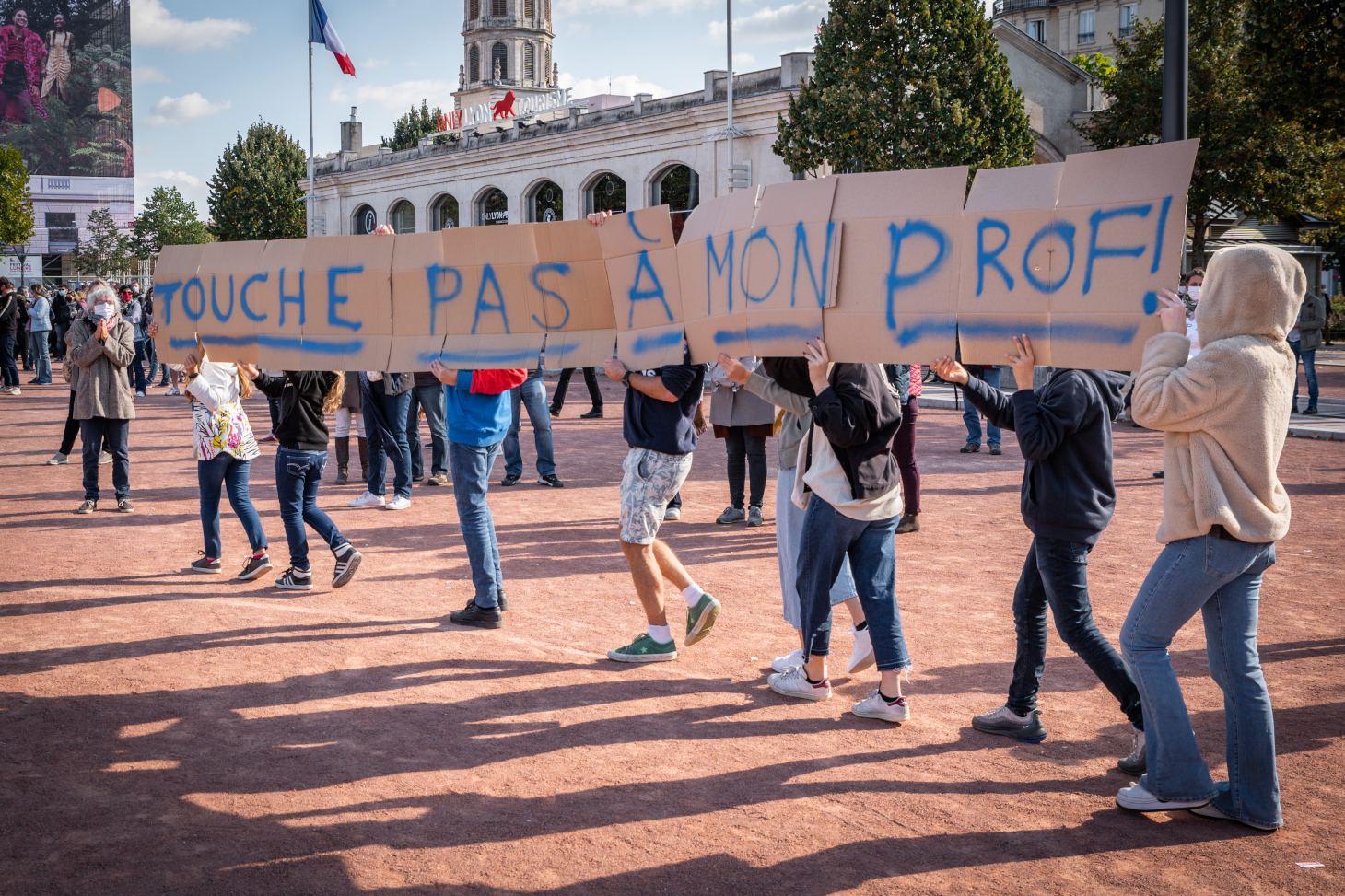
There is now a disconnect between what is expected of schools and what teachers are accustomed to doing there, having been specifically trained for that purpose. After all, they are expected to be more than just teachers, and this is undoubtedly neither obvious nor easy for them.
To appreciate the burden that this new task represents, and the extent of the changes affecting the teaching profession (in elementary, middle, and high schools), we can examine it through the lens of three key expectations now facing schools.
This disconnect is already evident in the school’s most traditional mission—one that endures and remains more relevant than ever: the transmission of knowledge. But rather than a “clash of knowledge, ” to use Gabriel Attal’s phrase, it must be a place where a clash of understanding takes place! Not merely accumulating knowledge, but first understanding what knowledge is and distinguishing it from opinion. For the essential thing is to move beyond opinions (to free oneself from them) in order to attain knowledge.
It is this process of “purification of the intellect, ” to use Spinoza’s words, that matters—far more than access to this or that specific body of knowledge. This is the “Copernican revolution” that schools must undergo to truly become a bulwark against ignorance and obscurantism: focusing not on knowledge itself, but on the process that enables access to it.
This shift is twofold. It involves taking a fresh look at academic subjects—and ensuring that no one is left behind. From the first perspective, academic subjects should no longer be viewed as ends in themselves, but primarily as opportunities to develop certain fundamental abilities or skills. Teachers should no longer be at the service of a subject, but at the service of the students whom that subject can help grow and progress as human beings.
The goal is not, for example, to train a mathematician or a scholar of the humanities. Rather, it is to use mathematics and the humanities to equip students with cognitive tools that will enable them to innovate and to tackle the wide range of problems they will encounter in this era of crisis and uncertainty in which we now live.
And when digital tools are developed that might make us fear being left behind, we must first enable students to develop themselves into “smart thinking tools,” capable of uncovering falsehoods and devising solutions to the problems they encounter. The school’s primary task today is to contribute to this development.
This is what leads us to rethink curricula (programs of study and development), focusing less on a variety of specific areas of knowledge (corresponding to academic disciplines taught for their own sake) and more on what each discipline can offer in terms of research methods, work attitudes, and the development and structuring of the mind.
Not discipline for its own sake, but for its contribution to the preservation and development of cognitive abilities. In short, it is a matter of preserving and developing what Rousseau called “perfectibility”—that is, the fundamental capacity to acquire and develop abilities (to act and to think).
The second concern (leaving no one behind) should lead to a focus on a “core curriculum school.” That is, a school centered on the fundamentals, as described above, and one that supports students over a sufficiently long period: no differentiation or major tracking should occur before the end of the current middle school. All children and adolescents must be included in this movement toward “reforming understanding.”
Far more than simply establishing a new relationship with knowledge, the second change is likely to be unsettling for teachers. It requires them to take an active role in a genuine, practical experiment in secularism. This can be understood on two levels.
The first is the teaching of secularism. This task falls largely to history and geography teachers, who, since 2015, have been responsible for providing moral and civic education (EMC) with three objectives, as specified in Official Bulletin No. 30 of July 26, 2018, issued by the Ministry of National Education: respecting others; to acquire and share the values of the Republic; and to build a culture of citizenship.
The new “moral and civic education” (EMC) program, enshrined in the 2013 School Reform Act, has sparked significant debate regarding its appropriateness, purpose, legitimacy, and even its feasibility. Recent events show that such education is absolutely necessary.
All students must understand what secularism means and the significance of the principle on which it is based: the distinction between laws—the free expression of the sovereign people, which apply to all citizens, who are equal as such—and beliefs, whether religious or otherwise, which everyone is free to adopt and defend, on the sole condition that they do not lead to actions that contradict the laws of the Republic.
But history and geography teachers must not be left alone on the battlements! It is up to the entire educational community (within the school) to put secularism into practice, so to speak. This means reiterating, whenever the opportunity arises—whether in class or in “school life”—the need to respect individual opinions and the people who express them, while always upholding the primary and fundamental respect for the laws of the Republic. And it means not hesitating to act as the guardian and defender of secularism by intervening when an act warrants punishment.
From this perspective, all members of the school community—including teachers—must agree to serve as representatives, and if necessary, as enforcers, of the principle of secularism.
There is indeed a battle to be fought, but ultimately it is against hatred—the kind that makes us forget that the other (the Palestinian, the Jew, the Christian, the French person…) is my fellow human being and my equal. Someone toward whom I have duties, which are simply the other—and the first—aspect of my rights.
School is also the place where we spend a significant part of the long—and often happy—years of our childhood and adolescence. These are years we spend within social groups made up of people of roughly the same age, but with relatively diverse beliefs and backgrounds, some of whom will become our lifelong friends.
This place, where friendships are forged and life paths are shaped and intertwined, must be a safe haven. Yet the jihadist threat turns it into a place where teachers, like students, become targets particularly vulnerable to the risk of terrorist attacks and may feel condemned to live in fear.
Schools must be highly secure spaces that provide shelter from fear—but without becoming fortresses cut off from the rest of society. Beyond measures that fall under the purview of the police—or even the military—a commitment to safety can also begin to take shape through actions such as the creation of “child-friendly zones,” areas free of vehicle traffic in front of school entrances. Or through a concerted effort to combat bullying, in which all teachers can—and must—participate.
For while we must be wary of deadly attacks from outside the school, recent history shows that attacks occurring within the school itself—specifically, bullying—can ultimately prove just as deadly. Every effort must be made to ensure that students can live in peace, safe from all forms of aggression, no matter where they come from.
[More than 85,000 readers rely on The Conversation’s newsletters to better understand the world’s major issues. Subscribe today]
The struggle for security and peace is thus multifaceted and ongoing. Teachers are, more than ever, called upon to participate in this struggle. And this can begin with fostering a peaceful working environment, based on mutual respect, within a classroom where making a mistake is not a fault, and where students can learn without fear—neither the fear of making a mistake, nor the fear of being mocked or attacked by others, nor the fear of becoming a victim of a terrorist attack.
It is clear, however, that teachers will only be able to truly commit to this new threefold role—as facilitators of the reform of understanding, active advocates of secularism, and peacemakers—if two conditions are met. The first is that they receive appropriate training in all three areas. The second is that society (finally) shows them recognition commensurate with the importance of their role and their commitment to this threefold struggle.