

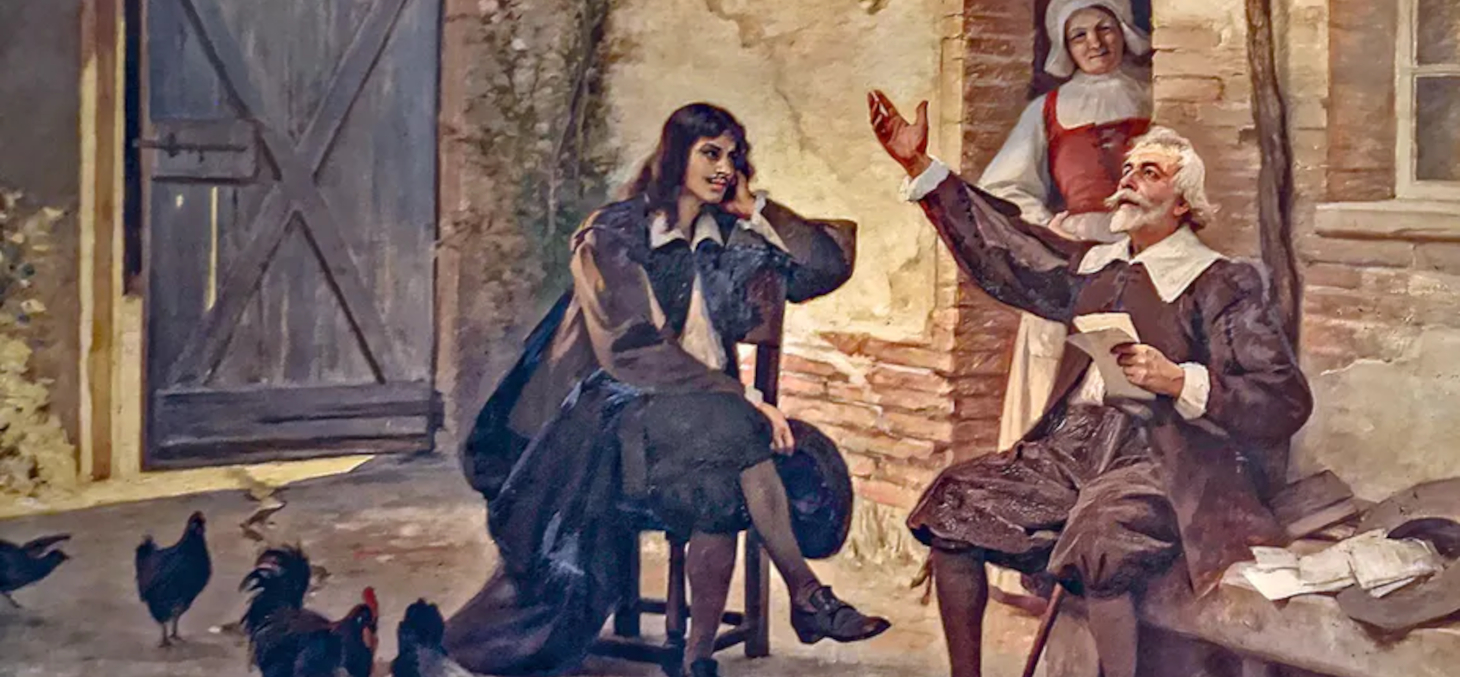
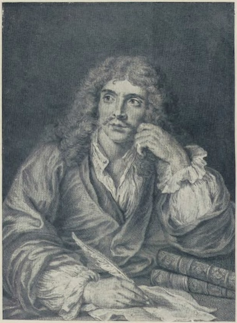
The first set of images allows us to venerate the dual image of Molière: that of the great French author, a representative of our country, depicted in the midst of his work, pen in hand; and that of a man whose regular features are said to reflect the qualities of his soul. The second set of images depicts the actor in the midst of his work—the performer taking on the exaggerated, grimacing role of the character Sganarelle.
While the first image has long been the norm in classrooms, its current juxtaposition with that of Molière in the role of a comic servant reminds us just how much the portrayal of this major author has evolved in school curricula since the late19th century. In what ways is the Molière taught to our parents and grandparents no longer quite the same as the one today’s students are discovering? Here are some historical insights as we celebrate the 400th anniversary of Molière’s birth in 2022.
For the authors of textbooks published before 1880, Molière was already considered the greatest French comic playwright; he was the benchmark of classical comedy, and while he was indispensable, it was primarily in his role as a representative of the educational value that comedy could have for young people; Molière’s humor was exploited solely for its axiological value, in accordance with the famous motto of comedy, “castigat ridendo mores” (correcting morals through laughter).
An initial image of the playwright has already taken shape: that of a highly talented portraitist. He is praised for the naturalness and liveliness of his writing—whether he is revealing the schemes of a Scapin, the hypocrisies of a Tartuffe, or the naivety of an Agnès—and he is seen as a keen observer of the mores of his time. Thus, he is a sure bet of the Grand Siècle: his genius lies in his writing, and it is for this reason that he is hailed as a great man by the school of thought preceding the great reform of 1880.
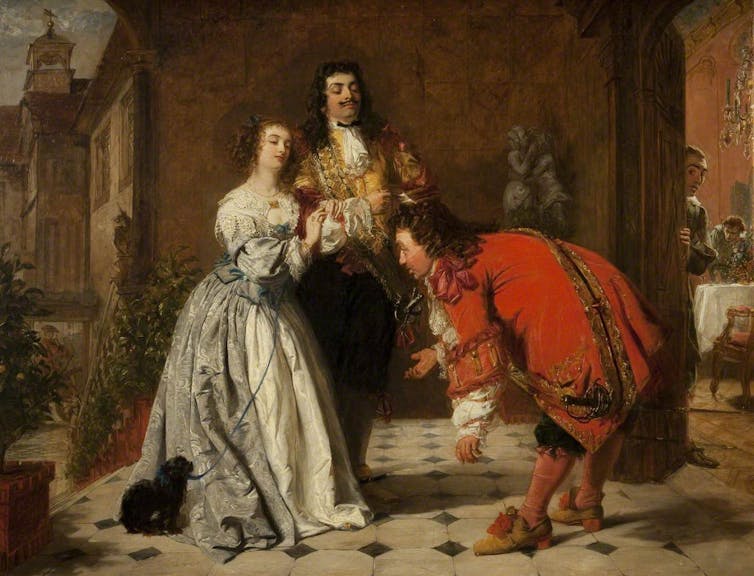
It was the republican high schools that, through the teaching of literature, would establish Molière as the quintessential classical playwright. The emergence of literature education thus coincided with the formation of a national literary heritage in which Molière became one of the key figures; his work, with its promotion of the image of the “honest man,” came to be seen as a repository of the virtues extolled by the young Republic.
It was during this period that Molière became a “national treasure, ” a key figure in the history of French identity, in the sense that he reflected national identity and democratic ideals. His work was harnessed to serve both the educational and patriotic functions of literature instruction, the primary aim of which remained the moral education of students.
During the period from 1925 to 1963, Molière’s image solidified and evolved. From then on, he became a true cultural icon. People were no longer content merely to revere France’s greatest comic writer; they also admired—in the words of Des Granges in his 1946 *Précis de littérature* —“the man of heart,” who was tolerant, loyal, courageous, and determined. His virtues were extolled in the same way as those of a true hero.
Through him, the characteristics of the humanistic vision that permeated the educational system of that era come into sharp focus. Molière, as a man, becomes the embodiment of patriotic values. He exemplifies the civilizing power of literature.
He is held up as a perfect example for fostering, as the official guidelines from 1953 still state, “courage, honor, loyalty, justice, tolerance, generosity, kindness, and wisdom.” A true icon and a living hero, he embodies the ideal of a man worthy of admiration—an educational role model held up to the youth. As for his theater, it remains the embodiment of ethical values.
But what has changed is that, now, his characters—just like the author—serve as examples for analyzing real-life situations, which can lead to reflections with an educational tone.
Molière is admired as a free thinker. From *Les Précieuses ridicules* to *Tartuffe*, from *L’Avare* to *Le Malade imaginaire*, his wisdom—so full of naturalness and sincerity—is extolled. His work is revered because it expresses a social moral lesson centered on the family. Textbooks from this period have portrayed him as a flesh-and-blood human being, evoking empathy in readers. Beyond being a classic author and a symbol of the democratic ideal, Molière has almost become a fictional character.
From 1963 to the present, Molière has remained, in textbooks, the greatest French comic writer, the master of comedy, single-handedly embodying the humor of the17th century. Building upon the foundations of this old myth, however, a new image has emerged—one more in line with the evolution of a different literary history, one that focuses on people’s daily lives and their cultural practices.
Three new virtual exhibitions on Molière are now available on our website:
— Comédie-Française (@ComedieFr) January 14, 2022
- Molière: A Thousand Faces:https://t.co/5kRRbSoB5r
- Molière on Stage:https://t.co/pZEZU09LbY
- Molière in Color:https://t.co/DdQb4jhDe2 pic.twitter.com/0bOmVJuncJ
Molière is no longer the melancholic man, the contemplative figure so cherished during the Romantic era. Through references to his early calling, his years of wandering, and his death “on stage,” what we admire above all is the theater practitioner. The author of *Le Bourgeois gentilhomme* remains an iconic figure of France, but since the late20th century, what we celebrate in him is the writer who embodies the quintessential man of the theater; it is the popular actor, the brilliant prankster who knew how to charm the Sun King, as recalled in Ariane Mnouchkine’s epic film released in 1978.
Through him, the image of the actor is restored to its former glory. It is in this capacity that he is revered in today’s textbooks, his life being characterized by farcical humor.
In line with this new perspective, the analysis of Molière’s works has expanded to include staging and acting. Since the late20th century, the study of Molière has straddled the line between classicism and modernity. His work continues to serve as a basis for reflection focused on the moral education of students, but our view of him as a man and as an artist has changed profoundly.
Rehabilitated as an actor and a comedy genius since the end of the 20the In the 20th century, the great playwright became, in textbooks, a virtually timeless figure—the perfect example of the complete artist.
This article is republished from The Conversation under a Creative Commons license. Readthe original article.

_Portret.png)
