

Exercising power? “It suits boys just fine!” That’s what Léo, age 5, told us during an interview—and his words raise some questions. Could it be that children internalize at such a young age the idea that power is a male domain and that girls, in their interactions with boys, must go along with their decisions?
Research in psychology has long shown that stereotypes—which conform to social gender norms—emerge at an early age. Children associate each gender with specific standards of appearance, types of play, as well as distinct skills and behaviors.
For example, the scientific literature highlights a contrast between agentic behaviors—such as assertiveness, competition, or aggression, which are more commonly associated with boys—and communal behaviors, which involve“care”and concern for others and are more often associated with girls. This approach, which focuses on the attribution of individual characteristics, has, however, overlooked how children perceive gendered social interactions.
Our work is part of this broader effort. As part of the CHILD-GAP project, supported by the French National Research Agency (ANR), we are examining these representations of power dynamics—for example, when one person imposes their choices on another.
Linking Power and Masculinity? Here’s What Kids Think
In a previous study conducted in France, Lebanon, and Norway, we presented children aged 3 to 6 with a scenario showing two characters interacting, one dominant and the other subordinate.
We then asked them to guess each character’s gender (from power to gender, see Figure A). Starting at age 4, in all three countries, the majority of both girls and boys perceived a male character as exercising power over a female character.
However, girls do not always subscribe to this gendered view of power. For when our experiment adopted the opposite approach—no longer asking participants to guess the characters’ gender based on a power situation (from power to gender, Figure A), but rather to guess who held the power in a scenario featuring a mixed-gender pair of puppets (from gender to power, Figure B)—the responses differed depending on the participants’ gender.
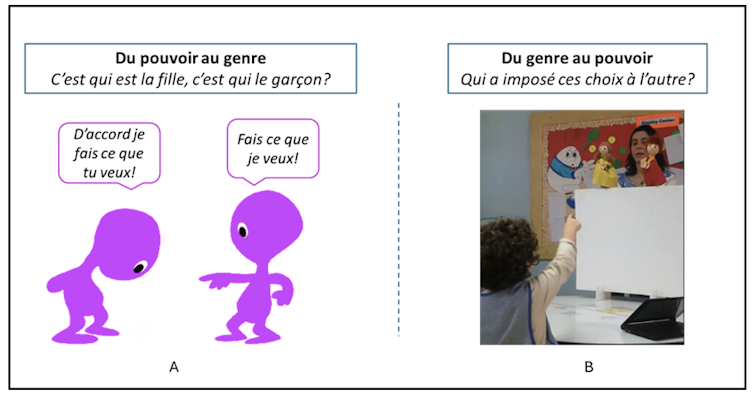
Boys (73%) still associated power with masculinity, but this tendency had disappeared among girls (44%). It is likely that mechanisms for affirming one’s own gender are at work here: among boys, they reinforce the association between power and masculinity; among girls, they tend to counteract it, without, however, reversing it.
From Gender Stereotypes to Prescribed Behaviors
When children are asked to reason about social groups, they tend to transform the patterns they observe (that is, the world as it is) into rules (that is, the world as it should be). For example, in a study conducted in the United States, children observed two groups of characters, each consuming a specific food. But when one of the characters began to adopt the eating habits of the other group, the children disapproved of that character’s behavior.
It is this shift that makes gender stereotypes problematic: they can become implicit norms that shape how we view others—or ourselves. Such biases exist among adults. Research onthe “backlash effect” shows that women are criticized more—and penalized economically—than men when they display power.
Does the association between power and masculinity also manifest itself in prescriptive attitudes among children? To answer this question, we showed 653 participants aged 3 to 8 short skits in which one character imposed their choice of play on another. Some of these interactions were same-sex (girl > girl or boy > boy), and others were mixed-sex, either conforming to the stereotype (boy > girl) or defying it (girl > boy).
To gauge the children’s attitudes, we asked them to distribute three stickers between the two characters. They could choose to favor the dominant character, thereby acknowledging the legitimacy of that character’s position, or to favor the subordinate character to compensate for the initial inequality. The question then was whether a bias in favor of the dominant male character would emerge.
The results did not confirm this hypothesis. Overall, the children surveyed did not show a preference for power when it was exercised by a boy rather than a girl. These results could support the hypothesis that such a tendency emerges at a later stage.
Promoting Your Gender Group
Beyond the absence of favoritism toward male authority, we observed two findings. The first was the influence of age, which has already been highlighted in other studies: the youngest children (ages 3–4) favored the dominant character, while children aged 7–8 favored the subordinate character. As they grow older, children therefore tend to view power asymmetries negatively, at least in play contexts such as the one studied here.
The second observation was that the children gave more stickers to the character of their own gender. This was particularly pronounced among girls, who favored the female character more strongly than boys did the male character.
In the specific context of power relationships, valuing one’s own gender group could thus act as a counterbalance to stereotypes. We have also observed this favoritism in other situations. In a study examining affiliative tendencies, we showed children aged 3 to 6 resource conflicts between a woman and a man, and then asked them with whom they would prefer to play. Their choices favored the winning character, but only when that character was of the same gender as they were.
In another study, we used an implicit association test to identify the automatic attitudes children may have toward gendered power. The goal here was to determine whether the association “male power = positive” was more automatic than “female power = positive.” Once again, a gender-bias effect was observed: girls were quicker to associate a positive stimulus (a smiley face) with an image showing a woman directing a man, whereas boys were quicker to make the opposite association.
To conclude, let’s quote Mia, age 7, who, in one of our ongoing studies, chose to assume a dominant position vis-à-vis a male character: “It feels good! It’s always the boys who are in charge. ” While there is no doubt here about Mia’s awareness of the existence of a gender hierarchy, this does not lead her to submit to it. In light of our findings, it appears that identification with her gender group, as well as a growing preference for equality, fuel this resistance.
This article is republished from The Conversation under a Creative Commons license. Readthe original article.