


Pursuing an education while competing at the highest level is often presented as a way to maintain a healthy work-life balance and prepare for life after a sports career. However, juggling these two commitments exposes those involved to challenges that are far more demanding than those faced by students or athletes who focus on just one role.
As a study conducted in Finland suggests, these increased demands are not without consequences for their mental health: 60% of the high school student-athletes surveyed exhibited signs of compromised mental health, as evidenced by symptoms of athletic and academic burnout. These consequences also affect long-term commitment to sports and overall performance. Indeed, whether in a sports, academic, or professional context, poor mental health will have a detrimental effect on performance.
The study conducted in Finland also establishes a link between burnout and dropping out of athletic programs. More specifically, student-athletes whose levels of athletic and academic burnout increased over the three years of the study were more likely to drop out of their athletic programs, thereby hindering their chances of reaching the elite level.
A recent systematic review highlighted a lack of studies on the specific requirements of dual-track projects, which can sometimes overlap (for example, the pursuit of performance and the time required to complete the project).
Added to this are other stressors that may be social in nature (for example, moving far away from home or family), financial (for example, the need to take on additional work), or administrative (for example, obtaining official student-athlete status).
Many elite athletes describe balancing their dual commitments (professional or academic and athletic) as a challenge in terms of organization and planning, as doesAstrid Guyart, a French Olympic fencer and aerospace engineer, who says, “I feel like my life is a game of Tetris.”
Just like in this game, where the goal is to stack shapes made up of four cubes, people juggling dual commitments try to balance the demands of different aspects of their lives. Taken together, these stressors pose mental health risks for student-athletes. It therefore seems appropriate to examine how these numerous demands are managed and how each commitment might influence the other.
While there is a lack of indicators on managing dual commitments in the context of sports and academics, information is available on balancing work and family life. Role theory, which stems from industrial and organizational psychology, suggests that there are overlaps between professional and family roles. This gave rise to the concept of work-family conflict, which is defined as “a form of inter-role conflict in which the demands of professional and family roles are mutually incompatible in certain respects” (free translation).
From this perspective, individuals have a limited amount of resources, such as energy and time. When they take on different roles, they must make trade-offs in how they use these resources, which can lead to conflicts.
These conflicts also arise in the context of sports and academics, where student-athletes may find themselves unable to attend a practice because they have a class at the same time, or may be forced to choose between studying for an exam and resting to recover before a competition.
Work-family conflicts identified in the workplace have a significant impact on mental and physical health. More specifically, people who feel a conflict between their roles may experience negative emotions, life dissatisfaction, symptoms of stress, and reduced well-being.
However, role theory is not limited to negative interactions between the two roles. It also highlights the existence of positive interactions, referred to as “enrichment” and defined as the fact that “experiences in one role [project] improve the quality of life in the other role [project]” (free translation).
From this perspective, each role can complement the other. For example, the knowledge and skills acquired in sports—such as goal-setting and stress management—can help student-athletes better manage their academic schedules or cope with stress as exams approach.
On the other hand, knowledge and skills acquired in academic settings—such as those in physiology or anatomy—can help student-athletes better understand their bodies and, as a result, better manage their athletic efforts. In the context of balancing work and family, fulfillment is positively linked to mental and physical health. This means that people who feel a strong sense of fulfillment in both roles report better mental and physical health.
Our work focused on highlighting the influence of role interactions on the mental health of student-athletes. Similar to research conducted in the work-family context, we found that when student-athletes perceived a positive interaction (i.e., an enriching relationship) between sports and their studies, their mental health was higher. Conversely, if they perceived a negative interaction (i.e., a conflict) between the two areas, their mental health was lower.
More specifically, our research identified three characteristic profiles of student-athletes (see chart):
a profile characterized by high conflict and low enrichment;
a profile characterized by high conflict and high enrichment;
and a profile characterized by low conflict and high enrichment.
It would appear (see table) that the first profile is a high-risk profile because it is associated with high levels of burnout (a negative indicator of mental health) and low levels of engagement (a positive indicator of mental health), that the second is a profile to monitor, as it is associated with high levels of burnout and engagement, and that the third is an adaptive profile, as it is associated with low levels of burnout and high levels of engagement.
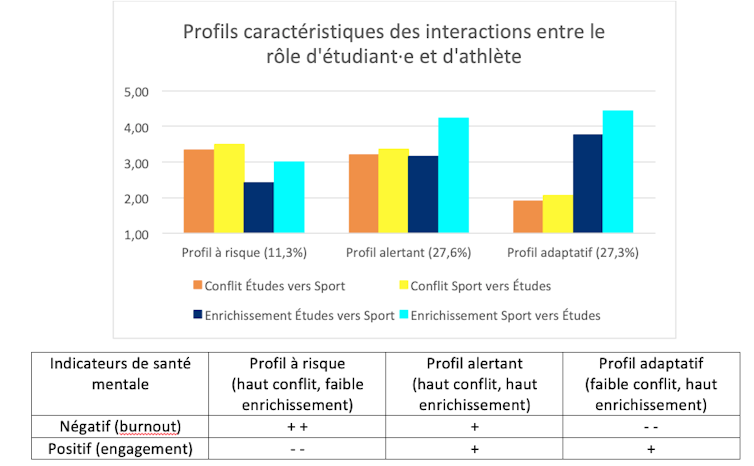
Based on these profiles, two approaches were identified to promote mental health:
Burnout could be reduced by decreasing conflict and/or increasing job enrichment;
Engagement could be improved by increasing enrichment regardless of the level of conflict.
In conclusion, this study suggests that the way student-athletes perceive their commitment to both areas can influence how they feel. If they feel that their sport facilitates or enriches their studies—or if their studies enrich their sport—then the consequences they experience will be positive. Conversely, if their studies are perceived as an obstacle or a hindrance to their athletic career, or if their sport is an obstacle to their studies, then the perceived consequences will be negative.
As a first step, it seems worthwhile to understand when student-athletes experience conflict or enrichment, so that we can then identify the factors that would enable them to better manage their dual commitments—namely, to reduce conflict and increase enrichment between their two commitments.
Furthermore, even though conflict sometimes seems inevitable, and some people perceive the sacrificing one's studies as a necessity for success in sports, there are facilities led by universities, which help to better reconcile the two initiatives.