


On November1, at the initiative of Santé publique France, the seventh annual “Smoke-Free Month” begins. Smokers of all ages are collectively encouraged to go 30 days without smoking a single cigarette—a step that, according to the organizers, increases the chances of quitting for good fivefold.
In recent years, young people in particular have been the primary focus of government efforts. The National Committee Against Smoking estimates that approximately 200,000 young people start smoking in France each year, and some time ago it singled out tobacco retailers for their lack of vigilance.
On average, young people smoke their first cigarette shortly after turning 14. Surveys by the French Observatory on Drugs and Addiction Trends (the most recent of which was conducted in 2017, pending analysis of data collected last March)—the French branch of a European Union agency—indicate that this age is getting later and later (one year later than in 2005).
Based on this observation, the 2018–2022 National Tobacco Control Program set a goal for children born since 2014—who will reach the age of majority starting in 2032—to become the first generation of non-smoking adults. How can this be achieved? Is it better to encourage them or to compel them when communicating with them? On Facebook, does the distance between them and the source of a public health message matter? This was the focus of our research, which suggests that the strategies to be adopted differ depending on who is responsible for disseminating the message.
Over the years, public authorities have often shifted the focus of their public awareness campaigns. In the 1970s, they emphasized the consequences of smoking, only to place greater emphasis on freedom and appeal in the following decade. The 1990s were marked by the social denormalization of smoking and the promotion of non-smokers. The 2000s saw a focus on promoting smoking cessation. Since 2010, there has been a great deal of discussion about motivation.

Over the years, a wide range of approaches has been employed. Suggesting a relationship of submission through photos of children holding cigarettes in their mouths—almost as if they were sex slaves—sparked controversy in 2011. Other methods that have been employed include using shocking images on cigarette packs and placing greater emphasis on education—such as the 1991 slogan “Smoking isn’t in my nature,” which was paired with an image of a Western hero. “Smoke-Free Month,” meanwhile, promotes support programs for smokers who want to quit.

This shift between different strategies shows that it is difficult to determine the most effective way to communicate. Our study therefore sought to identify the conditions under which a message that encourages initiative, offers a choice of treatment options, and provides relevant information—while minimizing pressure and control—proves more effective than a message that emphasizes directives and adopts an authoritarian stance with no choice. We focused in particular on persuasive anti-smoking messages targeting young adults, distributed on Facebook.
The concept of social distance —which refers to the perceived distance between two individuals—has been applied. We speak of “proximal” social distance in the case of someone close to us and “distal” social distance in the case of someone distant from us (I feel closer to my best friend than to an acquaintance).
[Nearly 80,000 readers rely on The Conversation's newsletter to better understand the world's major issues. Subscribe today]
We deliberately created a communication campaign similar to those we might find on Facebook. It consists of four different visuals that combine two dimensions: messages shared by friends versus those sponsored by Santé publique France (in other words, proximal versus distal social distance) and encouraging versus restrictive messages. Our goal was to identify the combinations that elicit the strongest intention to quit smoking among young adults aged 18 to 34.
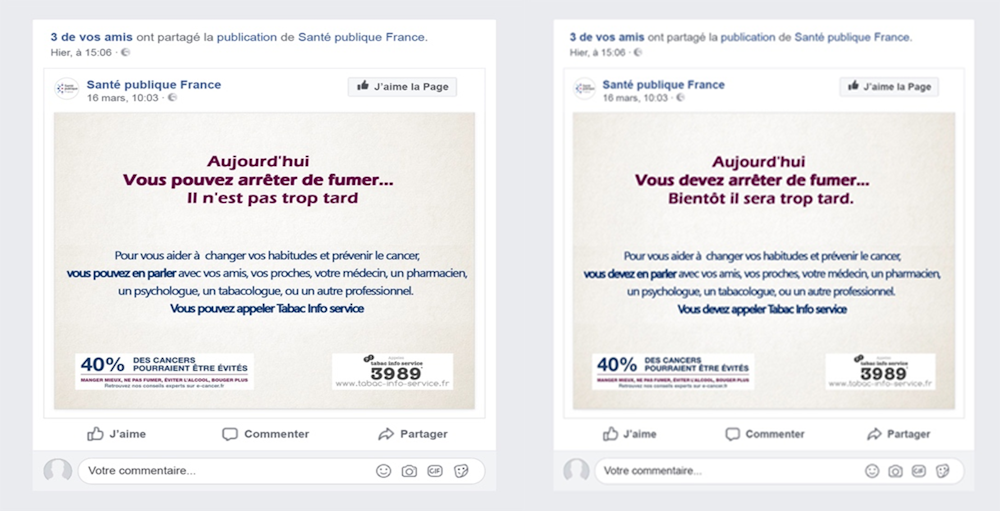
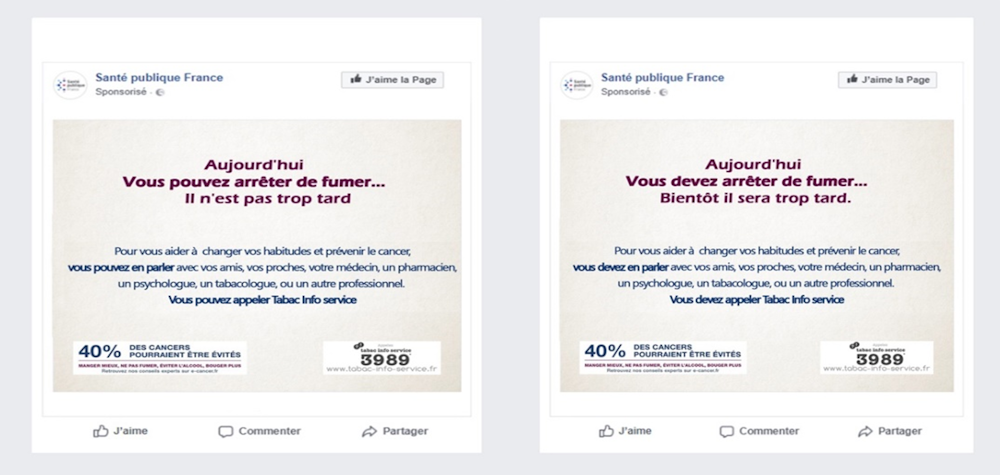
After analyzing the responses of 203 participants (average age 29, 41% male), the results show that an encouraging message is more effective when shared by a distal source, and that a restrictive message is more effective when shared by a proximal source.
Our study thus suggests that practitioners creating persuasive health communications should prioritize messages that leave the audience with a choice: for example, “If you feel ready to quit smoking, then visit https://www.tabac-info-service.fr/.” Messages that emphasize young smokers’ ability to quit (“we know you can do it”) also appear to be preferable.
A request to quit smoking made by someone close to the smoker is more likely to be accepted than one made by a stranger or a public agency. When it comes to this type of message, practitioners should focus on encouraging people close to the target (a friend, a family member, etc.) to share it.
Influencers whom young adult smokers follow daily on social media and with whom they feel a connection could also serve as effective communication channels, as could athletes, actors, or comedians. Enlisting these “opinion leaders” to spread compelling messages appears to reduce the risk of rejection. Involving them in the creation of these messages also seems entirely appropriate. Successful public health campaigns such as Sam (“If you’re driving, don’t drink”) or Tobacco-Free Month (nearly 120,000 registrants as of October 31 this year) have demonstrated the value of this approach.
Artificial intelligence could also prove particularly useful in improving the effectiveness of messages by personalizing them in the most effective way possible. When applied to Facebook, encouraging content would appear in young users’ news feeds when the message source is considered distal, and a more restrictive message would be displayed when the source is considered proximal.