

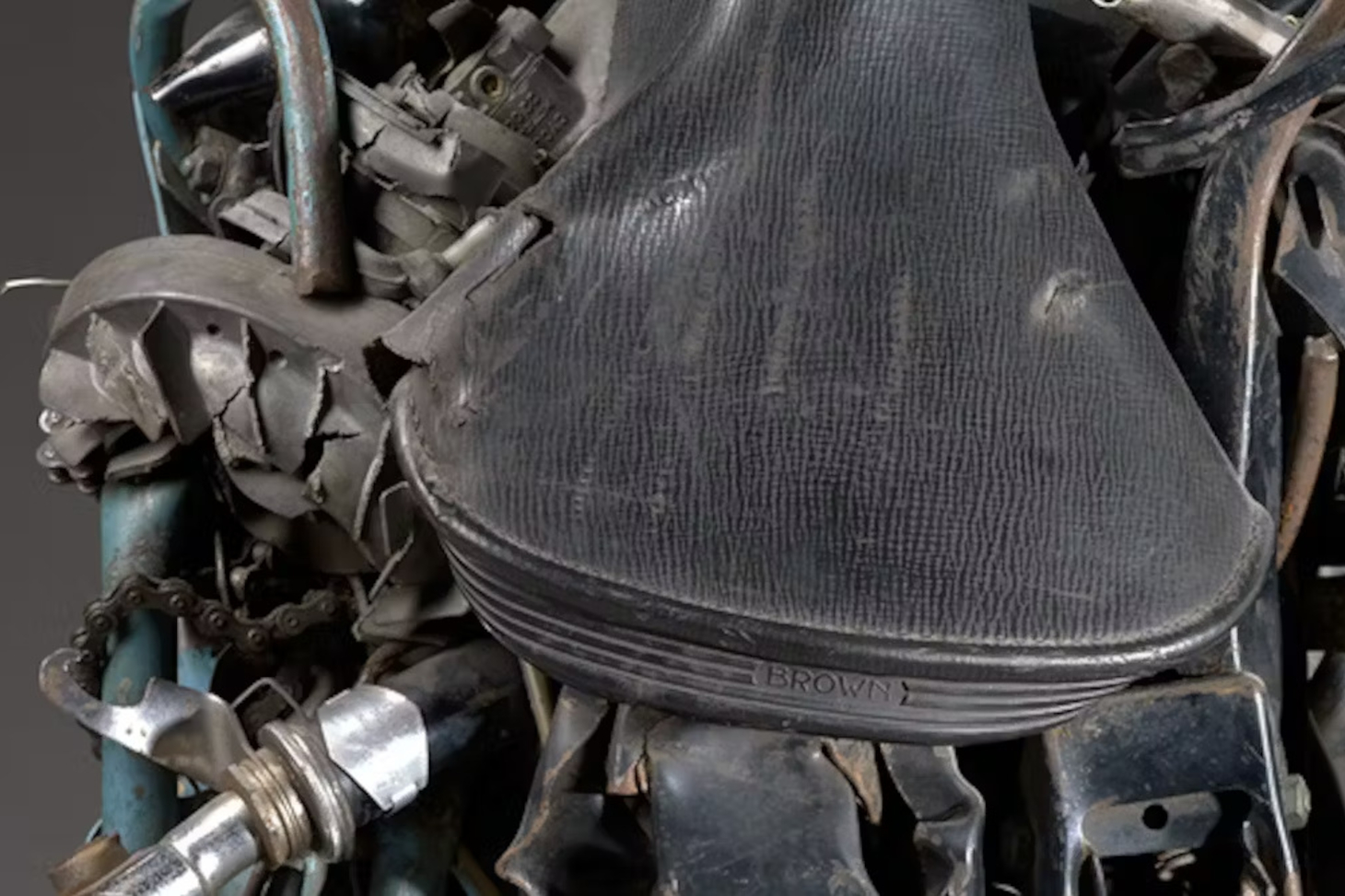
@parisladefense What is this intriguing piece of art in Paris La Défense? If you don’t know the answer, here’s a little hint �� (yeah, that one was easy…) #parisladefense #paris #art #artwork #cesar ♬ original sound - Paris La Défense
It was Renaud Bastien, a physicist at the CNRS in Toulouse, who introduced me to César… without meaning to.
A few months ago, he was telling me about his work on the apparent cohesion of schools of fish and flocks of birds such as starlings, and the resulting applications in robotics. Thinking aloud about the cohesion of matter, he said to me, “Ultimately, the two fundamental properties of an object in condensed matter physics are its weight and its volume.” It’s not that uncommon—sometimes stating what seems obvious opens up new possibilities. And on the train between Toulouse and Grenoble, I suddenly saw César’s “Compressions” in a different light.
The elementary and middle school curriculum devotes a great deal of time to volume, weight, mass, and density (or its equivalent, specific gravity). And for good reason. Every solid object is condensed matter. It is primarily characterized by its volume and weight. Changing either one is simple: you just need to remove or add matter.
To change the volume, the high pressures used in laboratories are monstrously high for a very slight—often even negligible—compression. Water ten kilometers deep in the ocean is still the same water we use every day. The enormous pressure has no effect on it. Pauli’s exclusion principle, at the heart of quantum physics, holds true: compressing the electron gas of a solid or a liquid is extraordinarily difficult. Nor can we walk through walls, which would be another form of compression.
Ultimately, aside from weight and this unchanging volume, everything else seems to me to be a matter of circumstance. In the collection of lectures titled “What Is Life?”, Erwin Schrödinger—winner of the 1933 Nobel Prize in Physics for “his” equation and creator of “Schrödinger’s cat”— explores the relationship between substance and form. He does so by reflecting on a dog-shaped paperweight he has just rediscovered. This can be read as a deeply meaningful tribute from a physicist to sculpture: “I am absolutely certain that this is the same dog—the dog I saw more than fifty years ago on my father’s desk.” But why am I so sure? It’s very clear. It is obviously the particular shape or configuration that establishes identity with certainty, and not the material content. If the material had been melted down and cast into the shape of a man, the identity would be much harder to establish. And there’s more: even if the material identity were established beyond a doubt, it would be of only very limited interest. I probably wouldn’t care much about the identity or non-identity of this mass of iron, and I would declare that my memory has been destroyed.”
If melted down, the dog-shaped paperweight would not have changed in volume or weight, any more than it would have after being transformed into a human-shaped statue. Everything else, it seems to me, is simply a matter of circumstance: changing the shape, texture, sheen, and colors would not have altered the weight or volume, but it would have changed the object entirely!
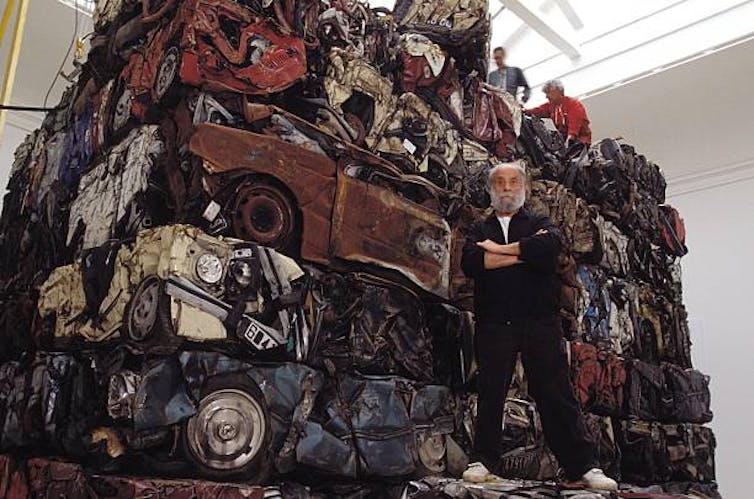
The U.S. strategic “Heavy Press Program,” at the heart of the Cold War between the United States and the Soviet Union, led to the creation of machines capable of applying forces equivalent to 45,000 metric tons on mechanical parts. These machines, used for the cold forging of large parts—often components of weapons systems—are not designed to compress but to deform. This is easier—though still extremely difficult, as evidenced by the colossal industrial investments made in the20thcentury, which required highly sophisticated expertise. There are more modest industrial versions used in auto scrapyards specifically to compress the bodies of wrecked cars into small, manageable cubes—which are still just as heavy. It was this type of machine that the sculptor César discovered in themid-20th century. In 1960, he exhibited *Trois tonnes*(Three Tons), a work consisting of three compressed cars. Mass, first and foremost.
Sculpture is defined first and foremost by its shape and color. A single volume of material can take on an infinite number of shapes and colors. We can create an infinite number of objects that all have the same volume. For example, if we consider a car body, what is that volume? It is not the volume that the car body occupies in space—including the space available for suitcases. Not at all. It is the space occupied by the sheet metal itself. And that volume—unless you cut the car open—cannot be altered. It is there before and after compression, intact, just like the weight.
In my view, César, through a drastic compression, sets out on a path toward a car body that would occupy only this ultimate, minimal volume. We also see how difficult—if not impossible—it is to achieve this. He’s far from the mark; there’s always empty space. Of course, if the goal is truly to achieve this, Erwin Schrödinger provides the solution: melt it down! But then the car wouldn’t be there at all. Through this incomplete compression, César preserves the memory of the original object—we can still make it out—but he also tells us that, in the end, it is nothing more than a mass of sheet metal. That is all it is, first and foremost—and under all circumstances!
The volume occupied by an atom in a liquid or solid does not vary that much. The density of the materials around us varies very little. And we all know this: a full glass can be filled with anything, and we’ll always be able to lift it. Extreme densities exist in the universe but not on Earth. On Earth, the density of liquid or solid matter is limited, and it is not possible to significantly exceed this limit. Once again, the Pauli principle is at work. On the other hand, when it comes to expansion, there is no fundamental limit. We can go from condensed matter to a vacuum, encompassing an immense variety of states (gaseous states foremost among them) and materials. Silica aerogel has a density of2 kg/m³, only twice that of air. Its diaphanous presence is quite surreal.
The density of the polyurethane foam used by César is probably between10 kg/m³and100 kg/m³; that of water is much greater, at 1,000 kg/m³. When it comes to expansion, before considering the shape, there is, once again, the question of mass and volume. Given a constant mass, one can seek to greatly increase the volume occupied in space as much as desired.
Through his sculptures, compressions, and expansions, César’s works explore form, mass, and volume for us through their materiality. He makes it clear—and it’s crystal clear: “I call my compressions ‘compressions’ and my expansions ‘expansions.’ *La Victoire de Villetaneuse*, *Ginette*, and *L’Hommage à Léon*—I call those sculptures.”
Sculptures—they have a unique form that establishes them as works of art and creations by César. What, then, are the “compressions”? The scientist Schrödinger and the artist César meet here and, I believe, agree: the “compressions” presented in this way highlight a very profound reality of the world, but we will not call them “sculptures”—rather, “anti-sculptures.”