

Art historian Dominic Johnson, a professor at Queen Mary University of London, whose research focuses on performance art and the performing arts—generally from a queer perspective—will conduct a research project in 2024 at the University of Southern California (Los Angeles) that has been described as: “the first scholarly study of the work of this British artist of South Asian descent in the context of the relationship between art and AIDS.”
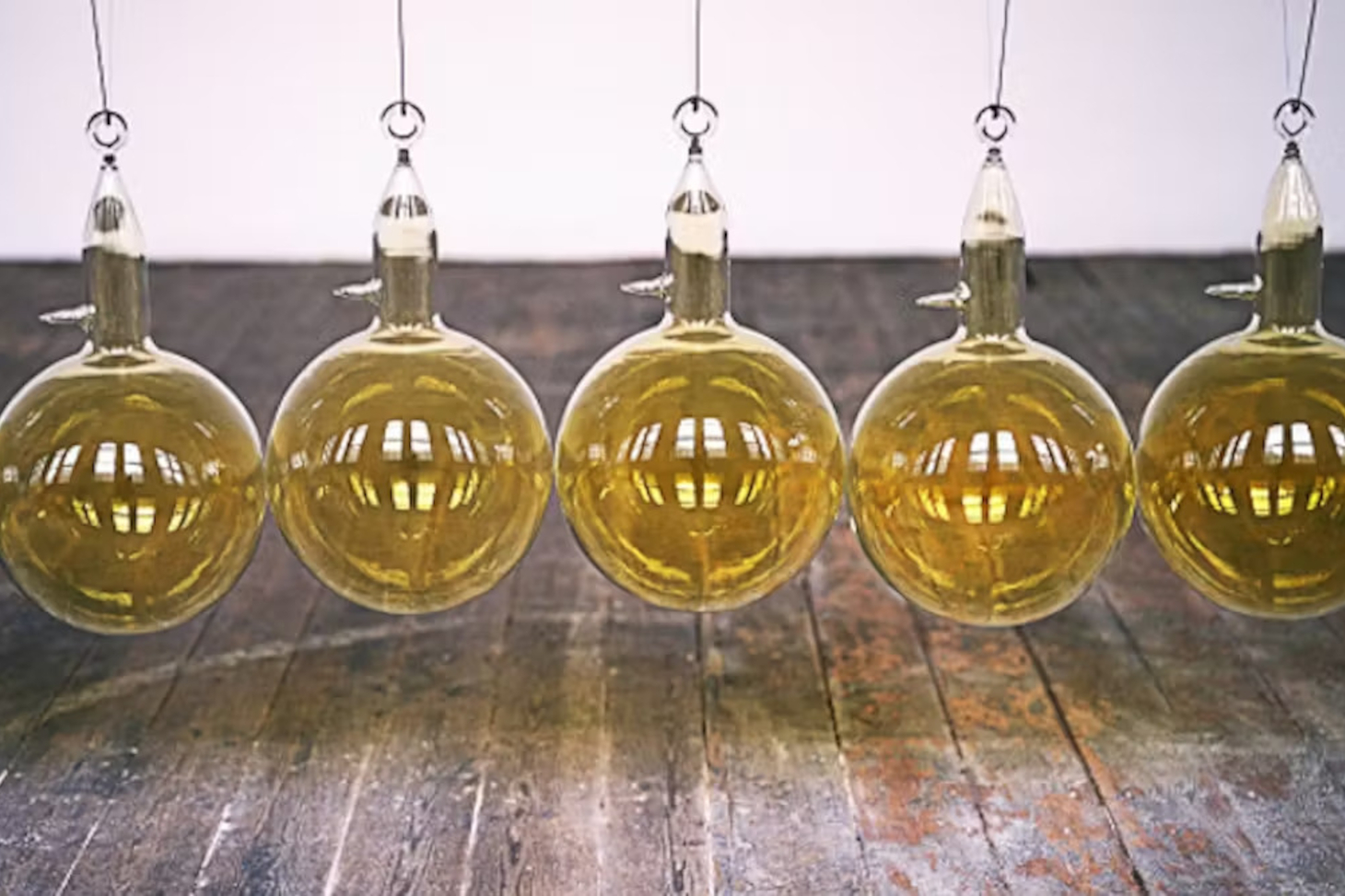
While waiting for that sum, I felt compelled, as a physicist, to take a closer look at a single piece by Hamad Butt, titled* Cradle *.
I haven’t yet seen the work in situ, but even in the photos, you can already sense its strength and visual power—with that stillness that calls for movement, and that sense of suspended motion. The object may seem mysterious at first glance, especially if you’re not familiar with Newton’s pendulum or aware of the dangers of chlorine gas. For beneath its neutral and harmless exterior, the work makes its presence felt through the very reality of danger—at once invisible and palpable.
The blown glass spheres actually contain real chlorine gas. It’s a beautiful yellow color… but deadly if too much is inhaled. This toxic substance is a powerful irritant to the eyes, skin, and respiratory tract. In other words, this artwork is indeed dangerous. Of course, strict safety measures ensure that the danger remains only potential, but it’s there, staring you right in the eye. This artwork exposes the public to danger, and to my knowledge, it’s one of a kind.
Hamad Butt brings the principles of physics and chemistry to life right before our eyes. In physics, he reimagines Newton’s pendulum: the five steel balls (here made of glass), through their movement and collisions, embody two fundamental laws of conservation—the law of conservation of mechanical energy and the law of conservation of momentum.
Once the balls are thrown, their behavior is spectacular.
The artist thus makes a very direct allusion to the fact that scientific knowledge and technological mastery have given us control over and the ability to develop mechanized movement—and, above all, speed. But here’s the thing: Hamad Butt’s “Newton’s pendulum” doesn’t move—“cradle” is perhaps an ironic allusion to this suspended pendulum motion. It must remain still for safety reasons. It irresistibly evokes movement, but setting it in motion would be dangerous!
Physics and chemistry are presented here in all their dimensions: the work evokes a research apparatus straight out of a laboratory, while at the same time highlighting how the alliance between science, technology, and industry was the key to development inthe 20thcentury—its cradle. From this perspective, Hamad Butt’s work is profoundly powerful: through its components and structure, it reminds us how this society has deployed science and technology on a global scale, while affirming its ability to protect us from most of the dangers and risks posed by this unprecedented development—without us having to worry about them in our daily lives.
The emergence of HIV/AIDS and the resulting toll on human life have largely overturned that belief, well beyond the final years of Hamad Butt’s life.
Chlorine is an extremely abundant chemical element. Sea salt, for example, is composed of equal parts sodium and chlorine. Bleach is one of the best-known forms of chlorine. The handling of chlorine, particularly in industrial settings, is therefore very common, but it remains dangerous. In June 2022, an accident in the port of Aqaba, Jordan, left 13 people dead and more than 250 injured.
While being loaded by a harbor crane, a cable snapped, causing a heavy chlorine container to fall directly onto the ship’s deck. The very dense yellow cloud that spread instantly left no room for doubt. There is a striking parallel here with *Cradle*, the work by Hamad Butt. The crane, the suspension cables, and the chlorine tank are all incorporated into his installation. The work, created a quarter-century before this accident, is practically a miniature version of the port setup. Truly striking!
This exploration of risk—through the danger posed by chlorine gas—was made possible through collaboration with chemists from Imperial College London and a technician specializing in blown glass. Here, they establish a truly unique relationship between the arts and sciences, built on shared responsibility and a common commitment to the public. They must ensure that this artwork does not pose any safety risks when on public display.
This is analogous to what science, technology, and industry have been doing everywhere for decades: producing a new device or innovation that is too promising not to take on the inherent risk, while at the same time striving to ensure safety.
But here, we are dealing with a “useless” installation: this device serves no purpose and has no practical use that would justify taking the risk. In reality, its function is quite different: Hamad Butt reminds us of the pact we all enter into when we entrust experts with our health and safety. The accident in the port of Aqaba shows that we are willing to pay the price for repeated, deadly accidents—yet collectively deem their impact limited enough that we are unwilling to forgo innovation.
Upon his retirement, Steve Ramsey, the glassblower—who was working at a scientific research laboratory at Imperial College at the time the artwork was being designed—recounted his collaboration with Hamad Butt: “I worked with this artist for more than two or three years, and he kept disappearing, even as he was pushing for this artwork to be completed. I found that quite frustrating, but I didn’t know he was dying of AIDS.”
This observation sheds new light on the work of Hamad Butt, the artist Dominic Johnson chose as the focus of his research. Indeed, it is difficult to separate this relationship to illness, finitude, and danger from Hamad Butt’s work.
With works that command attention through their physical presence and pose a potential danger to visitors, and that raise such contemporary questions, Hamad Butt remains at the center of our lives.