

Piero Gilardi is a leading figure in the Italian artistic movement known as “Arte Povera.” Of his “Tapis-Nature”—sculptures placed on the floor or hung on the wall that depict fragments of landscape—he said: “I created the Tapis-Nature in 1965, conceiving them as examples of interior decoration for the cybernetic ‘individual living cell,’ presented at the Machines of the Future exhibition. In creating the first Tapis-Nature, I drew on Claes Oldenburg ’s sensory poetics of the ‘soft,’ but for me, the primary function of the foam rubber was to accommodate and interact with the body.”
These “Nature Mats,” designed to welcome and interact with the body, are therefore made of plastic—more specifically, polyurethane. In a completely different context, for the philosopher Schopenhauer, who took issue with materialism, the very idea of matter without an intelligence to perceive it is so absurd that it conjures up the absurd image of a “piece of iron made of wood.” Perhaps one could have suggested this alternative image to him: “nature made of plastic,” the latter being in fact just as foreign to nature as iron is to wood.
These stylized “pieces” of nature were made of flexible plastic and became part of interior design. It is simply impossible to view them in 2022 the same way we did in 1965. Over the course of 50 years, Piero Gilardi’s artistic approach underwent a radical evolution: in 2008, he was among the founders of the Parco Arte Vivente in Turin, an Experimental Center for Contemporary Art dedicated to nature, biotechnology, and ecology. The garden designed by landscape architect Gilles Clément—known as the “Mandala Garden”—covers approximately 600 square meters on the building’s rooftop and is one of the center’s most striking installations.
After World War II, amid the “Thirty Glorious Years” and a period of triumphant progress, plastic production grew rapidly. The use of plastics—and thus that of polyurethane—became increasingly important and diversified.
Chemist Otto Bayer discovered polyurethane in 1937. In 1967, the Bayer K 67 car, produced in Germany, was nicknamed “the polyurethane car”: its entire body was made of this plastic. Polymers such as polyurethane are industrial products of petrochemical research. They are entirely man-made and form the core of what is commonly referred to as plastics.

So there is something new in the world of materials. Chemistry has made it possible to develop entirely new carbon-based materials with extraordinary properties. In the 1970s, physicist Madeleine Veyssié, a colleague of Pierre Gilles de Gennes in Paris, was the first to use the term “soft matter” to describe the scientific field that studies, among other things, the physics of these materials. Pierre Gilles de Gennes’s 1991 Nobel Lecture was titled “Soft Matter.” During those years, these materials took off and began to spread across the globe. But that was only the beginning.
In his article on carbon for the “La Main à la Pâte” website, Didier Pol, a certified teacher of natural sciences, explains: “Carbon is present in living organisms, but also in the atmosphere, water, and rocks. The biosphere, atmosphere, hydrosphere, and rocks thus constitute four carbon reservoirs. ” He then describes the circulation of carbon between three of these four reservoirs, notably using this diagram.
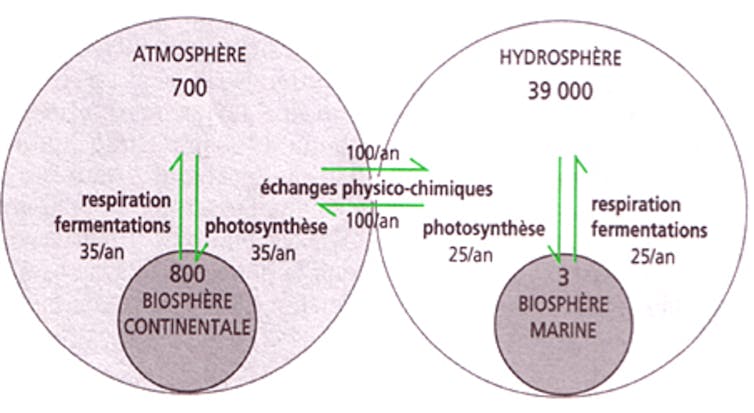
Photosynthesis, respiration, and fermentation form the link between living organisms, air, and water. In particular, photosynthesis converts “mineral carbon”—CO₂—present in the air and water into “biological carbon” in plants.
There is also an exchange between the air—which we are constantly loading with moreCO2—and water: the ocean is a massive reservoir ofCO2, at the cost, in particular, of its acidification.
This article by Didier Pol is an outstanding description of carbon reservoirs and cycles, intended for middle and high school students. It does not mention plastics, which—as a result of human activity—constitute a new carbon reservoir. There is a good reason for this—at least, the most compelling one, in my view: while plastic is spreading everywhere, it is not part of the Earth’s major carbon cycles, beyond perhaps a very slow degradation process that is currently being studied.
And when we consider this interference with carbon cycles, our thoughts turn above all to toxicity. Who can envision a life form capable of feeding on plastic waste—which would change everything? For now, plastic waste is becoming ever more prevalent, invasive, and widespread, largely cut off from the Earth’s carbon cycle. We extracted it from oil—a fossil of an ancient living organism—only to send it down this dead-end path. The Tapis-Nature works highlight this separation, and it is this separation that imposed on my mind the image of “wooden iron,” when in fact, here, everything is nothing but carbon.
The power of art is astonishing. Today, I cannot look at the *Tapis-Nature* without thinking: this work goes even beyond the original intention articulated by Piero Gilardi. With it—though Piero Gilardi surely did not realize it yet in 1965—his work strikes the right note in the face of the formidable rise of the plastic arts.
We are reminded of the philosopher Hubert Damisch: “Painting does not merely show; it thinks.” Art historian Daniel Arasse cites this in support of his analysis of Michel Foucault’s text on Velázquez’s *Las Meninas* in the introduction to *The Order of Things*. Daniel Arasse explains: “Las Meninas, as we see them today, think for themselves, independently of what Velázquez intended.” Is this a hallmark of major works of art?
Piero Gilardi, with “this plastic nature” that infiltrates interiors, makes us realize the full extent of these upheavals at the heart of global urbanization. In my view, the Tapis-Nature have now become a spectacle of horror, which is what makes them significant works of art.
First, they highlight our physical separation from living things, which would then be present in our daily lives only through this distorted representation—a plasticized nature, a substitute for our perception. And so, they bring this artificial plastic—which increasingly appears as a threat to living things—into the very heart of our lives. This work is like a manifesto that serves as a warning.
Works of art have this incredible power: over time, they can transcend their creator’s original, explicit intention and transform before the viewers’ eyes.
Here, I listened again to Daniel Arasse’s extraordinary remarks on anachronism in art, once again drawing on Michel Foucault’s text. By not getting bogged down by this glaring anachronism, anyone today can freely engage with Piero Gilardi’s work. Through this work, I discovered this artist and came to admire his work, but I couldn’t live with a *Tapis-Nature* in my home. Yet I should: this work, which has become horrifying today is right. It reminds us once again of the urgent need to reconnect with the living world and to pay the closest attention to what we do with our lives. For example, when—casually and out of habit—we throw away a plastic bag that we’ve used for at most a few minutes, as if sending a message to the nonhuman world.