

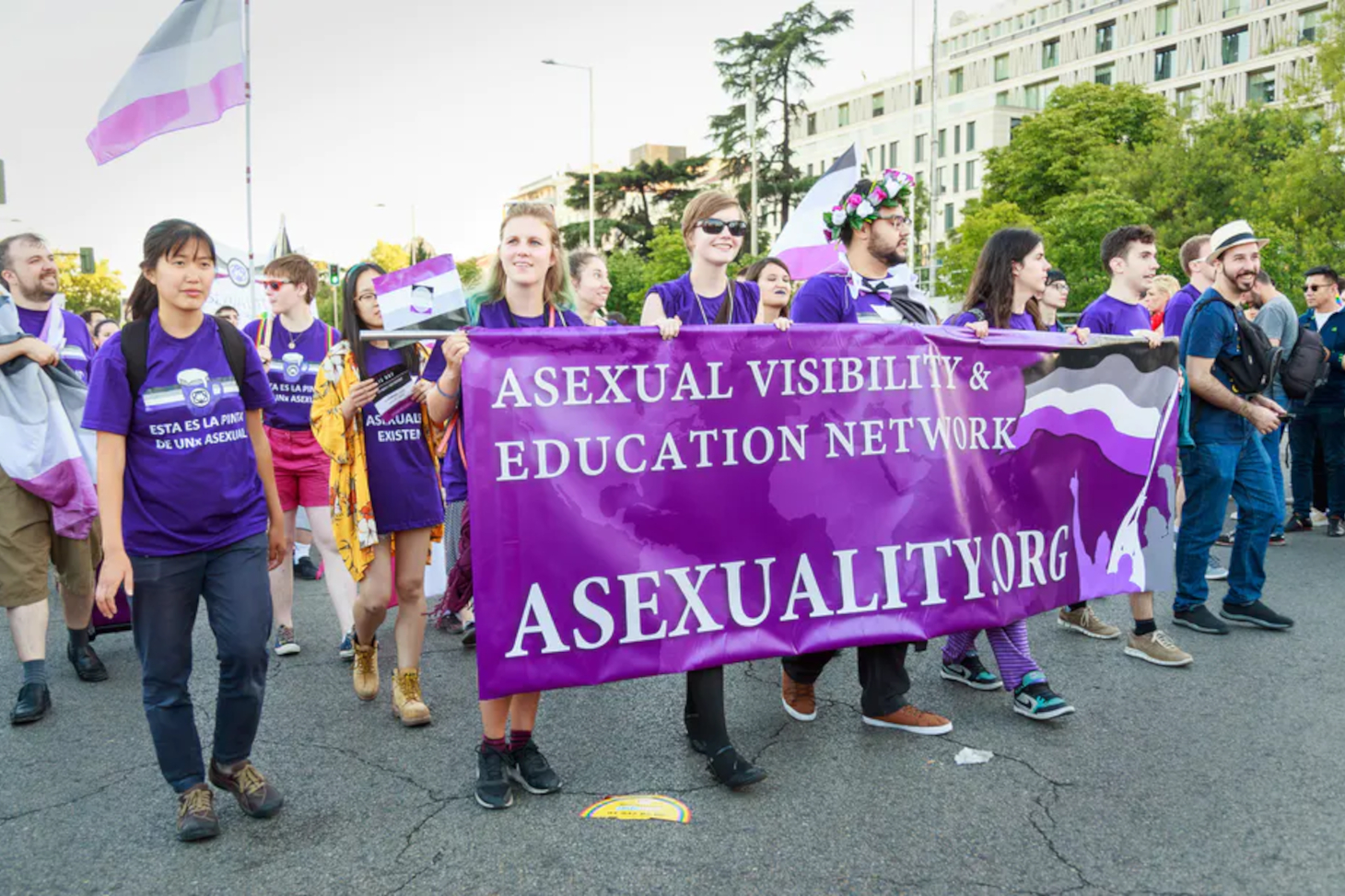
“Asexual Studies.” The term, which is brand-new in France, still throws many people off balance. First, because even though asexual visibility has been increasing in recent years, many people still know little or have a poor understanding of the concept of asexuality.
If that’s the case for you, let me briefly go over a few basics. Asexuality refers to the absence of sexual attraction toward others and has been recognized since 2017 as a sexual orientation in its own right, affecting 1 to 4% of the population according to studies. If this topic is new to you and you’re interested, I encourage you to check out the dozens of articles and personal accounts that are starting to pop up all over the internet. But for now, the key takeaway regarding studies on asexuality is this: no, not all humans on this planet experience sexual desire. Some experience very little of it, some experience it only during certain periods of their lives, and some don’t experience it at all—ever. And this is certainly not a recent phenomenon.
This is where it gets really fascinating from a research perspective: we have very rarely—if ever—focused on people who naturally show a lack of interest in sex. The belief that sex is, if not a need, then at least a desire for everyone, is deeply ingrained in our minds. So much so that for centuries, reams have been written to explore every possible hypothesis and observation about all variations in sexual activity… without ever—or almost never—taking the time to consider people for whom sex is boring, repulsive, annoying, or simply uninteresting.
Of course, there are studies on chastity, the sanctification of virginity, and celibacy, but all too often these are confined to the religious sphere without being linked to a potential lack of interest in sex.
In short, a lack of desire is never studied in and of itself, and when it is observed in an individual, there is a tendency to simply dismiss that person as a complete outlier.
That, then, would be the starting point for asexual studies: to stop viewing people who do not experience sexual desire as anomalies and to accept that they are—and always have been—an integral part of our society. And, of course, to ask all the questions that this implies, whether from a scientific, sociological, historical, or artistic perspective.
You may have already heard of gender studies—this new field of scholarship that addresses issues of gender and non-heterosexual sexualities to examine science, society, art, and history. These studies open up new perspectives for research by examining aspects of our society that have traditionally been overlooked, such as homosexuality. In this sense, it is similar to decolonial studies: we shift our perspective to focus on population groups that have traditionally been overlooked or even completely ignored.
Gender studies thus branch out into gay studies, trans studies, queer studies, and so on, depending on the minority group addressed by the field of study… and now, as you’ve probably gathered, into asexual studies. The basic idea is simple: to start from the current observation that an asexual community exists and to examine this fact by examining it through the lenses of sociology and biology, as well as art and history.
Many people have a hard time visualizing how the recognition of the existence of the asexual community can be translated into concrete research. Biology, for example, can be brought into the discussion: we might ask what could scientifically explain variations in human sexual desire, just as the natural existence of homosexuality has been scientifically proven. Is asexuality cultural, is it linked to people’s individual experiences, or can it be explained by concrete biological differences? These are, of course, interesting questions for biologists.
At the same time, sociology can also address many of the questions raised by asexuality. First, by providing reliable data on the asexual population, to explore why more people identify as asexual in certain communities, certain age groups… and based on their gender. Why do more women than men identify as asexual, for example? Can sexual trauma lead to a long-term lack of interest in sexual desire? Conversely, do our society’s masculine norms make it more difficult for men to come out as asexual? Asexual studies can thus become a way to examine our relationship to sex in relation to our gender in a much broader and more compelling way for many people…
It may not seem immediately obvious, but history and literary studies, for example, can also contribute to asexual studies. When we flip through our history books with the issue of asexuality in mind, we quickly realizethat there have always been people living without sex. Of course, we cannot say with certainty that all of these people were asexual: the term is too recent for us to make such a claim without risking anachronism. But studying this sexually inactive population can be interesting from a contemporary perspective, as it allows us to examine the place of asexual people in society.
Did you know thatElizabeth I and Immanuel Kant remained virgins until their deaths? That Franz Kafka never showed any interest in sexuality, while Marilyn Monroe admitted to deriving little pleasure from sexual intercourse? That Louis XIV’s sister-in-law poured her heart out in her letters about her virginity, regained through sexual inactivity, or that Joan of Arc showed such a lack of interest in the matter that her comrades-in-arms, initially attracted to her, eventually found themselves unable to desire her anymore? Of course, times and mores change too much over the course of history for us to claim that all these figures were asexual. But isn’t it interesting to explore this aspect of their personalities—and, in doing so, to challenge the myth that sex has always been an integral part of everyone’s life?
The same is true of art, mythology, and literature, which also abound in such figures. The Greek goddess Artemis, the heroes of medieval courtly love novels, and even famous characters from more modern novels—such as Jean Valjean from *Les Misérables*—are notable for their lack of sexual desire or activity.
Asexuality is everywhere, but we rarely think to take an interest in it, mainly because, traditionally, we tend to study behaviors rather than their absence. Asexual activists themselves refer to asexuality as an “invisible orientation”… Yet many themes present in art and thought since antiquity can be linked to asexuality: chaste or platonic love, voluntary celibacy, sexual asceticism, or certain religious considerations. Regardless of what we call it, non-sexuality has always existed; it has always been part of our societies. It is a rich subject, and one that reveals a great deal about how we view sexuality in general.
Of course, research on asexuality can benefit asexual people by helping them better understand themselves and providing them with prominent figures to identify with, as well as greater visibility. But don’t we all have something to gain from this exploration of desire? Can’t the study of all these figures help us, from a modern perspective, to reconsider our relationship to sex and free ourselves from all the social pressures surrounding sexual behavior and performance? What does asexuality reveal about our society’s relationship to sex? What does it allow us to deconstruct, both on an individual and a broader level?
It is these questions that the asexual studies invite us to take action. As is always the case when a new field of study emerges to examine our society, this will require a collective effort—a process of reflection in which everyone can participate.